

Food Truck Grill: Your Guide for Los Angeles Success
Choosing the right food truck grill is easily the most critical equipment decision you'll make for your Los Angeles business. It’s the heart and soul of your mobile kitchen, the single piece of gear that defines your menu, how fast you can serve, and ultimately, how profitable you'll be on the cutthroat streets of LA. It all comes down to matching the hardware to your culinary dream, whether you're serving up authentic Mexican food in East LA or Korean BBQ in K-Town.
The Heart of Your Mobile Kitchen
Jumping into the LA food truck scene means you’re entering a market that’s as vibrant as it is demanding. Your success is all about having the right tools to execute your vision perfectly, day in and day out. The grill isn't just a hunk of metal; it’s the engine that powers your menu, whether you're slinging Korean BBQ short ribs in the Arts District or breakfast burritos in Santa Monica. A reliable food truck grill is just as essential as your commercial refrigerators and freezers.
The food scene here is a mosaic of global flavors. That means your grill has to be a perfect match for the food you plan to serve. A truck specializing in Thai street food has totally different needs than one cranking out Japanese yakitori or classic American smash burgers. Get this first decision right, and the rest of your restaurant equipment will fall into place.
Flat-Top Griddles: The Versatile Workhorse
For a huge number of LA food truck operators, the flat-top griddle is the undisputed king of versatility. That massive, smooth cooking surface gives you consistent, even heat, making it the perfect platform for all kinds of popular food concepts.
Think about the workflow for a busy Mexican food truck. A big griddle lets you warm tortillas, sear off carne asada, and sauté peppers and onions—all at the same time. That ability to multitask is what keeps the line moving during a frantic lunch rush.
Here’s where a griddle really shines for classic LA cuisines:
- Mexican Food: The go-to for cooking meats, melting cheese for quesadillas, and keeping tortillas warm.
- American Classics: Nothing beats it for getting that perfect crust on a smash burger or making a killer grilled cheese.
- Breakfast Concepts: You can handle pancakes, eggs, bacon, and hash browns all at once, without breaking a sweat.
- Asian Street Food: It's fantastic for fried rice, teppanyaki-style dishes, or getting a great sear on proteins for Chinese and Thai food.
Charbroilers: Delivering That Authentic Flavor
While a griddle is all about flexibility, a charbroiler brings something special to the table: that smoky, flame-kissed flavor and those perfect grill marks. For some cuisines, this isn't just nice to have; it's absolutely essential for an authentic taste. A charbroiler is how you get that backyard BBQ flavor that people line up for.
Imagine a Korean BBQ truck trying to operate without one—it’s impossible. That signature char on galbi or bulgogi can't be faked on a flat-top. The intense, direct heat from a charbroiler kicks off a delicious Maillard reaction on the meat's surface while rendering fat, creating an aroma and taste that’s just irresistible. If you're building your menu around grilled meats, checking out different commercial charbroilers is your first homework assignment.
A charbroiler is non-negotiable for any menu built around grilling. The flavor it creates is a powerful marketing tool in itself, pulling customers in with the incredible smell of food cooking over an open flame.
The food truck industry's growth shows no signs of slowing down. The global market is projected to hit around USD 5.8 billion in 2025 and is expected to almost double by 2035. This boom means more competition, making specialized, top-notch cooking gear like a dedicated charbroiler a key way to stand out. It lets you perfect a niche and make a name for yourself in a very crowded field.
To help you visualize the best fit for your LA-centric menu, here’s a quick breakdown:
Food Truck Grill Comparison for LA Cuisines
| Grill Type | Best For Cuisines | Pros | Cons |
|---|---|---|---|
| Flat-Top Griddle | Mexican (Tacos, Burritos), American (Burgers, Philly Cheesesteaks), Breakfast, Asian (Teppanyaki, Chinese, Thai) | Extremely versatile, easy to clean, excellent for high-volume, multi-item cooking. | No grill marks or smoky flavor. Not ideal for fatty meats due to flare-ups. |
| Charbroiler | Korean BBQ, Japanese (Yakitori), American BBQ, Steak Sandwiches, Mediterranean (Kebabs), Burgers | Unbeatable smoky flavor, authentic grill marks, great for rendering fat. | Harder to clean, less versatile for things like eggs or pancakes, potential for flare-ups. |
| Infrared Grill | High-End Burgers, Steaks, Seafood | Heats up incredibly fast, intense and even heat, reduces flare-ups. | Higher initial cost, can be too intense for delicate foods if not managed carefully. |
Ultimately, the right grill comes down to your menu. A griddle offers the most flexibility, but a charbroiler delivers a unique flavor profile that can define your brand and draw a loyal following.
Sizing Your Grill for Maximum Speed and Profit
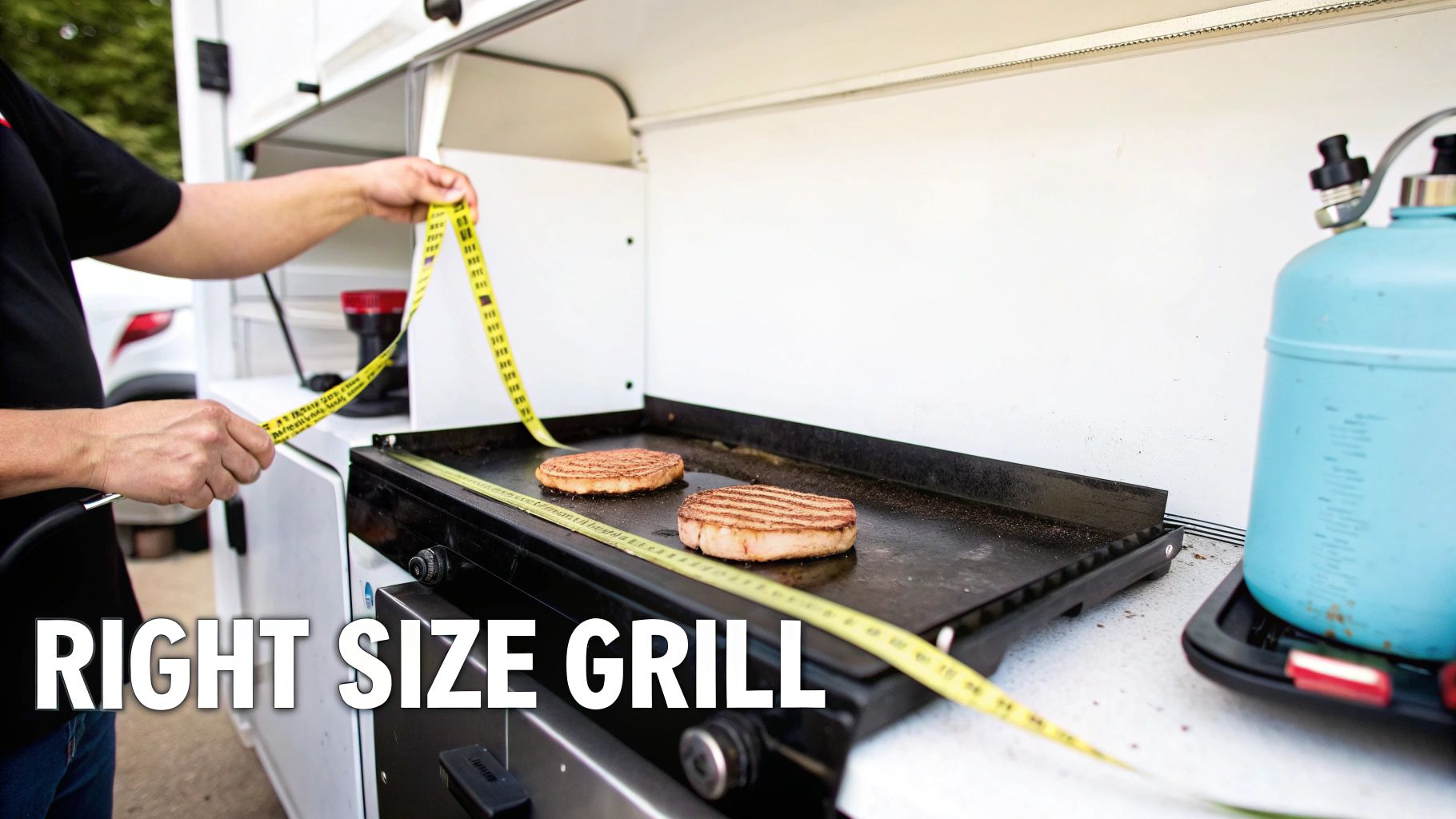
Choosing the right food truck grill is about so much more than just filling an empty spot in your layout. It's one of the most important calls you'll make, directly impacting your service speed and, ultimately, your bottom line. A grill that's too small becomes an instant bottleneck during a rush, leaving customers hungry and costing you sales. On the flip side, a massive unit just eats up precious real estate and burns through propane for no good reason.
You're looking for that sweet spot between cooking capacity and physical footprint. That perfect balance is different for every truck—it all depends on your menu, your layout, and the reality of serving the fast-paced Los Angeles lunch crowd.
From Blueprint to BTU
Before you even think about dimensions, let's talk power. A grill's power is measured in BTUs (British Thermal Units), which tells you exactly how much heat it can throw. High BTU output is everything when you're slamming down dozens of cold burger patties or mounds of carne asada.
A low-BTU grill will struggle to keep up. It loses heat with every new batch of food and takes forever to recover, leading to slow, uneven cooking. A high-BTU grill, however, has the muscle to bounce back almost instantly, giving you a consistent sear and faster cook times. That's how you maximize throughput.
To figure out what you need, look at your menu's busiest moments:
- High-Volume Taco Truck: If you’re slinging tacos, you need a big griddle—think 48 inches—with at least 90,000 BTUs. This lets you sear meats, warm stacks of tortillas, and sauté veggies all at the same time.
- Gourmet Burger Truck: You need enough real estate for patties and buns. A 36-inch griddle with around 60,000-80,000 BTUs is a solid choice, offering a great balance of space and recovery power.
- Japanese Yakitori Skewer Truck: This is all about intense, focused heat. You’d be better off with a smaller, 24-inch charbroiler that has a high BTU rating per burner, rather than a giant griddle.
Measuring Twice and Cooking Once
Once you've got your power figured out, it's time to break out the tape measure. The physical size of your grill is limited by your cook line. You have to account for the grill itself plus the essential landing zones on either side. These spaces are critical for plating and keeping a smooth workflow. For more ideas on setting up your workspace, consider other essential restaurant equipment like stainless steel prep tables, which are must-haves for any food truck.
Never underestimate the need for "elbow room." A cramped cook line is an inefficient and unsafe cook line. Make sure you leave at least 12-18 inches of clear workspace on each side of your grill.
The food truck scene is booming, projected to hit $2.8 billion in U.S. revenue in 2025, and that growth is all about efficiency. Nailing your grill size is a foundational step to competing in this market.
Fueling Your Operation
Finally, think about your fuel. Nearly every food truck in Los Angeles runs on propane, so you need a solid plan for consumption and storage. Your total BTU load directly dictates how fast you’ll burn through that propane. A high-powered grill needs larger or more propane tanks to get you through a full shift without a shutdown right in the middle of a rush.
Always have your propane setup installed by a licensed professional to ensure it meets all LA County Fire Department regulations. This isn't just about rules; it’s about safety—secure mounting, proper ventilation, and accessible shut-off valves keep your team and your business safe on the road.
Navigating LA County Health and Fire Code Compliance
In the cutthroat world of Los Angeles food trucks, an amazing menu gets you on the map, but staying compliant with the code is what keeps you there. Messing up on health or fire regulations can mean more than just a headache; we're talking about heavy fines, frustrating delays, or even getting shut down before you sell a single thing. Getting these rules right isn't just about dodging penalties—it's about protecting your crew, your customers, and the truck you've poured everything into.
The rulebook from the Los Angeles County Department of Public Health and the LA County Fire Department can feel like a maze. But at the end of the day, it's all about one thing: running a safe, clean mobile kitchen. That means every single piece of gear, especially your food truck grill, has to be up to snuff.
A Type 1 Hood Is Not Optional
If you're cooking anything that creates greasy smoke—think a charbroiler for that perfect Korean BBQ or a griddle for sizzling carne asada—you absolutely need a Type 1 hood. It’s the first thing any inspector is going to look for, period. Its job is to suck up all that smoke, heat, and grease before it turns your truck into a fire hazard or a grimy mess.
And just having one isn't enough; it has to be installed right. The hood needs to be bigger than your grill's cooking surface to catch everything, and it must be hooked up to a powerful exhaust fan that meets code. Trying to save a few bucks here is a surefire way to fail your inspection right out of the gate.
Fire Suppression: Your First Line of Defense
There's a good reason the LA County Fire Department is so strict. A food truck is a tight space packed with high heat, flammable grease, and propane tanks. A fire can get out of control in the blink of an eye. That’s why a wet chemical fire suppression system is mandatory for any truck with cooking equipment.
This system is your automated safety net. If a fire ever breaks out, it's designed to automatically spray a fire-killing foam all over your grill and up into the ventilation hood. It can literally save your business and, more importantly, save lives.
A compliant system will always include:
- Automatic Nozzles aimed directly at your grill and other hot equipment.
- A Manual Pull Station you can grab to set it off yourself.
- Regular Servicing. You'll need a pro to inspect and certify the system on a tight schedule, usually every six months.
Don't ever think of fire safety as just another box to check. A professionally installed and maintained suppression system is the most critical safety feature you'll have. The peace of mind alone is worth every penny.
Get Your Gas Lines Done by a Pro
Your propane system is the heart of your kitchen, firing up everything from the grill to the fryer. It’s also one of the most heavily scrutinized parts of an inspection. All gas lines have to be installed by a licensed professional who knows the ins and outs of the specific codes for mobile food businesses in Los Angeles.
An inspector is going to look for rock-solid connections, the right fittings, easy-to-reach shut-off valves for every appliance, and zero leaks. Trying to DIY your gas lines isn't just illegal; it's incredibly dangerous. A pro makes sure your system is not only compliant but also tough enough to handle the constant bumps and rattles of driving on LA streets. Paying for a proper installation now prevents a disaster later.
When you're getting ready for your inspection, try to see your truck through an inspector's eyes. They'll be checking to make sure every piece of equipment is commercial-grade, bolted down tight, and easy to clean. They'll want to see that your fire suppression certificate is current and that your ventilation is working perfectly. If you nail these safety and compliance pillars from the very beginning, you're setting yourself up for a smooth approval and a long, successful run on the streets of LA.
Securely Installing Your Grill for the Road
You’ve navigated the permit maze and found the perfect grill. Now comes the real work: getting that cooking beast securely into your mobile kitchen. This isn't just about finding a spot for it; it's a genuine engineering challenge. Think about it—you've got a heavy, intensely hot appliance inside a vehicle that's constantly starting, stopping, and turning on LA's less-than-perfect roads. The installation has to be rock-solid.
Don't even think about skimping here. A grill that shifts an inch in transit could sever a gas line or, worse, start a catastrophic fire. This is exactly why your standard restaurant equipment stand just won’t do the job. Your grill needs to be fastened to a custom-fabricated stainless steel stand, which is then either bolted directly through the floor into the truck's frame or welded securely in place. There is zero room for error on this one.
The Critical Gas Connection
Once the grill is locked down, it's time to hook up the fuel. This is way more than just attaching a propane tank. Every single connection point is a potential leak waiting to happen if it’s not handled with absolute precision.
You must use commercial-grade, flexible gas hoses made specifically for mobile kitchens. These things are built tough, designed to handle the constant vibration and movement of a food truck without getting brittle or cracking. For anyone operating in Los Angeles, getting the right parts is everything. You can find a range of certified commercial gas hoses and fittings to make sure your setup is 100% safe and up to code. Every fitting has to be tightened correctly and then double-checked by a licensed pro.
The food truck scene is blowing up, with the global market expected to grow at a CAGR of about 7.4% between 2024 and 2029. This growth is all about custom designs and advanced kitchens that meet new consumer demands and tight regulations. A professional, secure installation is the new standard. You can dig into more of these market trends on researchandmarkets.com.
Your Post-Installation Safety Checklist
Even after a professional signs off on the installation, the daily safety check is on you. Treat it like a pilot’s pre-flight checklist before a busy day of service. This simple habit gives you peace of mind and helps you spot a small problem before it becomes a disaster.
Before you roll out for a shift, always run through these checks:
- The Soapy Water Test: Mix some soap and water in a spray bottle. Turn the gas on and spray every connection, from the tank all the way to the grill. If you see any bubbles forming, you've got a gas leak. Shut off the gas immediately and call a professional to fix it.
- The Level Check: Make sure your grill is perfectly level. An uneven surface means uneven cooking and can cause grease to pool in one spot—a serious fire hazard.
- The Lockdown Verification: Give the grill a good push from a few different angles. It shouldn't move, wobble, or shift at all. If you feel any give, the mounting bolts need tightening or the welds need to be inspected right away.
A secure installation isn't a one-and-done deal; it's an ongoing commitment to safety. Making these quick checks part of your daily opening routine is one of the smartest habits any food truck operator can develop.
Mastering Grill Cleaning and Maintenance Routines
Keeping your food truck grill clean is more than just about passing the next LA County health inspection. It’s about the flavor of your food, the performance of your equipment, and protecting the single most valuable asset in your mobile kitchen.
When you let grime build up, you get carbon, uneven heat spots, and funky flavors that can completely ruin a perfect batch of Korean bulgogi or Thai street-style chicken satay. Think of your maintenance routine as a non-negotiable part of your daily prep—it’s what separates the pros from the amateurs.
Consistent care prevents those nightmare breakdowns during a dinner rush and guarantees every dish has the clean, authentic flavor your customers are lining up for.
The Daily Shutdown and Scrub
Your most important maintenance happens in the last 30 minutes of every shift. This daily ritual is all about tackling grease and food bits before they get a chance to harden into a stubborn, carbonized mess.
The trick is to work while the grill is still warm, but not scorching hot. That’s the sweet spot where residue comes off easily without a fight.
Make sure this checklist is part of your end-of-day routine:
- Scrape Down the Surface: Grab a heavy-duty grill scraper and clear all the loose debris off the cooktop. If you're working with a flat-top griddle, follow up with a grill brick while it's still warm to lift away any caked-on grime.
- Empty and Clean the Grease Trap: This is non-negotiable for fire safety and sanitation. A neglected grease trap is an open invitation for pests and an easy way to fail a health inspection. Empty it out, then give it a thorough wash with hot, soapy water.
- Wipe Down Exterior Surfaces: Use a food-safe degreaser and a clean cloth to wipe down the front, sides, and knobs. This simple step prevents that sticky, grimy film from building up over time.
This quick daily habit not only keeps your grill looking sharp but also cuts down the time you'll have to spend on deeper cleanings later.
Weekly and Monthly Deep Cleaning
Daily scraping is your first line of defense, but a more thorough deep clean is what keeps your grill at peak performance. These weekly and monthly jobs ensure your grill operates efficiently and safely, giving you an even flame and consistent temps for years.
A well-maintained food truck grill can easily last for over a decade. But neglect? That can cut its lifespan in half. Spending 30 minutes a week on a deep clean is one of the smartest investments you can make in your business.
For a griddle, a weekly seasoning is a must. After you've cleaned it thoroughly, apply a very thin layer of a high-smoke-point oil (like canola) and heat the grill until the oil just starts to smoke. This process, called polymerization, creates a natural, non-stick surface that’s perfect for everything from Japanese okonomiyaki to classic smash burgers.
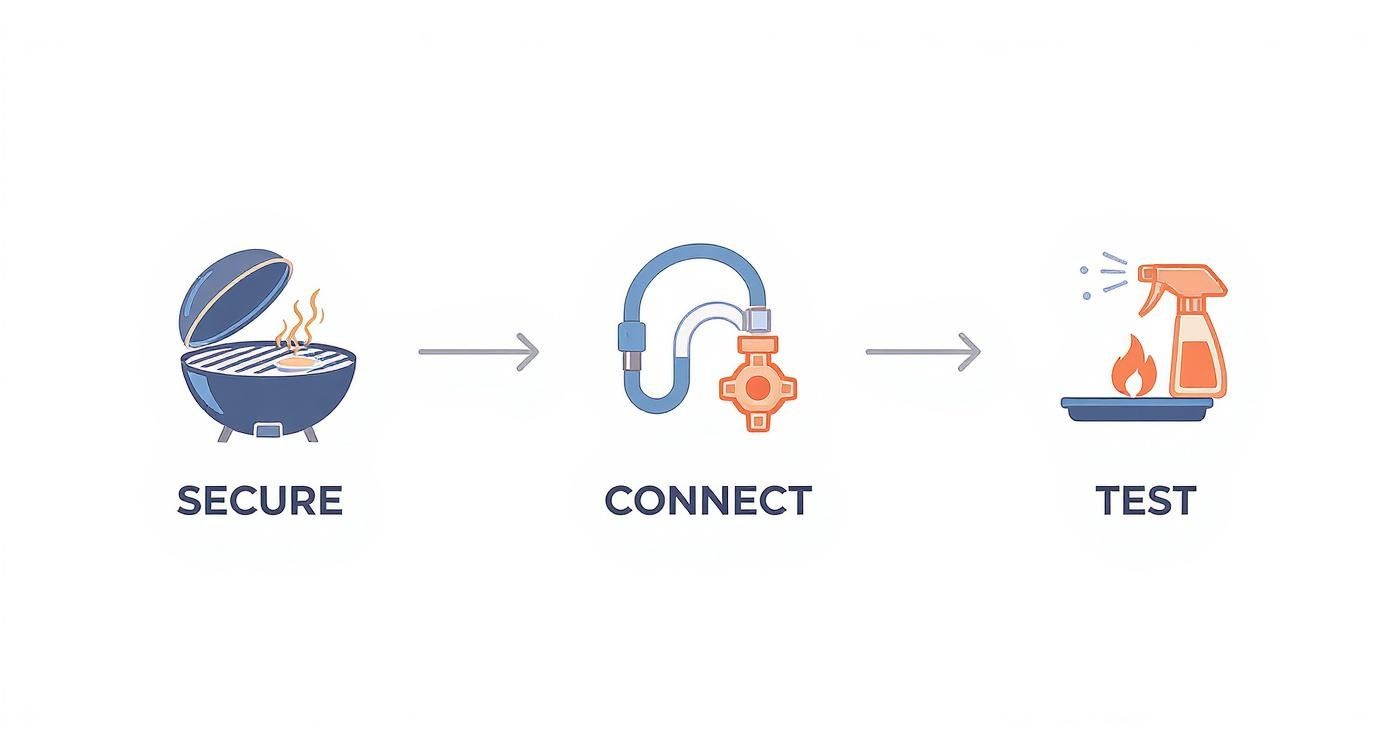
This simple illustration is a great visual reminder: after your equipment is secured and connected, routine testing is a fundamental part of keeping things safe day in and day out.
Advanced Maintenance for Longevity
Beyond the cooking surface, the internal guts of your grill need attention, too. These monthly checks are crucial for extending your grill's life and preventing a dangerous malfunction when you're on the road.
Monthly Grill Maintenance Checklist
| Task | Why It's Important | Pro Tip |
|---|---|---|
| Check Gas Hoses | Look over all your gas lines for any cracks, kinks, or signs of wear. A damaged hose is a serious gas leak waiting to happen. | Use the soapy water test on all your connections once a month. It’s the best way to catch tiny leaks before they turn into big problems. |
| Clean Burner Ports | Take a wire brush or even a paperclip and clear any gunk out of the burner ports. Clogged ports mean an uneven, inefficient flame. | You're looking for a clean, blue flame. If you see yellow or orange, it’s a sign your ports are clogged or the air mixture is off. |
| Inspect Ignitors | Make sure your ignitors are clean and creating a solid spark. A little grease buildup is all it takes to keep your grill from lighting properly. | Use a small brush to gently clean around the ignitor tip and the ceramic piece. |
When you stick to a schedule like this, maintenance stops being a chore and becomes just another part of your routine. It’s the real secret to keeping your food truck grill in prime shape, making sure you're always ready for the next service on the busy streets of Los Angeles.
Your Top Food Truck Grill Questions Answered
Even with a solid plan, questions always come up when you’re in the thick of building out your LA food truck. Your food truck grill is one of the biggest investments you'll make, and getting it right is non-negotiable for a smooth launch and a profitable business. We hear the same questions from food truck owners all over Los Angeles, so we’ve put together some straight answers.
These insights will help you sidestep common mistakes and make smarter choices for your mobile kitchen, whether you're slinging Chinese street food in the San Gabriel Valley or fresh mariscos on the Westside.
What’s the Most Versatile Grill for a Diverse LA Menu?
For a city with a palate as diverse as Los Angeles, the undisputed champion of versatility is a high-quality flat-top griddle. It's the ultimate workhorse, ready to tackle a massive range of menu items that are popular across the county.
Think about it: a griddle can handle breakfast like pancakes and eggs, flip smash burgers and Philly cheesesteaks for the lunch rush, and then sear fish or stir-fry rice for Thai and Chinese concepts at dinner. That massive, even surface is a lifesaver for cooking multiple orders at once—a must for keeping the line moving. You can get a great sear, sauté your veggies, and toast buns all on the same piece of equipment.
Sure, you won't get those classic grill marks you'd get from a charbroiler, but the sheer number of things you can cook on a griddle makes it the heart of most successful food trucks.
How Do I Know if My Propane System Can Handle a New Grill?
Figuring out if your propane system can support a beast of a new grill isn't just a good idea; it's a critical safety calculation. You need to figure out your total BTU load.
Start by making a list. Write down the BTU rating for every single gas appliance in your truck—the fryers, the burners, your water heater, everything. Add all those numbers up. Now, add the BTU rating of the new grill you're eyeing. That final number is your absolute maximum demand.
Next, go look at your propane regulator. Its BTU capacity is usually stamped right on the unit. Here's the crucial part: The regulator's capacity must be greater than your total appliance BTU load. If it’s not, you're going to starve your equipment for fuel, leading to weak flames, poor cooking performance, and serious safety risks. If the numbers don't add up, upgrading the regulator is not optional. You should also think about your tank size. A high-demand kitchen with a powerful grill might need a bigger tank (or a dual-tank setup) to avoid the nightmare of running out of gas mid-service.
Can I Save Money Buying a Used Food Truck Grill?
Absolutely. Buying used restaurant equipment is a smart way to save some cash, but you have to go into it with your eyes wide open. A great deal can turn into a huge headache if you don't inspect it like a pro.
When you're looking at a used grill, here's what to check for:
- The Surface: Look for any warping or pitting on a griddle top. That kind of damage creates hot and cold spots and is basically impossible to fix.
- The Guts: Get a look at the burners and gas valves. You're searching for heavy corrosion, rust, or any obvious damage.
- A Live Test: Never buy a used grill without seeing it run. You need to confirm it heats up evenly across the whole surface and that all the temperature knobs actually work.
- The Certification: Find the data plate and look for a commercial certification, like the NSF mark. Without that, you won't pass your health inspection in LA County, period.
You can definitely find some killer deals on the used market, but just remember that they almost never come with a warranty. Buying from a reputable used equipment dealer can be a good middle ground. They usually inspect and service their gear before selling it, giving you a better balance of savings and peace of mind.
Ready to find the perfect new or used food truck grill for your Los Angeles operation? Los Angeles Restaurant Equipment offers a massive selection of commercial-grade griddles, charbroilers, and other essential kitchen gear to fit any mobile kitchen. Explore our inventory and get expert advice today.
Find your perfect grill at https://losangelesrestaurantequipment.com.