

Maximizing Your Commercial Kitchen Small in Los Angeles: A Guide for Restaurants and Food Trucks
A commercial kitchen small in size doesn't mean small in output, especially in the competitive Los Angeles food scene. Far from it. It's all about a smart game plan and making every single square foot work for you. For food entrepreneurs in Los Angeles, a compact kitchen is often just part of the deal, whether you're running a bustling food truck, a ghost kitchen, or a cozy neighborhood spot. Success comes down to a blueprint that puts workflow first, backed by the right restaurant equipment and a crystal-clear understanding of what your menu demands.
Your Blueprint for a Compact Los Angeles Kitchen
Launching a food business here in L.A. is a unique beast. Think of a Korean BBQ food truck hitting the streets of Koreatown, a Mexican taqueria in East LA, or a Thai ghost kitchen slinging noodles to the Westside—the one thing they absolutely have in common is needing a high-powered culinary engine in a tight space.
A well-planned commercial kitchen small in footprint will run circles around a larger, clunky one every single time. It's time to stop obsessing over square footage and start thinking about flow, efficiency, and how your restaurant equipment works together as a team.
This guide is that essential blueprint. We're getting into the nitty-gritty with real-world advice tailored to the fast-paced L.A. food scene. Forget the generic fluff; let's dive into the details that will actually make a difference for you.
Mastering the Los Angeles Food Scene
The food culture in Los Angeles is wildly diverse, and your kitchen has to be ready for the challenge. A kitchen built for slinging Japanese ramen has totally different needs than one cranking out authentic Mexican tacos. That means your menu has to drive every single decision from day one. Before you even glance at a floor plan, you need to nail down your operational needs based on your specific cuisine.
Start by asking yourself these critical questions:
- Menu Complexity: Is your menu focused, like a Thai curry spot with a handful of killer dishes? That requires fewer specialized stations than, say, a complex Chinese dim sum operation with dozens of moving parts.
- Service Style: A quick-service takeout window thrives on a straight, linear workflow. On the other hand, a small dine-in restaurant might need a more complex, zone-based layout to keep prep, cooking, and plating from tripping over each other.
- Equipment Needs: The right restaurant equipment is everything. A high-heat wok range is non-negotiable for a lot of Chinese cooking, just like high-capacity commercial refrigerators and freezers are vital for keeping that pricey sushi-grade fish perfectly fresh.
I see this mistake all the time: people buy equipment before finalizing their layout. Always, always, always design the workflow first. Then, you can pick out compact, multi-functional appliances that fit into that plan—not the other way around. This simple shift prevents those frustrating bottlenecks and lets your team fly during a busy service.
From Concept to Compliance
Bringing your kitchen to life is about more than just where the fryer goes. You're building an entire system that needs to fire on all cylinders. This covers everything from your first rough sketches to passing those notoriously strict L.A. County health inspections.
A deep understanding of your commercial kitchen layout design is the bedrock of a successful and compliant operation. We'll walk you through each critical stage, making sure your small kitchen is built for performance, safety, and—most importantly—profitability from the second you open your doors.
Mapping Your Kitchen Workflow for Maximum Output
Before you even think about ordering a single piece of equipment, the most important work happens on paper. When you're dealing with a commercial kitchen small on space, the layout is everything—it’s the choreography that keeps your entire operation from descending into chaos on a slammed Friday night. A smart workflow is what turns that tight footprint into a high-output machine.
It all starts with tracing the journey of your ingredients. A truly efficient kitchen maps this path logically, from the delivery door to the final plate, cutting down on wasted steps and clearing out potential bottlenecks. This path should always follow a clear sequence: receiving, storage, prep, cooking, plating, and service.
The idea is to build a seamless flow where your team isn't constantly bumping into each other or backtracking. This doesn't just make service faster; it's also a critical part of preventing cross-contamination and nailing the food safety standards that Los Angeles health inspectors watch like a hawk.
This simple flow chart really breaks down what it takes to succeed in a compact kitchen.
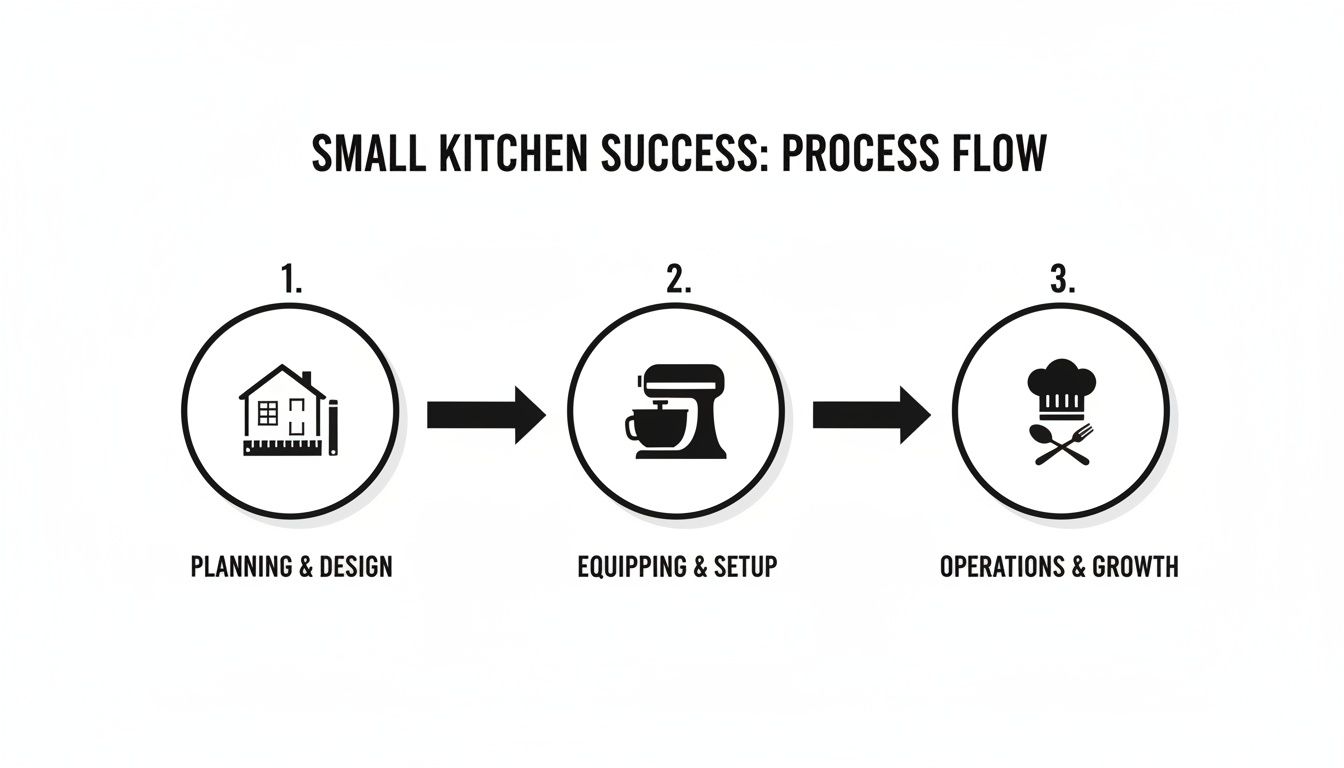
As you can see, a successful kitchen is built on a solid foundation of smart planning and strategic equipment choices—not just hustle during service.
Choosing Your Kitchen Layout
You’ve probably heard of the classic "work triangle," and it’s a decent starting point. But for modern, tight commercial kitchens, you often need something more specialized. The right choice is all about your specific venue and menu. A Los Angeles food truck has completely different needs than a brick-and-mortar quick-service spot.
Here are a few popular layouts that really shine in compact spaces:
- Linear or Assembly-Line Layout: This is the go-to for countless Los Angeles food trucks and QSR concepts. All the equipment is set up in a single line, perfectly mirroring the production sequence. Think of a Mexican taco truck where ingredients come out of the commercial refrigerator, move to the prep table, hit the flat-top grill, and get served at the end of the line.
- Zone Layout: This approach carves the kitchen into distinct stations for different tasks—a prep zone, a cooking zone, a plating area, and a wash station. It’s ideal for a small restaurant with a varied menu, like a Thai spot where one cook is at the wok station and another is working the deep fryer. Each zone is self-sufficient, which cuts down on staff movement.
- Galley Layout: Often seen in long, narrow kitchens, this layout features two parallel counters with a walkway down the middle. It can be incredibly efficient, but you have to be careful. That central aisle needs to be at least 3-4 feet wide to keep staff from colliding when they’re moving with hot pans.
A well-designed workflow is your best defense against service slowdowns. If your team has to walk more than a few steps between the cold line, the cooking station, and the pass, you're losing valuable seconds on every single order. Those seconds add up to lost revenue and frustrated customers.
Tailoring Layouts to L.A. Cuisines
The culinary diversity in Los Angeles is what makes this city special. A layout that’s perfect for a Korean BBQ joint in K-Town would be a total nightmare for a Japanese sushi bar in Little Tokyo. Let's connect these layout ideas to real-world L.A. food businesses to see how they work in practice.
Thinking about how each layout supports a specific cuisine can make it much clearer which one is right for your concept. You want to match the physical flow of the space to the production flow of your most popular dishes.
The table below shows how these common layouts fit with different Los Angeles food operations, highlighting where they shine and where they might cause headaches. This should give you a solid starting point for designing your own commercial kitchen small enough to be nimble but powerful enough to crush the dinner rush.
Small Kitchen Layouts for Popular Los Angeles Cuisines
| Layout Type | Best For (Cuisine/Venue) | Key Advantage | Potential Challenge |
|---|---|---|---|
| Linear | Mexican food trucks, build-your-own bowl concepts, sandwich shops | Unbeatable Speed: Creates a logical, step-by-step process that is easy to train and execute quickly. Perfect for high-volume, limited-menu operations. | Limited Flexibility: Can feel restrictive if the menu expands or requires multiple simultaneous cooking processes that don't fit the linear flow. |
| Zone | Quick-service Chinese, Thai, or Japanese restaurants | Menu Diversity: Allows multiple complex dishes to be prepared at once without interference between stations (e.g., frying, sautéing, and plating). | Requires More Space: Even with compact equipment, creating distinct, functional zones can be challenging in the smallest footprints (under 300 sq. ft.). |
| Galley | Small restaurant kitchens, ghost kitchens, catering operations | High Efficiency: Keeps all equipment within a step or two, minimizing staff movement and speeding up communication between stations. | Potential for Congestion: The central walkway can become a major bottleneck if not wide enough or if multiple staff members are working at peak times. |
Matching your layout to your menu isn't just a suggestion; it's the foundation of an efficient and profitable kitchen. Take the time to get this right on paper, and you’ll save yourself countless headaches once the orders start rolling in.
Choosing the Right Restaurant Equipment for Your Small Footprint
Once your workflow is mapped out, you can get to the fun part: picking the hardware that brings your menu to life. In a commercial kitchen small enough to feel every inch, your restaurant equipment choices are a high-stakes game. The goal isn’t just finding pieces that fit; it’s about making smart capital investments in compact, multi-functional, and high-performance units that can handle a Los Angeles dinner rush.
Every piece of restaurant equipment has to earn its keep. There’s simply no room for one-trick ponies or oversized units that drain energy and clog up your flow. Instead, you need to right-size everything—from refrigeration to your cookline—to match your menu and how many covers you plan to do.
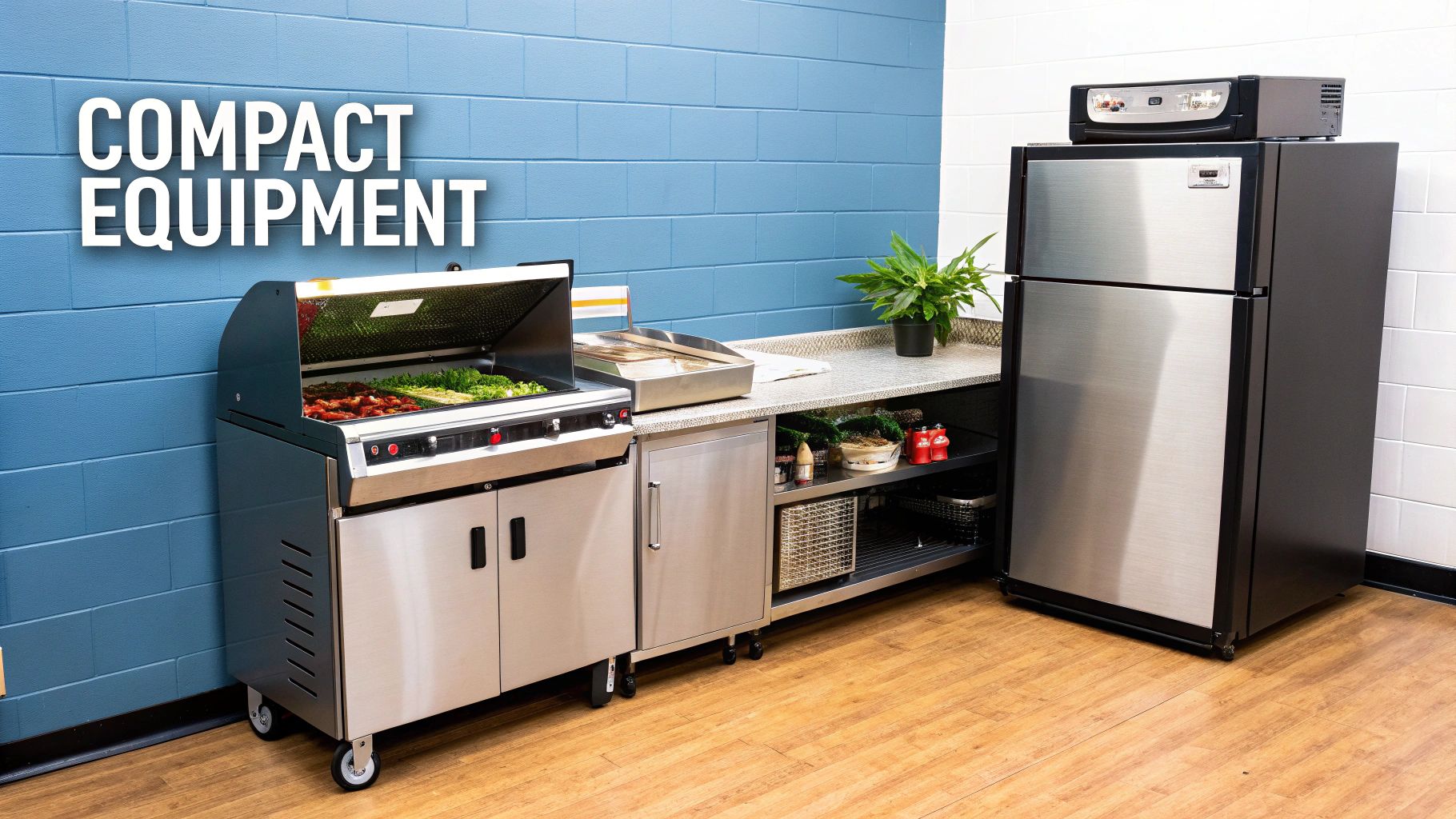
This is about more than just measurements. It’s a deep dive into energy efficiency, durability, and versatility to make sure every dollar you spend contributes directly to your bottom line.
Mastering Your Cold Line with Compact Refrigeration
For any L.A. food business, whether it's a Thai Town cafe or a Mexican taco truck in East L.A., solid cold storage is non-negotiable. Spoiled inventory is lost profit, period. The challenge in a small space is getting enough refrigeration without eating up your prep area. Commercial refrigerators and freezers are your lifeline.
This is where you have to think both vertically and horizontally.
-
Under-Counter Refrigerators and Freezers: These are the undisputed champions of saving space. Tucking refrigeration directly under prep tables creates a seamless workflow, keeping ingredients right where your cooks need them. A sandwich prep table is a perfect example, combining refrigerated wells, a cutting board, and cold storage all in one.
-
Slim Upright Models: When you need more vertical storage, slim or narrow-depth upright commercial refrigerators and freezers are a fantastic solution. They offer serious capacity with a much smaller footprint than standard models, making them perfect for tight corners or galley kitchens.
For a Los Angeles food truck, under-counter units are almost always the way to go. But a small brick-and-mortar cafe might benefit from a mix: an under-counter unit up front and a slim upright in the back for bulk storage.
Rightsizing Your Cookline for Specific Cuisines
Your cookline is the heart of your operation, and the restaurant equipment has to be perfectly aligned with your menu. A one-size-fits-all approach just doesn't work when you're dealing with the incredible diversity of L.A. food.
Think about these cuisine-specific examples:
-
Korean BBQ: A countertop charbroiler is a must for that perfect sear on bulgogi or galbi. These compact units deliver intense, direct heat without taking up the space of a full-sized floor model.
-
Japanese Tempura: Success here is all about precise temperature control. A high-efficiency countertop deep fryer ensures quick recovery times so the oil temp doesn’t plummet between batches—key for consistently crispy, non-greasy tempura.
-
Chinese or Thai Wok Cooking: A versatile range is your best friend. Look for a combination unit with high-BTU wok burners next to standard open burners. This lets a chef blast a stir-fry while simmering a stock right next to it, maximizing output from one piece of equipment.
Investing in quality restaurant equipment isn't just an expense; it’s a strategic move. The global commercial kitchen appliances market was valued between USD 98.34 billion and USD 101.65 billion in 2024, with North America leading the charge. This just goes to show how much value the industry places on reliable, high-performance gear.
Focusing on Energy Efficiency and High Volume
When you’re making your final selections, two things are crucial for your bottom line: energy efficiency and the ability to handle high volume. An energy-efficient freezer might cost more upfront, but it can save you hundreds, if not thousands, on utility bills over its lifespan.
Likewise, your equipment has to be built for the relentless pace of a commercial kitchen. Look for NSF-certified products made from durable stainless steel. A machine that can’t keep up during your busiest hours isn't a bargain; it’s a liability.
To get a better handle on what to prioritize, check out our guide on building a commercial kitchen equipment checklist. It'll help you pinpoint the essentials you need to succeed from day one. Making smart choices here means your kitchen will be a reliable, cost-effective engine for your business, ready for whatever the L.A. food scene throws at it.
Navigating Los Angeles Health Codes and Utilities
You can dream up the most brilliant workflow and pick out the perfect restaurant equipment, but none of it matters if you can't pass your inspections. For any commercial kitchen small or large in Los Angeles, compliance isn't the final step—it’s part of every single decision you make. The Los Angeles County Department of Public Health has some of the toughest regulations in the country, and they pay special attention to Los Angeles food trucks and other mobile setups.
Getting this right from day one saves you from agonizing delays and expensive, forced renovations later on. Think of it as building a safe, legal, and solid foundation for your business. That means you need to plan your ventilation, utilities, and plumbing with the same obsession you put into crafting your menu.
Mastering Ventilation Requirements
Proper ventilation isn't just a suggestion; it's a non-negotiable for both safety and passing your inspection. The kind of hood system you'll need is dictated entirely by your cooking equipment, and L.A. health codes are extremely specific here.
-
Type 1 Hoods: These are mandatory for any equipment that creates grease-filled vapors. We're talking about charbroilers for Korean BBQ, deep fryers for perfect Japanese tempura, or the high-heat woks in a Thai or Chinese kitchen. A Type 1 hood comes with a fire suppression system built right in, which is critical for stopping dangerous grease fires before they start.
-
Type 2 Hoods: These are for appliances that kick off heat and steam but not grease. Think convection ovens for baking or big pasta cookers. They do a great job of managing steam and keeping the kitchen from overheating, but they don't need the heavy-duty grease filters of a Type 1 system.
Trust me, installing the wrong hood is one of the most common—and costly—mistakes I see new operators make. You absolutely have to confirm the requirements with the health department before you lock in your cookline.
Planning Your Electrical and Plumbing Needs
A small kitchen's utility setup has to be a real workhorse. It needs to handle the heavy demands of commercial equipment without breaking a sweat. You can't just start plugging things in and cross your fingers; you need a solid, strategic plan.
First, figure out your total electrical load. Add up the amperage for every major appliance—your commercial refrigerators, freezers, ovens, and fryers. You'll need a licensed electrician to confirm your panel and circuits can handle that peak demand without constantly tripping breakers and shutting you down during a dinner rush.
Plumbing is just as important. Los Angeles County has strict rules for sink setups to ensure food safety:
- A three-compartment sink is required for the wash, rinse, and sanitize process.
- A dedicated handwashing sink for staff use only, kept separate from all others.
- A food preparation sink is a must if you're washing fresh produce for Mexican or Thai dishes.
Fitting all these into a tight space like a food truck takes some creativity, usually involving compact, NSF-certified sinks and smart layout choices. The global market for this kind of specialized gear shows just how critical it is; valued at USD 36.04 billion in 2023, it's expected to jump to USD 54.35 billion by 2032.
Never assume your building's existing utilities are good to go. I've seen it happen too many times. Older L.A. buildings often have ancient electrical or plumbing systems that were never meant to support a modern, high-output kitchen. A thorough professional assessment before you sign any lease is essential.
The Final Step to Opening Your Doors
Passing your health and safety inspections is a huge milestone. It’s proof that you’ve built a professional and safe operation from the ground up. Before your compact commercial kitchen can legally open for business, getting a valid Certificate of Occupancy is the final, mandatory step. This document is the city's official stamp of approval, certifying your space is safe for its intended use.
Wading through all these codes and utility plans can feel overwhelming, but with careful planning, it's a completely manageable process. By getting ahead of ventilation, electrical, and plumbing needs early, you're setting your Los Angeles food business up for a smooth opening and a long, compliant future.
Smart Procurement and Financing Your Kitchen
Getting your dream kitchen outfitted is easily one of the biggest investments you'll make, but that doesn't mean it has to completely drain your startup funds. For any entrepreneur in Los Angeles launching a food truck or a cozy new restaurant, the secret is a combination of smart procurement and flexible financing. That’s how you build a powerful commercial kitchen small on space but massive on potential.
Making smart financial choices from the get-go really sets you up for long-term success. This isn't just about finding the lowest price tag; it's about looking at the total cost of ownership—that includes delivery, warranties, and the potential cost of downtime if something breaks.
Strategic Sourcing for L.A. Businesses
Trying to navigate the world of restaurant equipment can feel pretty overwhelming. That's why working with a specialized supplier who really gets the unique demands of the Los Angeles market is a total game-changer. You need a partner who offers more than just the equipment itself. Look for competitive pricing, of course, but also reliable freight delivery that can actually reach your spot without a headache, and warranties that give you real protection.
Think of a solid warranty as your safety net. When you invest in a new piece like an Atosa commercial refrigerator, a strong warranty—say, two years on parts and labor plus five on the compressor—means you’re covered when the unexpected happens. That kind of peace of mind is invaluable. A single cooler failure during a dinner rush can cost you way more in lost business than the warranty ever would.
Flexible Financing to Conserve Capital
Let's be honest: for most startups, cash is king. If you tie up all your capital buying equipment upfront, you leave your new business vulnerable. This is exactly where flexible financing, especially lease-to-own programs, becomes an essential tool for building a business that lasts.
A lease-to-own plan has some serious advantages:
- Conserves Startup Cash: Instead of one huge upfront payment, you have predictable monthly payments you can actually budget for. This frees up your cash for other critical things, like marketing, payroll, or stocking up on ingredients for your new Korean, Japanese, or Thai menu.
- Aligns with Cash Flow: Your payments are spread out, which means you're matching your equipment expenses with the revenue that very equipment is helping you generate. It just creates a much healthier financial situation, especially in those crucial first few months.
- Builds Business Credit: Making your lease payments consistently and on time can help establish and grow your business's credit history. That's a huge deal when you need to secure more funding down the road.
This approach takes a major capital expense and turns it into a manageable operating expense. If you want to dive deeper into the nuts and bolts, you can learn more about restaurant equipment financing options that can help get your kitchen up and running without breaking the bank.
Think of financing as a strategic tool, not a last resort. It allows you to acquire high-quality, reliable equipment from day one. Investing in a new, warrantied commercial freezer from the start is far smarter than buying a used, unreliable unit that could fail and spoil thousands of dollars worth of inventory.
The Financial Logic of Reliable Equipment
The global market for specialty small kitchen appliances is absolutely booming. It's projected to jump from USD 14 billion in 2025 to a staggering USD 20.5 billion by 2034. The commercial side of things—operations just like yours—makes up a huge 25.5% of this market, which just goes to show the massive demand for compact, efficient equipment.
This growth really highlights a key idea: investing in quality pays off. When you choose a reliable commercial refrigerator or charbroiler, you're reducing the risk of costly emergency repairs and the kind of catastrophic downtime that can sink a new restaurant. Every hour your kitchen is closed is an hour of lost sales.
By getting dependable, warrantied equipment through smart financing, you're not just buying a machine; you're protecting your bottom line and investing in your restaurant's future. Another flexible funding alternative for growing businesses that might be suitable is revenue-based financing, which ties repayments directly to your monthly sales.
Answering Your Top Questions About Small L.A. Kitchens
When you're trying to build a big dream in a small space, you're bound to run into some tough questions. We hear them all the time from passionate chefs and entrepreneurs across Los Angeles. From fitting the essentials into a food truck to deciphering local health codes, getting it right from the start is everything. Let's tackle some of the most common hurdles you'll face.
What's the One Piece of Equipment I Absolutely Can't Skimp On?
Every chef has a favorite stove or oven, but the true, non-negotiable hero of any kitchen—big or small—is high-quality refrigeration. A cheap or unreliable commercial refrigerator or freezer is a disaster waiting to happen. It can cost you thousands in spoiled food, lead to a failed health inspection, and literally shut your doors overnight.
For tight spaces, a good under-counter refrigerator or a slim sandwich prep table is often the perfect solution, giving you cold storage and a workspace in one. Think of your refrigeration as the foundation of your entire operation. Everything from food safety to inventory control is built right on top of it.
How on Earth Do I Fit a Three-Compartment Sink in a Food Truck?
This is the classic L.A. food truck puzzle, thanks to our county's very specific health codes. The trick is to find a compact, NSF-certified three-compartment sink that’s been specifically designed for mobile kitchens. These units are often narrower and a bit shallower than what you'd find in a restaurant, but they're built to meet every local requirement.
To save every inch of counter space, look for models that have integrated drainboards. You absolutely have to plan this out with your equipment supplier first. Making sure the sink, your plumbing, and your layout all work together before you buy is one of the most critical steps in a Los Angeles food truck build.
I always tell my clients to lock down their sink and plumbing design before anything else, especially in a truck. That's the one thing you can't easily move. Your cookline, your prep tables—all of that is more flexible. Get the sink wrong, and you’re looking at a huge, expensive headache.
Is Buying Used Restaurant Equipment a Smart Way to Save Money?
It’s tempting, I get it. Startup cash is tight. But buying used restaurant equipment is a gamble that almost never pays off. You're getting gear with no warranty, meaning you're on your own when it inevitably breaks down. On top of that, older equipment is usually less energy-efficient and might have a hidden history of problems.
Imagine your main fryer going down during a Friday night rush. The money you lose in sales and the damage to your reputation will dwarf whatever you saved upfront. A much smarter move is a lease-to-own program for new equipment. You get a reliable, warrantied machine, keep your cash for other expenses, and have a predictable monthly payment you can actually budget for.
Do I Really Need a Hood for an Electric Convection Oven?
In Los Angeles County, it’s not about whether the appliance is gas or electric; it's about what you're cooking in it. While some "ventless" electric ovens exist, the moment you start producing grease-laden vapor—like you would when roasting chicken or beef—you'll almost certainly need a Type 1 hood. This applies to many popular menu items in Mexican, Korean, and Chinese cuisine.
This is not something you want to guess on. You must talk directly with the L.A. County Department of Public Health and your licensed contractor to confirm exactly what's required for your menu. An assumption here can bring your project to a grinding halt with failed inspections and costly rework.
Ready to build out your small kitchen with gear you can count on? At Los Angeles Restaurant Equipment, we have a huge selection of commercial refrigerators, freezers, cooking equipment, and everything else you need to bring your vision to life. It's all backed by solid warranties and flexible financing. Check out our catalog and let's build your dream L.A. kitchen today at https://losangelesrestaurantequipment.com.