

Choosing Commercial Walk In Refrigerators
From a Koreatown BBQ spot serving banchan to a taco truck cruising the streets of East LA, every Los Angeles restaurant has an unsung hero working behind the scenes: the commercial walk-in refrigerator. It’s so much more than a big cold box. Think of it as a critical piece of restaurant equipment protecting your inventory, streamlining your kitchen's workflow, and ultimately, padding your bottom line.
Choosing Your Kitchen's Most Valuable Player
This guide is your roadmap for navigating one of the most important equipment decisions you'll make for your restaurant in the fast-paced LA food scene. A walk-in isn't just another appliance; it’s the central hub that keeps thousands of dollars in ingredients safe. It ensures the produce for your Thai curries stays crisp, the fish for your Japanese sushi bar remains pristine, and the prime cuts for your steakhouse remain at peak quality. Getting this choice right means your kitchen runs like a well-oiled machine, whether you're managing a massive Chinese banquet hall in the San Gabriel Valley or a tiny, bustling café.
Choosing to invest in a new walk-in puts you right in line with a major industry trend. The global market for these essential units is on the rise, projected to grow from $11.2 billion in 2025 to a massive $19.5 billion by 2035. This boom is mostly fueled by indoor models, which make up about 71.9% of the market, thanks to the convenience and protection they offer busy commercial kitchens.
What This Guide Covers
This buyer's guide will break down everything you need to know to choose with confidence. We'll walk through the key decisions every Los Angeles restaurant owner needs to make, making sure your investment is one that serves you well for years. You’ll get a solid handle on:
- Assessing Your Needs: How to figure out the perfect size and layout for your specific menu and customer volume, whether you're serving Mexican, Japanese, or Korean cuisine.
- Types of Walk-Ins: A straightforward comparison of prefabricated units versus custom-built solutions for any kitchen space.
- Technical Specifications: We’ll make sense of the jargon, from BTU ratings and compressor types to insulation values for both commercial refrigerators and freezers.
- Operational Costs: Looking past the initial price to understand what really matters—energy efficiency and long-term running costs.
By the time you're done, you'll have the know-how to pick a walk-in that can take the heat of your LA kitchen. And while this guide is all about walk-ins, you can also browse our wide selection of other commercial refrigerators to get your kitchen fully equipped. Let's find you a unit that boosts your efficiency and protects your valuable inventory.
Before we dive deep, let's start with a quick overview. Deciding on a walk-in involves balancing space, budget, and performance. For a busy LA restaurant, where every square foot and every dollar counts, getting these initial factors right is crucial.
Key Decision Factors for Your LA Restaurant's Walk-In
| Decision Factor | Why It Matters for LA Restaurants | Key Consideration |
|---|---|---|
| Size & Capacity | LA real estate is expensive. Maximizing storage for diverse ingredients—from Mexican chiles to Korean kimchi—is key. | Measure your available space precisely and forecast inventory needs for peak seasons. |
| Prefab vs. Custom | Your kitchen layout—whether in a historic downtown building or a modern food truck—dictates your options. | Prefab is faster and often cheaper. Custom fits awkward spaces but costs more. |
| Refrigeration System | Southern California's heat puts extra strain on compressors. An undersized unit will fail, spoiling your inventory. | Match the system's power (BTUs) to your expected usage and LA's ambient temperatures. |
| Energy Efficiency | High utility costs in LA mean an energy-guzzling walk-in can drain your profits month after month. | Look for high R-value insulation, efficient compressors, and well-sealed doors. |
| Installation & Permits | Navigating LA city and county permits can be complex. A smooth installation is vital to avoid downtime. | Work with a supplier who understands local codes and can manage the permitting process. |
This table is just the starting point. Each of these factors has layers of detail that we’ll unpack in the following sections to help you make the smartest possible investment for your business.
Prefabricated vs. Custom-Built Walk-Ins
When you’re ready to invest in a commercial walk-in, your first big fork in the road is deciding between a prefabricated unit and a custom-built one. This choice really sets the stage for your budget, how quickly you can get it installed, and how seamlessly it will fit into your Los Angeles kitchen. Each option has its own clear upsides, and the right answer depends entirely on your restaurant's situation.
You can think of a prefabricated walk-in like any other standard piece of kitchen equipment. Just like a stock prep table or a range, it’s built to predefined, factory-standard sizes. Because they're mass-produced, these units are usually easier on the wallet and can be delivered and installed much, much faster.
For a brand-new L.A. restaurant trying to open on a tight deadline or a Los Angeles food truck with a pretty standard layout, a prefab model is almost always the perfect call. It gets you reliable, high-quality cold storage quickly and affordably, without the back-and-forth of a custom design.
This decision tree can help you map out the choice, zeroing in on your available space, how much you need to store, and whether you need a cooler, a freezer, or both.
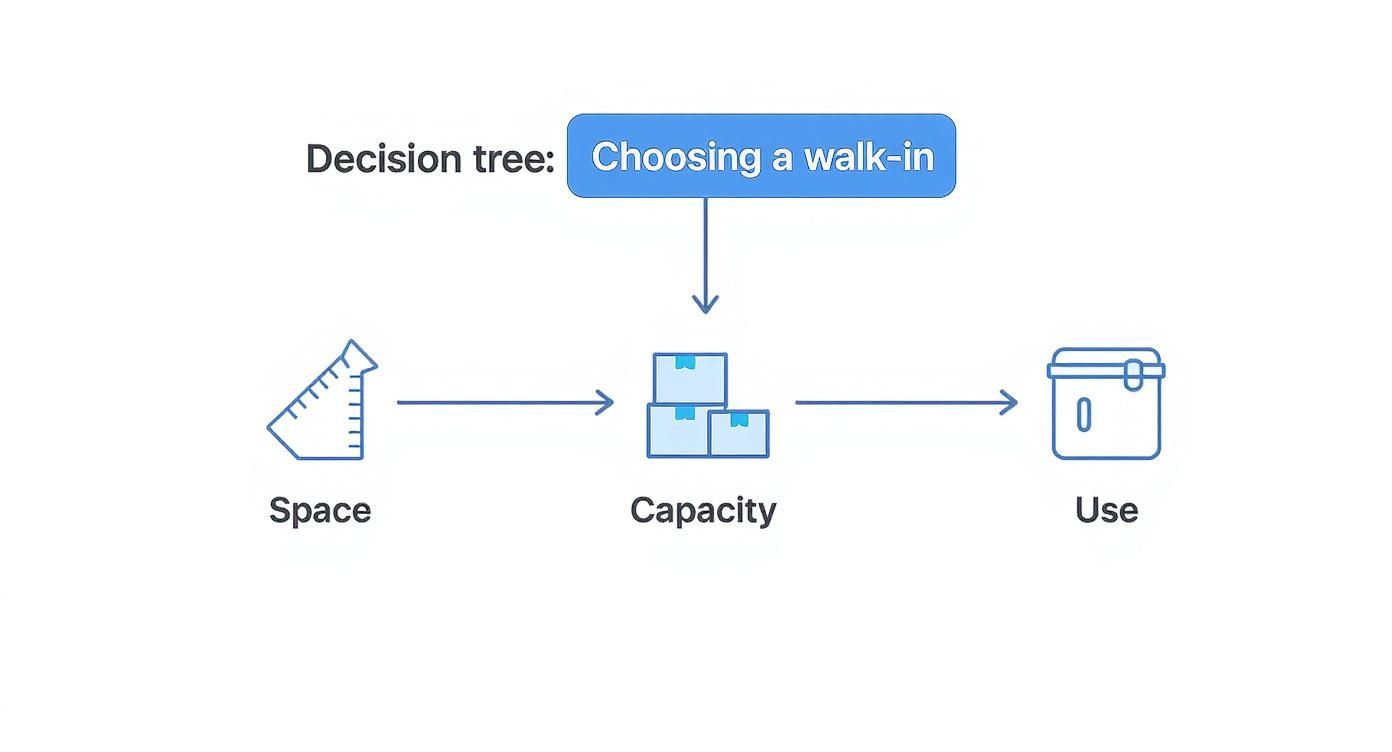
The main thing to remember is that your kitchen's physical footprint and your daily operational needs are what should guide you toward a standard or a tailored solution.
The Case for Custom-Built Walk-Ins
Now, a custom-built unit is a whole different ballgame. It's designed and built from the ground up to fit your space like a glove. This is the only way to go when you're dealing with the unique architectural challenges you find all over Los Angeles—from historic downtown buildings with inconveniently placed support beams to kitchens with low ceilings or funky layouts. A custom build lets you use every single inch you have.
Picture a high-end sushi spot in Beverly Hills needing several precise, separate temperature zones for different grades of fish. Or think about a massive Chinese banquet hall in the San Gabriel Valley that needs an L-shaped walk-in to wrap perfectly around a structural wall. In these cases, a standard box just isn't going to cut it.
A custom walk-in turns tricky architectural features from a problem into an advantage. It ensures your cold storage works with your kitchen's natural flow, not against it, which can make a huge difference in your team's efficiency every single day.
Comparing Scenarios: Prefab vs. Custom
To make it even clearer, let's look at two common L.A. businesses: a small Thai food truck and a big Korean BBQ restaurant.
- The Thai Food Truck: Space is tight and standardized. The number one priority is getting a reliable, compact unit installed ASAP. A prefabricated walk-in cooler is the obvious choice here. It’s a cost-effective piece of restaurant equipment that will fit right into the vehicle's dimensions.
- The Koreatown BBQ Restaurant: This place is in an older building with a weird, irregular floor plan. To store huge amounts of marinated meats and all their banchan, they need a unit that can tuck into a non-standard corner. A custom-built combination walk-in cooler and freezer is the only way they can maximize their space and keep up with their high-volume business.
At the end of the day, it's a balancing act between your budget, your timeline, and your physical space. Prefab units give you speed and affordability for most standard kitchens, while custom solutions offer unmatched flexibility when your space or your menu demands it.
Decoding Your Refrigeration System
Think of the refrigeration system as the hardworking engine of your commercial walk in refrigerator. For any restaurant in Los Angeles, from a Japanese kitchen in Little Tokyo to a Thai spot in Hollywood, getting this part right is absolutely critical.
This system doesn't just keep things cold; it's in a daily battle with LA's ambient heat, all while trying to keep your utility bills from skyrocketing. The right choice keeps your ingredients safe, your kitchen comfortable, and your budget intact.
This isn't just a local concern. The demand for reliable cold storage is climbing everywhere. The global walk-in refrigerator market is valued at roughly $10.9 billion in 2024 and is expected to hit $15.7 billion by 2030. This boom shows just how vital these systems are for businesses around the world. You can learn more about the growth of the walk-in refrigerator industry.
Three Core System Types Explained
When you start shopping for commercial refrigerators or freezers, you’ll run into three main types of refrigeration systems. Each one is built for different kitchen layouts, budgets, and needs. Figuring out the key differences is the first step toward a smart investment.
To make it easier to decide, let's break down the three main types of refrigeration systems you'll encounter. Each has its own place, depending on your space, budget, and how much cooling you need to do.
Comparing Refrigeration System Types
| System Type | Best For | Pros | Cons |
|---|---|---|---|
| Self-Contained | Smaller restaurants, Los Angeles food trucks, tight spaces, or businesses on a strict budget. | All-in-one "plug-and-play" unit. Lower upfront cost and simpler installation. | Adds heat and noise directly into the kitchen. Less efficient for larger spaces. |
| Remote | Most busy restaurants, especially those with limited kitchen space or a focus on staff comfort. | Moves the noisy, heat-producing condenser outside (usually the roof). Creates a cooler, quieter kitchen. | Higher initial cost and more complex installation. Requires professional setup. |
| Multiplex | Large-scale operations: Chinese banquet halls, catering kitchens, hotels, or restaurants with multiple cold storage units. | One powerful central unit runs multiple coolers and freezers. Highly energy-efficient at scale. | Significant upfront investment. Requires specialized design and installation. |
Choosing between these comes down to your operational reality. A self-contained unit might be perfect for a small cafe, but a bustling restaurant will almost always benefit from a remote system that keeps the kitchen environment sane.
Key Technical Terms You Need to Know
Beyond the system type, a few technical specs will pop up. Don't let them intimidate you. They’re just the vital stats that tell you how powerful and efficient your walk-in's engine really is.
The BTU (British Thermal Unit) rating is all about cooling power. The higher the BTU number, the more heat the system can pull out of the box. That’s a huge deal during a scorching LA summer or when your line cooks are opening the door every 30 seconds during a dinner rush.
Next up is the compressor—the heart of the whole system. It’s what circulates the refrigerant that actually does the cooling. Reputable brands like Atosa use beefy compressors built to handle the non-stop demands of a commercial kitchen, and they back them up with solid warranties.
A walk-in's insulation is measured by its R-value. Simply put, a higher R-value means it’s better at keeping heat out. A walk-in freezer packed with expensive seafood for a Japanese restaurant needs much thicker insulation than a cooler holding produce for a Mexican kitchen.
Finally, don’t overlook the smaller details. Sturdy, self-closing doors with tight magnetic seals are non-negotiable for preventing cold air from leaking out. Modern features like digital temperature displays and energy-efficient fans give you precise control and help lower those utility bills. It’s these details, often standard on quality equipment from brands like Atosa, that really add up and lower your total cost of ownership over the years.
Planning Your Sizing and Layout
Picking the wrong size for your walk-in cooler is one of the costliest mistakes any restaurant owner in Los Angeles can make. Go too small, and your staff will start cramming shelves full of product. That chokes airflow, creates dangerous hot spots, and puts your entire inventory at risk. Go too big, and you're just burning money on utility bills to cool empty space that could’ve been a new prep station.
Getting the size right isn't just about square footage; it's a strategic decision that needs to match the unique rhythm of your kitchen. A high-volume Mexican spot in Boyle Heights getting daily produce drops for fresh salsa has completely different needs than a niche Korean dessert cafe in K-Town receiving specialty ingredients once a week.
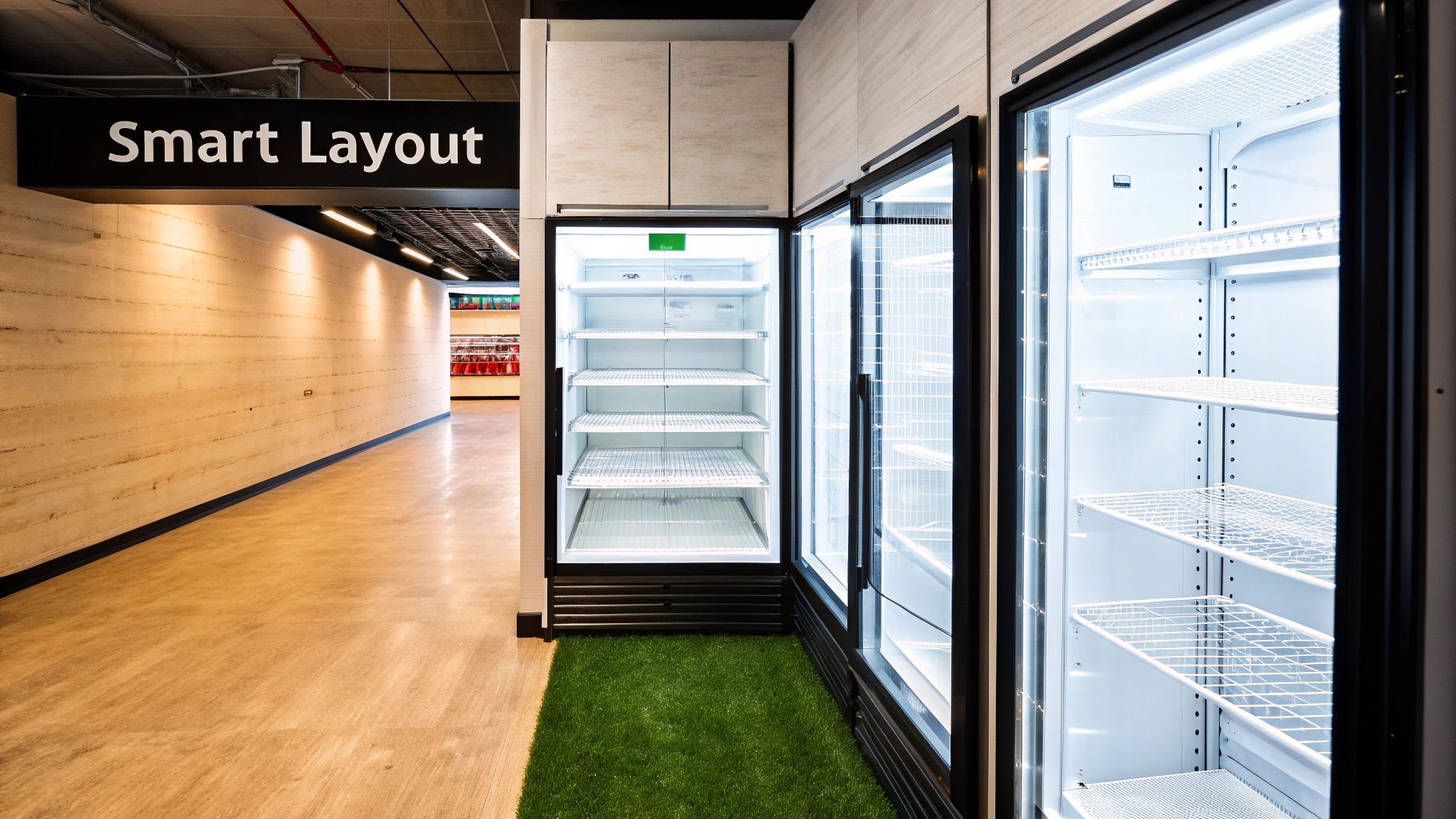
This is about figuring out how much product you truly need to hold, not just how much you can physically cram inside.
Calculating Your Ideal Walk-In Size
To really dial in the right dimensions, you need to answer a few key questions about your inventory and workflow. Think beyond today's menu—plan for future growth, seasonal specials, and that catering gig you want to land.
- Menu & Inventory: What on your menu actually needs refrigeration? You need to calculate the cubic feet required for bulky items like cases of produce for a Chinese restaurant, five-gallon buckets of sauce for a Thai kitchen, and large primals of meat.
- Delivery Frequency: Are you getting trucks daily, three times a week, or just once? More frequent deliveries mean you can get by with a smaller walk-in, which is a massive advantage in a cramped L.A. kitchen.
- Turnover Rate: How fast are you flying through ingredients? A busy Thai restaurant burning through hundreds of pounds of produce and protein every day needs serious storage space, even if they get deliveries all the time.
As a starting point, you can estimate about one cubic foot of storage for every 25 to 30 pounds of food. But remember, this can change a lot depending on packaging, so always build in a buffer for good air circulation.
Designing an Efficient Interior Layout
Once you’ve settled on a size, the interior layout is your next mission. A smart layout is more than just organization—it’s about boosting efficiency, nailing food safety, and making life easier for your kitchen crew. A well-organized interior turns your cold storage from just a box into a high-performance engine for your kitchen.
For many restaurants, one giant walk-in isn't the answer. You might get more out of separate units or a combo system. You can learn more in our guide on the benefits of a walk-in cooler and freezer combination.
Shelving and Organization Best Practices
The right shelving is everything. Your choice really depends on what you’re storing:
- Wire Shelving: This is your all-around workhorse. It’s perfect for individual containers and smaller boxes, and the open design is fantastic for letting cold air move freely around your products.
- Dunnage Racks: These are the heavy-lifters. They are low-profile, heavy-duty racks built to keep bulky items like kegs, huge bags of flour, or cases of drinks safely off the floor.
Most importantly, you have to organize your products to meet health codes and stop cross-contamination in its tracks. Ready-to-eat foods always go on the top shelves. Below that, place produce and other prepped items. Raw meat, poultry, and seafood must live on the bottom shelves to prevent any drips from contaminating everything below.
Navigating LA Permits and Proactive Maintenance
Putting a commercial walk in refrigerator into your Los Angeles restaurant isn't as simple as just putting the panels together and flipping a switch. You've got to navigate the maze of local building and health codes to make sure your spot—whether it's a Thai kitchen in Hollywood or a Mexican restaurant in East LA—gets started on the right foot.
This part is absolutely non-negotiable. Trying to sidestep the permit process is a surefire way to get hit with heavy fines, forced shutdowns, and orders for expensive rework. It's crucial to team up with licensed, insured contractors who know the Los Angeles Department of Building and Safety (LADBS) and the LA County Department of Public Health inside and out.
The LA Permitting Maze
Dealing with local bureaucracy can feel like a headache, but a good contractor will handle all the heavy lifting for you. They already know the specific rules for electrical work, plumbing for drainage, and the right kind of ventilation for your refrigeration system.
This local knowledge is everything. A pro who’s been around the block knows exactly how to draw up and submit plans that get a green light on the first try, saving you from delays that could mess up your grand opening. This is especially true if you’re doing a custom install in an older building, which is a pretty common story for LA restaurants.
Your walk-in isn't just an appliance; it's a structural addition to your building. Everything from the foundation it sits on to the electrical panel it’s wired into has to meet strict safety and health standards. Getting this right from day one is your best insurance policy.
Once your walk-in is installed and has the official sign-off, your job shifts from setup to upkeep. A consistent, proactive maintenance routine is your best defense against the kind of catastrophic failure that could absolutely wreck your business during a packed Friday night service.
Your Proactive Maintenance Checklist
Think of maintenance like a series of quick, regular check-ups that keep the heart of your kitchen pumping. Ignoring these little tasks is like never changing the oil in your car—sooner or later, a small, cheap problem will turn into a huge, expensive nightmare.
This approach is vital in a market as busy as North America, which dominates the global scene, holding about 49.2% of the market share in 2024. This is all driven by high-volume restaurants that simply can't afford any downtime. You can dig into more global walk-in refrigerator market trends to see just how important this equipment is.
Here’s a simple checklist to keep you on track:
- Clean Condenser Coils Regularly: Dust and grease are efficiency killers. When coils get clogged, the compressor has to work way harder, which sends your utility bills through the roof and leads to breakdowns. Clean them at least every three months.
- Check Door Seals for Leaks: A bad gasket lets all your cold air escape and invites in warm, moist air. Try the "dollar bill test"—if you can slide a bill out easily when the door is closed, it's time for a new seal.
- Monitor Refrigerant Levels: This is a job for a professional, but keep an eye out for warning signs, like the unit struggling to stay cold. Get a pro to inspect it twice a year to catch any leaks early.
- Calibrate Thermometers: If your thermometer is off, your entire inventory is at risk. Check it regularly against a calibrated handheld thermometer to make sure your food is always safe.
Understanding the Total Cost of Ownership
When you’re looking to invest in a commercial walk in refrigerator, it’s easy to get fixated on the sticker price. But the real number you need to focus on is the total cost of ownership. This includes the initial purchase price, sure, but also everything else it takes to get that unit humming away in your Los Angeles restaurant.
Think of it like planning the menu for your Korean BBQ spot. You don't just budget for the prime cuts of meat. You have to factor in the marinade, the banchan, the labor, and the gas for the grill. The same logic applies here; the upfront cost is just one ingredient in the bigger recipe of restaurant equipment costs.
Breaking Down the Upfront Costs
That initial price tag can swing wildly depending on a few key factors. Getting a handle on these variables helps you set a realistic budget and pick a unit that makes sense for your bottom line.
- Prefabricated vs. Custom: A standard-size, pre-fab walk-in is usually the most budget-friendly route, often landing somewhere between $7,000 and $15,000. But if you're trying to squeeze a unit into an odd-shaped space in an old Downtown LA building, a custom job could easily push past $20,000.
- Size and Refrigeration: It’s simple: bigger units cost more. So do units with beefier remote refrigeration systems, which are a must for battling the LA heat. A small walk-in cooler for a food truck will be on the lower end, while a massive walk-in freezer for a bustling Chinese restaurant is a much bigger investment.
- Special Features: Want to add glass display doors, a reinforced floor for heavy kegs, or extra shelving? Each of those bells and whistles will bump up the initial price.
And don't forget to set aside money for delivery and professional installation. Getting it set up correctly by a pro is non-negotiable for making sure your walk-in runs right and meets local codes.
Financing and Warranty: The Keys to Accessibility and Peace of Mind
Let’s face it, a walk-in is a major capital expense. It can be a tough pill to swallow for any business, whether you're a brand-new Japanese ramen shop or a Thai kitchen that's been around for years. This is where financing and leasing really shine. They let you get the restaurant equipment you need now without wiping out your cash reserves, breaking the cost down into predictable monthly payments. You can learn more about how restaurant equipment financing works to see what kind of plans are out there for your LA business.
Finally, you have the manufacturer's warranty—your ultimate safety net. It’s the brand’s promise to you, protecting your business from the financial gut-punch of an unexpected repair.
A strong warranty is more than just a piece of paper; it’s a direct reflection of the manufacturer's confidence in their product's quality and durability. It provides critical peace of mind, knowing you're covered if something goes wrong.
Always look for comprehensive coverage. A great brand like Atosa offers solid warranties, typically covering parts and labor for two years and the all-important compressor for five years. That kind of protection means a sudden breakdown won't crash your operations or your budget, letting you focus on what you do best: serving incredible food.
Common Questions About Walk-In Refrigerators
Even after sorting through all the specs, a big purchase like a commercial walk-in refrigerator always brings up a few last-minute questions. It doesn't matter if you're running a high-volume Chinese spot in the San Gabriel Valley or launching a new Korean food truck—you need clear answers. Here are a few things Los Angeles restaurant owners often ask.
How Often Should I Service My Commercial Walk-In Refrigerator?
You'll want to get your walk-in professionally serviced at least twice a year. Think of it as a check-up to prevent a sudden, catastrophic (and expensive) failure. A tech will clean the essential condenser and evaporator coils, check refrigerant levels, inspect door seals for costly leaks, and make sure all the electrical parts are in good shape.
If your kitchen is especially busy or you're in one of the dustier parts of LA, bumping that up to a quarterly service schedule is a smart move.
What Is the Main Difference Between a Walk-In Cooler and a Walk-In Freezer?
It really boils down to two things: their operating temperature and how much insulation they have.
- Walk-in Cooler: These commercial refrigerators are built to hold a temperature between 35°F and 41°F. It's the perfect environment for keeping fresh ingredients, like produce for a Thai kitchen, perfectly chilled.
- Walk-in Freezer: A commercial freezer is a different beast entirely, operating at or below 0°F. This is for long-term storage of frozen goods, like the bulk meats a busy Mexican restaurant goes through.
To handle that intense cold, a walk-in freezer needs much thicker insulation panels (which means a higher R-value), insulated floors, and a far more powerful refrigeration system to keep everything frozen solid.
Think of it this way: a cooler is like a light jacket, perfect for a cool LA evening. A freezer is a heavy-duty parka, built to handle a deep freeze.
Can I Install a Commercial Walk-In Refrigerator Myself?
While it might seem like a good way to save a few bucks, trying to install one of these yourself is a really bad idea. We strongly discourage it. These units involve complicated electrical work, handling high-pressure refrigerant lines, and getting the box perfectly level and sealed—it’s not a simple DIY project.
One wrong move could instantly void your warranty, create huge energy leaks that drive up your utility bills, and even get you in trouble with Los Angeles building and health codes. To protect your investment and make sure all your restaurant equipment is safe and up to code, always bring in a licensed and insured professional for the job.
Ready to find the perfect cold storage solution for your restaurant? The team at Los Angeles Restaurant Equipment has the expertise and inventory to help you select the right unit for your needs and budget. Explore our collection and get a quote today at https://losangelesrestaurantequipment.com.