

Dishwashing Machine for Restaurants: A Guide for Los Angeles Eateries
Think of a high-performance dishwashing machine for restaurants as the unsung hero of your Los Angeles kitchen. It's the key to keeping things running smoothly, staying on the right side of health codes, and even managing your labor costs. Especially for restaurants here in Los Angeles, from a bustling Koreatown BBQ joint to a trendy Venice food truck, picking the right machine isn't just a purchase—it's a critical investment in a clean, efficient, and profitable future.
Why the Right Dishwasher Is Your Kitchen's Best Friend
For any L.A. restaurant owner, whether you’re running a busy Thai spot downtown or a popular food truck in Silver Lake, your commercial dishwasher is so much more than just an appliance. It's the heart of your kitchen's sanitation and workflow. In a city with famously strict health codes and high labor costs, the right machine directly props up your bottom line.
This guide will walk you through finding the perfect unit for your spot. We'll figure out how to match a machine to your menu, whether you're power-washing mole off plates in an upscale Mexican kitchen or carefully handling delicate glassware at a fine-dining Japanese restaurant.
It's About More Than Just Clean Plates
A great commercial dishwasher is the linchpin that connects everything your restaurant does, from the front of the house to the back. It guarantees you have a steady stream of clean plates, glasses, and silverware, which prevents those dreaded bottlenecks during a dinner rush. That kind of reliability is just as vital as having dependable commercial refrigerators and freezers keeping your ingredients fresh. It’s a silent partner, working tirelessly so your service never grinds to a halt over a mountain of dirty dishes.
The right dishwashing machine for restaurants doesn't just get things clean. It proves your commitment to public health, keeps your service moving at top speed, and protects your financial stability. It’s a workhorse asset that upholds your reputation with every single spotless plate you send out.
This isn't just a small-time investment, either. The commercial dishwasher market in the United States is expected to hit USD 1.66 billion by 2030, and restaurants make up over 53% of that demand. That growth just shows how much the industry depends on powerful warewashing to keep things hygienic and efficient. You can get more details on market trends and their impact on the restaurant industry.
Matching the Machine to Your Menu and Volume
Picking the right commercial dishwasher is a lot like casting for a movie. Each model has a specific role to play, and your choice will make or break the flow of your kitchen, especially during a hectic Los Angeles dinner rush.
If you pick a machine that’s too small, your team will constantly be playing catch-up, creating a bottleneck that slows down your entire service. Go too big, and you’re just wasting valuable kitchen real estate, not to mention driving up your water and energy bills. The sweet spot is finding that perfect balance between capacity and efficiency.
Undercounter Dishwashers: Small But Mighty
Think of the undercounter dishwasher as the perfect machine for smaller spots where space is a luxury. They look a lot like the one you might have at home but are built tough for commercial use, washing a full rack in just a couple of minutes.
They’re a go-to solution for many Los Angeles businesses where every square foot counts.
- Small Cafes: Perfect for a coffee shop in a neighborhood like Larchmont Village that mostly deals with mugs, plates, and silverware.
- Bars: A must-have for washing glassware behind the bar, keeping a steady supply of clean beer glasses and cocktail shakers ready.
- Los Angeles Food Trucks: For food trucks slinging everything from Korean fusion tacos to Thai street food, an undercounter unit is often the only choice.
Their capacity is modest, usually around 20-40 racks per hour, but they pack the cleaning power needed for lower-volume operations without eating up your floor plan.
Door and Hood Type Machines: The Versatile Stars
For most mid-sized restaurants, the door-type (or hood-type) dishwasher is the real workhorse. These are the freestanding beasts you see in most busy commercial kitchens, offering a big jump in capacity from the undercounter models. Your dish person slides a rack in, pulls the hood down, and a powerful wash cycle takes care of business.
This model is a fantastic middle-ground, blending speed, power, and a manageable footprint. It’s why you’ll see them everywhere from a packed Japanese spot in Sawtelle to a popular Mexican restaurant in East L.A. They can typically handle 40-80 racks per hour, which is ideal for restaurants with a steady stream of diners.
This chart can help you figure out if it's time for an upgrade.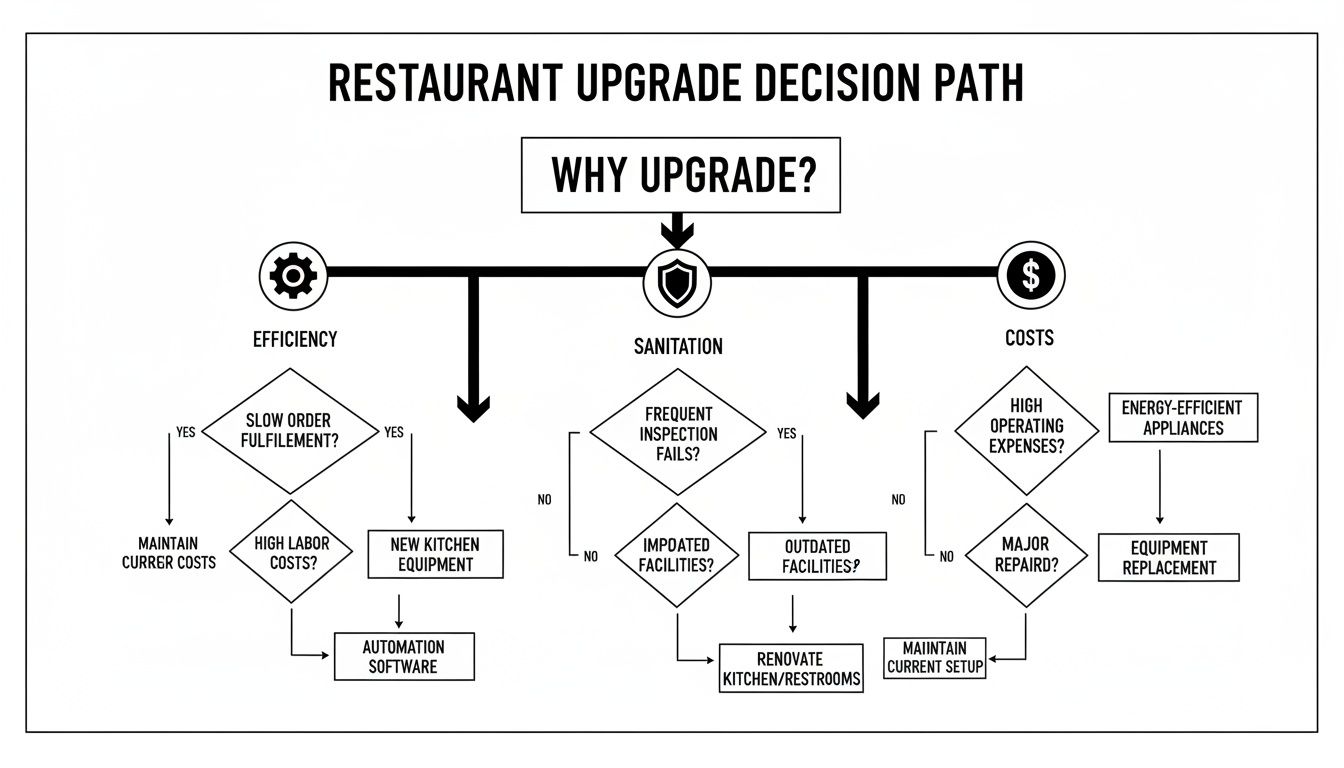
As you can see, the decision to upgrade usually comes down to three core needs: boosting efficiency, ensuring top-notch sanitation, and controlling costs.
Conveyor Dishwashers: The High-Volume Powerhouse
When your restaurant is running on a massive scale, you need a machine that can keep up. That’s where the conveyor dishwasher comes in. These are the undisputed champions of high-volume cleaning, built for places that wash hundreds of racks an hour.
Dishes get loaded onto a conveyor belt that pulls them through separate chambers for washing, rinsing, and sanitizing. It’s a completely automated, high-speed process.
A conveyor system isn't just a nice-to-have; it's an absolute necessity when the flow of dirty dishes never stops. Picture a giant Koreatown BBQ joint on a Saturday night or a hotel banquet hall hosting a wedding. In those situations, a standard door-type machine would be completely overwhelmed.
The capacity is enormous, with some models blasting through more than 200 racks per hour. They demand a significant investment and a lot of space for the machine and its landing tables, but nothing else can handle that kind of relentless demand. For huge Chinese restaurants in the San Gabriel Valley or university cafeterias, a conveyor dishwasher is the heart of the entire operation.
Commercial Dishwasher Types for LA Restaurants
Here's a quick comparison to help you match a dishwasher model to your restaurant's size, volume, and menu.
| Dishwasher Type | Best For (LA Cuisine/Type) | Capacity (Racks/Hour) | LA-Specific Use Case |
|---|---|---|---|
| Undercounter | Small cafes, bars, food trucks | 20-40 | A craft cocktail bar in DTLA or a taco food truck in Venice. |
| Door/Hood Type | Full-service Mexican, Japanese, Thai | 40-80 | A busy Thai Town restaurant or a brunch spot in Silver Lake. |
| Single-Tank Conveyor | High-volume Korean, Chinese | 80-200 | A large family-style Chinese restaurant in the San Gabriel Valley. |
| Flight Type | Hotels, hospitals, universities | 200+ | A convention center downtown or a university dining hall. |
Ultimately, the right machine depends on how many people you serve and what you’re serving them. This table should give you a solid starting point for figuring out what will work best for your L.A. kitchen.
Navigating Los Angeles Installation and Compliance
Putting a commercial dishwashing machine for restaurants in your Los Angeles kitchen is more than just plugging it in. You’ve got to deal with local rules, specific utility hookups, and even our unique environmental quirks. Getting this stuff right from day one saves you from expensive headaches, ensures you fly through inspections, and keeps your machine running strong for years.
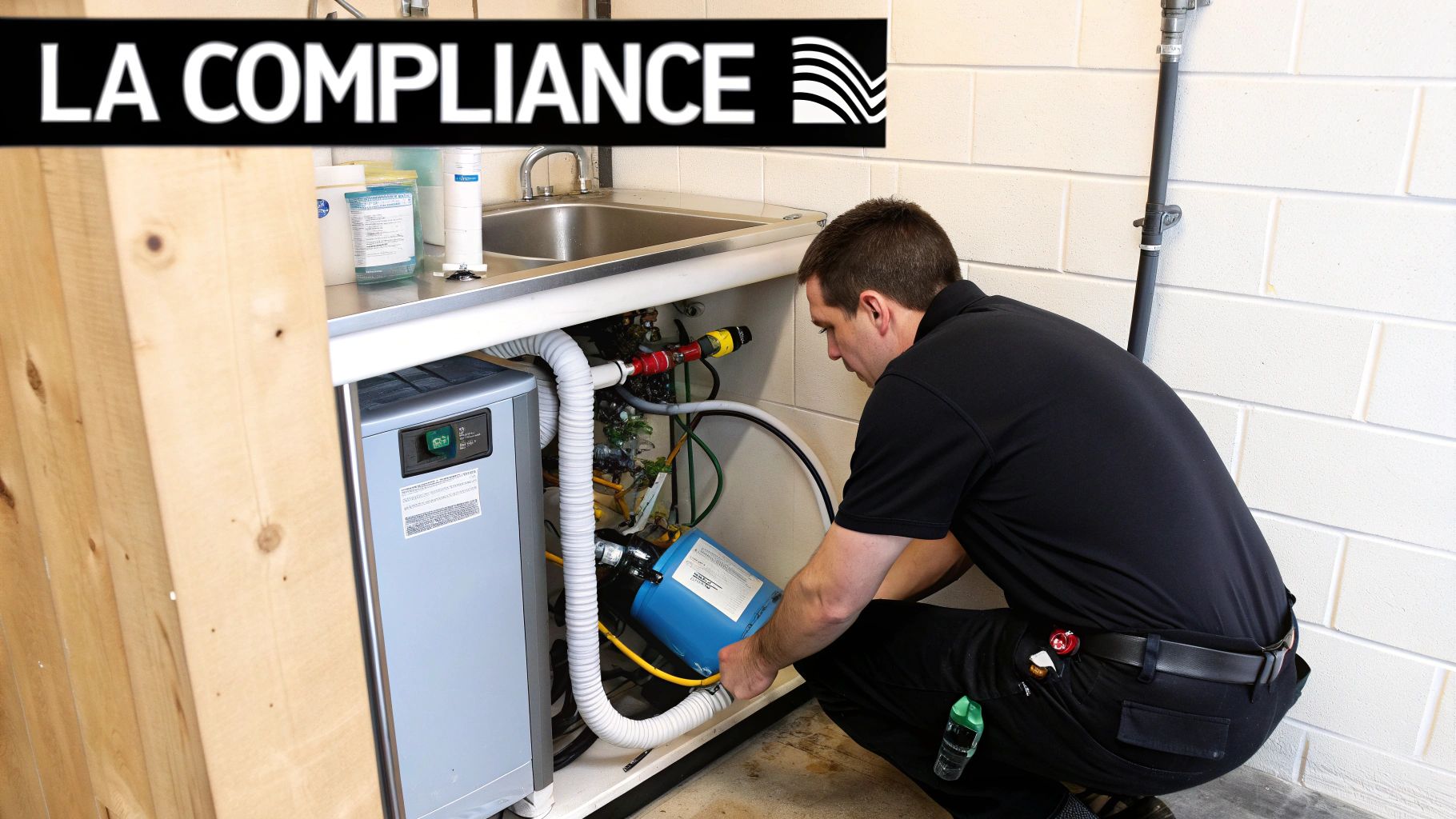
Whether you’re running a busy Thai spot in Hollywood or a massive Chinese restaurant in the SGV, every kitchen faces these same hurdles. Knowing what’s ahead is the first step to a smooth, compliant installation.
The Hard Truth About LA's Water
It’s no secret: Los Angeles has notoriously hard water, loaded with minerals like calcium and magnesium. It's fine to drink, but it’s the number one enemy of your kitchen equipment—especially your high-temp dishwasher.
When that water gets hot, the minerals bake onto surfaces, forming a chalky crust called limescale. This gunk is brutal. It clogs up the spray jets, fries expensive heating elements, and leaves those dreaded white spots all over your glassware. For a Japanese restaurant that lives and dies by pristine presentation, that’s a dealbreaker.
In Los Angeles, a commercial water softener isn't a luxury—it's a must-have. It acts like a bodyguard for your dishwasher, stopping internal damage before it starts, making your soap work better, and even cutting down on your detergent costs.
A water softener is a vital piece of restaurant equipment that protects not just your dishwasher but your ice machine, too. Think of it as essential insurance for any machine in your kitchen that's hooked up to a water line.
Powering Up Your Dishwasher Correctly
Your new dishwashing machine for restaurants will have very specific power and water demands. If you get them wrong, you’re looking at a fried machine, a voided warranty, or worse, a dangerous electrical short.
- Electrical Requirements: Does it need a 120V, 208V, or 240V hookup? Is it single-phase or three-phase? A small undercounter unit for a Los Angeles food truck might just need a standard outlet. But a big conveyor system? That needs its own dedicated, high-voltage circuit, and you’ll need a licensed electrician to install it.
- Plumbing Essentials: The machine needs solid water pressure and a hot water line that’s running between 120°F and 140°F. Drainage is just as critical to avoid backflow and keep things sanitary. All the plumbing work has to follow local codes, which have strict rules for things like floor sinks and indirect drains. To get the full picture, it helps to be familiar with related codes, like those that dictate the proper mop basin faucet height, because it all ties into a fully compliant kitchen.
Passing the Health Inspection with NSF Certification
Here in Los Angeles County, any piece of equipment that touches food absolutely must be NSF Certified. That little NSF (National Sanitation Foundation) seal is your proof that the machine meets tough standards for public health and safety.
When the health inspector walks into your Korean BBQ joint or Mexican taqueria, one of the first things they'll look for is the NSF mark on your big-ticket items, from your commercial freezers to your dishwasher.
Trying to get by with a residential machine is a massive health code violation that can get you fined or even shut down. NSF certification means the dishwasher is built to last, a breeze to clean, and can properly sanitize every dish, every time. It’s the non-negotiable seal of approval for any pro kitchen.
Budgeting for Your Dishwasher Purchase and Operation
A commercial dishwasher is a serious piece of equipment, but buying one doesn't have to break the bank. With a little smart planning, it's a manageable investment for any Los Angeles restaurant. The key is to think beyond the sticker price. You have to look at the whole financial picture—from the initial purchase to the daily costs of running it—to make a decision that keeps your business healthy for the long haul.
The upfront cost is just the first chapter. The real story is the total cost of ownership, which includes what you pay today plus all the ongoing expenses like chemicals, water, electricity, and the inevitable service call.
Understanding the Initial Investment
The price of a dishwashing machine for restaurants can be all over the map, depending on its size and how many racks it can handle per hour. A food truck has different needs and a different budget than a massive Koreatown BBQ joint, and dishwasher prices reflect that.
Here’s a general idea of what LA restaurant owners can expect to pay for a new machine:
- Undercounter Models: These compact workhorses usually run from $3,000 to $7,000. They're a great choice for a small cafe, a Los Angeles food truck, or as a dedicated glasswasher behind the bar.
- Door/Hood Type Machines: This is the sweet spot for most mid-sized spots. Expect to see prices between $6,000 and $15,000. They have the capacity and muscle for a busy Japanese or Mexican restaurant.
- Conveyor Systems: Built for pure, high-volume power, these are a major investment. They often start around $20,000 and can easily climb past $50,000 for the bigger, multi-tank models needed in hotel kitchens or large Chinese banquet halls.
The Hidden Costs of Operation
The initial purchase is a one-time hit to your budget, but it's the day-to-day operating costs that you'll feel month after month. These recurring expenses are just as critical as the sticker price and can make a machine that seemed like a bargain end up costing you more over time.
The best deal isn't always the machine with the lowest price tag. It's the one that strikes the right balance between the upfront cost and long-term efficiency with energy, water, and chemicals. An ENERGY STAR certified model, for instance, can literally save you hundreds of dollars a year on your utility bills.
Here are the big operational costs to keep in mind:
- Utilities: High-temp models use a lot of electricity to heat water, and every machine adds to your water bill. A truly efficient unit can cut that consumption by 25% or more.
- Chemicals: If you go with a low-temp machine, you’re signing up for an ongoing expense for detergents, rinse aids, and sanitizers.
- Maintenance and Repairs: Just like your commercial refrigerators, your dishwasher needs regular attention. Budgeting for preventative maintenance will save you from the panic and high cost of an emergency service call on a busy Saturday night.
Financing Your Restaurant Equipment in Los Angeles
For many restaurant owners in LA, dropping thousands in cash for a new dishwasher just isn't in the cards. That’s where financing comes in. It lets you get the essential gear you need without wiping out your capital. The two main routes are leasing or getting a loan.
Leasing means you make smaller monthly payments for a set period. You get to use the equipment without the commitment of owning it, and at the end of the lease, you can often choose to buy it, upgrade to a new model, or just return it. It's a great way to protect your cash flow. On the other hand, buying with a loan means it's your asset from day one, and you build equity as you pay it down.
The right choice really depends on your restaurant's financial health and where you see your business going. To get a better handle on how these options work for local businesses, check out our guide to Los Angeles restaurant equipment financing, which breaks down all the pros and cons.
The Unsung Heroes: Chemicals and Maintenance
Your commercial dishwasher is a workhorse, but it can't do the job alone. Getting those consistently spotless, perfectly sanitized results is a team effort between the machine, the right chemicals, and a solid maintenance schedule. Think of it this way: a proactive approach doesn't just keep your dishes sparkling; it protects your investment and prevents those dreaded mid-service breakdowns.
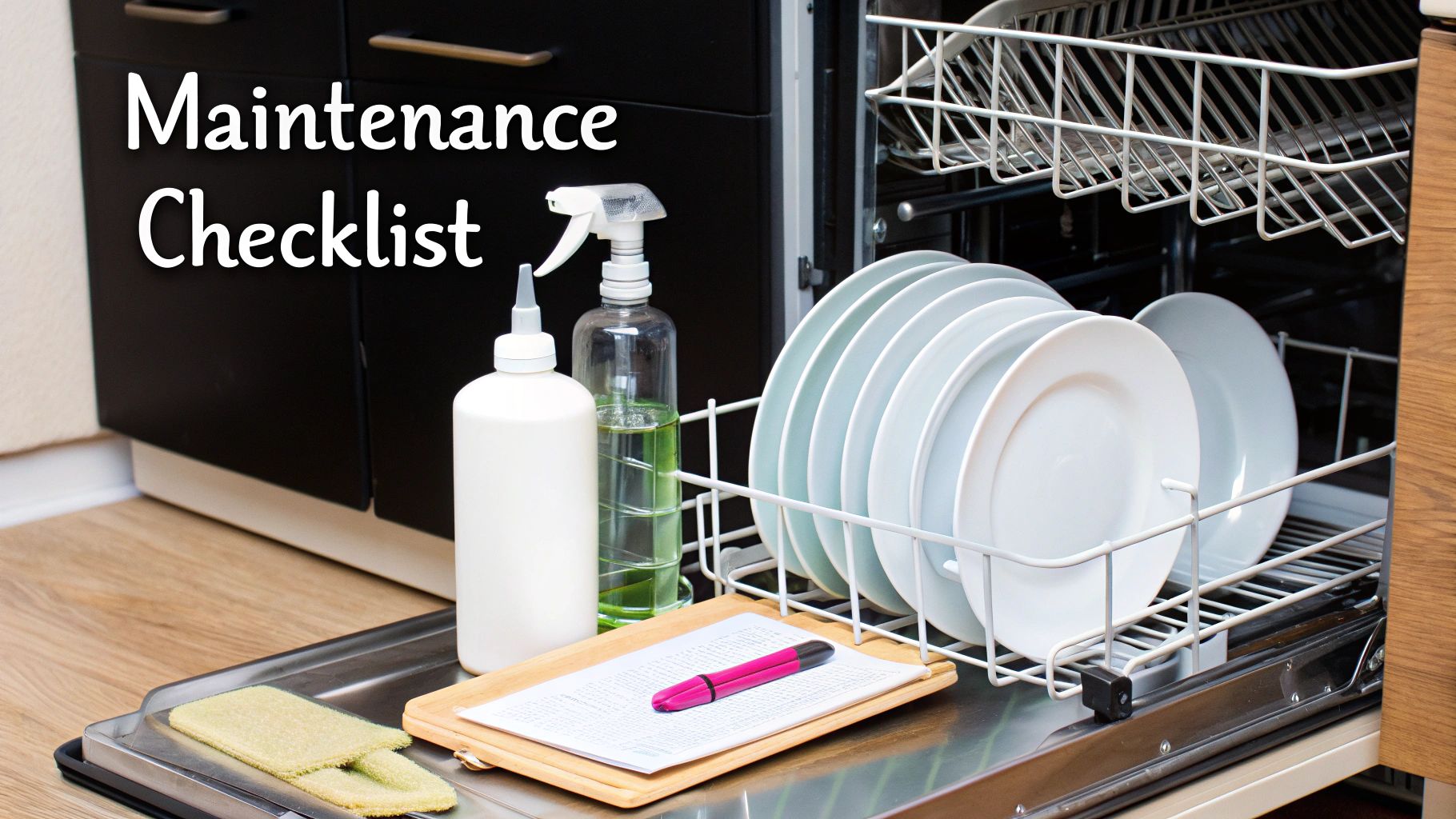
It’s just like running a busy Los Angeles kitchen line—every station has its role, and they all have to sync up perfectly. The same goes for your warewashing chemicals.
The Chemical Trio for Perfect Results
Using a matched set of chemicals is the secret to meeting LA County health codes and getting that perfect clean every time. Each one has a specific job to do.
- Detergent: This is your primary cleaner. Its whole purpose is to break down and lift away stubborn food soils—whether it’s baked-on cheese at a Mexican spot or greasy residue at a Korean BBQ joint.
- Rinse Aid: This is how you get spot-free glassware. Rinse aid breaks the surface tension of water, making it slide right off dishes. This speeds up drying and, crucially, prevents those annoying mineral spots left behind by LA’s notoriously hard water.
- Sanitizer: For any low-temp machine, this is the most critical step. After the wash and rinse, a chemical sanitizer is injected to wipe out any remaining harmful bacteria, making sure every single dish is safe for your guests.
The FDA defines sanitization as a multi-step process: first, a wash cycle to get rid of food. Next, a rinse to wash away the detergent. The final step is applying either a chemical sanitizer or using high-temperature water to kill pathogens.
A Simple Maintenance Checklist That Actually Works
Preventative maintenance is your best defense against expensive repairs and frantic emergency calls. A few simple tasks, done regularly, can honestly prevent 90% of the most common machine problems.
Daily Tasks (End of Day)
- Drain and Clean: Empty all the water from the machine.
- Remove and Clean Filters: Pull out the scrap trays and filters. Give them a good scrub to get all the food debris off.
- Wipe Down Interior: Grab a soft cloth and wipe down the inside, getting into all the corners.
- Check Spray Arms: Make sure the little nozzles on the spray arms aren't clogged up with anything.
Weekly Tasks
- Delime the Machine: This is non-negotiable in Los Angeles. Run a delime cycle to get rid of the mineral scale that builds up from our hard water.
- Inspect Chemical Lines: Take a quick look at the tubes feeding the detergent, rinse aid, and sanitizer. Make sure they aren't cracked or clogged.
- Calibrate Dispensers: Double-check that your chemical dispensers are pushing out the right amounts.
Warranty and Service in Los Angeles
Even the best-maintained machine might need a professional touch eventually. This is where understanding your warranty comes in handy. Most manufacturer warranties will cover parts and labor for a set time—usually one or two years—but they won't cover problems that come from neglect or a bad installation.
When you do need a repair, always call a factory-authorized service technician. These pros are trained on your specific brand of machine and use the right parts, so you know the job is done correctly. Keeping your restaurant equipment in top shape also means taking care of its stainless steel surfaces. For some great tips, check out our guide on what is the best stainless steel cleaner. For any restaurant owner in the LA area, building a relationship with a reliable service company is just plain smart business.
Your Final Purchase Checklist
Picking the right dishwashing machine for restaurants is a big deal. It’s an investment that pays off every single day... or becomes a constant headache. To help you get it right, we’ve put everything we’ve covered into a final checklist.
Think of this as your last gut check before you buy. Whether you're running a busy Mexican spot in East LA or a new food truck in Venice, these questions will make sure the machine you choose is a true workhorse for your kitchen.
Key Questions Before Buying Your Dishwasher
Answering these questions honestly before you even talk to a supplier will save you a world of trouble. It’s all about matching the machine to your food, your volume, and your unique space.
| Consideration | Key Question For Your Restaurant | Why It Matters in LA |
|---|---|---|
| Menu & Food Soil | What kind of food are we serving? Is it greasy, cheesy, starchy, or delicate? | Koreatown BBQ grease is a different challenge than the delicate glassware at a Beverly Hills fine-dining spot. Your machine must handle your specific menu. |
| Volume & Speed | How many racks do we need to wash per hour during our absolute busiest rush? | A brunch spot in Santa Monica has a different peak rush than a dinner-only restaurant downtown. Be realistic about your peak demand, not just the average. |
| Space & Layout | Have we measured the exact footprint available in our kitchen, including vertical clearance? | LA kitchens are notoriously tight on space. An undercounter might be your only option, or you might need to reconfigure a line to fit a door-type model. |
| Utility Hookups | What are our exact electrical (voltage, phase) and plumbing (water temp, pressure) capabilities? | Older buildings in Hollywood might have different power setups than new constructions. Getting this wrong means costly installation delays. |
| Energy & Water | Are we looking for an ENERGY STAR certified machine to lower our LADWP bills? | Utility costs in Los Angeles are significant. An energy-efficient machine can save you thousands over its lifespan, directly impacting your bottom line. |
| Local Support | Who will install this machine, and who will fix it when it breaks down at 8 PM on a Friday? | Traffic is a real factor. You need a reliable service partner with technicians who can actually get to your restaurant quickly, no matter where you are in the county. |
Getting clear on these points is the difference between buying a piece of equipment and making a smart, long-term investment for your restaurant.
Tying It All to Your LA Restaurant Style
The needs of a Japanese sushi bar in Little Tokyo are world's apart from a Koreatown BBQ joint. Your menu is the single biggest factor in choosing the right dishwasher.
-
For High-Volume Mexican Restaurants: You’re dealing with baked-on cheese and heavy grease all day. A powerful, high-temperature machine is non-negotiable for blasting that stuff off without hours of pre-scrubbing.
-
For Japanese or Fine-Dining Restaurants: Presentation is everything. Your glassware and plates have to be spotless. Look for a high-temp model with an excellent rinse aid system to get those crystal-clear, spot-free results your customers expect.
-
For Chinese, Thai, or Korean Restaurants: Fast-paced service means woks, bowls, and plates are flying back and forth. You'll need a quick-cycle door-type or even a conveyor system to keep up with the constant demand and cut through oily sauces.
-
For Los Angeles Food Trucks: Space and power are everything. You have to know your exact voltage and amperage, and measure your footprint down to the inch before even looking at a compact undercounter model.
Questions for Your Supplier
Once you know what you need, it’s time to talk to an equipment dealer. A good supplier is more than just a salesperson; they’re a partner.
Before you sign anything, get solid answers on delivery, installation, and who to call when things go wrong. A great price means nothing if your machine is sitting in a crate for a week or if the closest service tech is in another county.
Here are the final questions to ask your supplier:
- Installation and Delivery: What’s the delivery process look like for a tricky spot like Downtown LA? Do you offer professional installation, including hooking it up to my plumbing and electrical?
- Warranty and Service: Who is your go-to service partner in the Los Angeles area? What’s their average response time for a service call on a busy night?
- Chemicals and Training: Can you set me up with a chemical supplier who knows how to handle LA's hard water? Will you show my team how to do the daily cleaning and basic upkeep?
Nailing down these final details ensures you’re covered from day one. You'll end up with the perfect piece of restaurant equipment that truly works for your kitchen, your food, and your team.
Frequently Asked Questions
Stepping into the world of commercial dishwashers can feel overwhelming. To help clear things up, we've put together answers to some of the most common questions we hear from restaurant owners right here in Los Angeles.
What Is the Difference Between a High-Temp and Low-Temp Dishwasher?
The main difference is pretty straightforward: it’s all about how the machine sanitizes your dishes. You're choosing between sanitizing with intense heat or with chemicals.
A high-temp machine is the powerhouse. It uses a built-in booster heater to get the final rinse water up to a blazing 180°F, which instantly kills off bacteria. The big advantage here is that the intense heat causes dishes to flash-dry in seconds, a massive help during a busy service and the secret to getting spotless, sparkling glassware. The trade-off? They use more energy and will almost certainly require a commercial vent hood to manage all that steam.
On the other hand, a low-temp machine does its work with cooler water (usually between 120-140°F) and uses a chemical sanitizer in the final rinse cycle to get the job done. These models are typically less expensive upfront and are kinder to your utility bills. Just remember, you'll have an ongoing monthly cost for the special sanitizing chemicals.
Does My Los Angeles Restaurant Need a Water Softener?
If you're opening up shop in Los Angeles, the answer is a hard yes. L.A. is known for having incredibly hard water, loaded with minerals like calcium and magnesium. While it’s fine to drink, this water is the absolute worst enemy of your kitchen equipment.
Think of a water softener as essential insurance for your kitchen. It's not just for the dishwasher; it also protects your ice machines, coffee makers, and steamers from the damaging effects of limescale buildup.
When hard water gets heated, those minerals turn into a chalky, crusty scale. This scale clogs up spray nozzles, ruins heating elements, and leaves those annoying white spots all over your "clean" dishes and glasses. A water softener tackles the problem at the source by removing those minerals, which protects your investment, makes your dishwasher clean more effectively, and even lets you use less detergent.
Can I Use a Residential Dishwasher in My Small Cafe or Food Truck?
This is a firm no. Putting a home dishwasher in any commercial kitchen—even a Los Angeles food truck—is a serious health code violation in Los Angeles County. It's one of the fastest ways to get your operation shut down by an inspector.
Here are a few critical reasons why this is a deal-breaker:
- No NSF Certification: Home dishwashers are not NSF Certified. This means they haven't been tested and approved to meet the strict sanitation and durability standards required for serving the public. A health inspector will spot this immediately and fail your inspection.
- Painfully Slow Cycles: A residential dishwasher can take an hour or more to complete a cycle. A commercial machine powers through a rack in just 1-4 minutes. There's simply no way to keep up with the dinner rush using a machine designed for a family of four.
- Not Built for the Job: Commercial dishwashers are built like tanks, with heavy-duty pumps and parts made to run constantly, day in and day out. A residential unit would burn out and break down within weeks under that kind of pressure.
Investing in a proper commercial dishwashing machine for restaurants isn't just a good idea—it's a fundamental requirement for running a legal, safe, and efficient food business in Los Angeles.
Ready to find the perfect workhorse for your kitchen? The team at Los Angeles Restaurant Equipment has the expertise and selection to match you with the ideal dishwasher, commercial refrigerator, or freezer for your specific needs. Explore our full catalog and get your kitchen running at peak efficiency today. Visit us at https://losangelesrestaurantequipment.com.