

Draft Beer System Installation Your Guide to a Perfect Pour for Los Angeles Restaurants
A top-notch draft beer system starts with a solid plan. Before you even think about running a single beer line, a detailed site assessment is crucial. This initial step ensures your system becomes a profit center for your Los Angeles restaurant, not a constant headache, by mapping out the most efficient route from the keg to the tap to minimize foam and maximize your yield.
Planning Your Draft System for Maximum Profit
The foundation of a profitable draft beer program is laid long before the first keg is tapped. It all begins with a careful site assessment that’s unique to the flow of your Los Angeles establishment.
Whether you're running a sprawling Korean BBQ joint in K-Town with high-volume needs or a nimble food truck serving tacos in Silver Lake, the principles are the same. This phase is all about maximizing efficiency and cutting down on waste. You need to take a hard look at your bar's layout to find the best path for beer lines. Shorter, more direct routes are always better because they reduce temperature swings that create foam and eat into your profits.
Assessing Your Space and Storage
The heart of your draft system is its refrigeration. Your first big decision is where to keep the kegs. Will they go in a large, central walk-in cooler, or will you use a smaller commercial refrigerator or kegerator right behind the bar? This choice will impact the entire installation.
For instance, a high-volume Japanese restaurant in Downtown LA specializing in sushi and yakitori would likely benefit from a large walk-in cooler that can hold dozens of kegs. This setup would require a long-draw glycol system. On the other hand, a Thai spot in Hollywood with a smaller tap list might find a simple direct-draw system with an undercounter commercial refrigerator to be more practical and budget-friendly.
Keep these key factors in mind during your assessment:
- Distance to the Taps: How far will the beer travel? This determines if you need a more complex and expensive glycol-cooled system to keep it cold.
- Keg Storage Capacity: How many kegs can your cooler hold? Don’t forget to plan for backup kegs of your most popular brews to avoid running dry mid-service.
- Workflow Efficiency: How easy is it for your staff to change kegs during a rush? A poorly placed cooler can create a major bottleneck. Our guide on picking a walk-in cooler and freezer combination can offer more tips for optimizing your cold storage.
A well-planned draft system isn't just about serving cold beer; it's a strategic asset. By mapping the shortest, most insulated route from keg to glass, you can reduce beer waste from foam by up to 15-20%, directly boosting your bottom line on every pour.
The best draft system depends entirely on your venue's space, volume, and budget. Here’s a quick breakdown of common systems for typical L.A. foodservice operations.
Choosing the Right System for Your Los Angeles Venue
| System Type | Best For | Pros | Cons |
|---|---|---|---|
| Direct-Draw | Small bars, food trucks, or venues with taps directly on the cooler. | Simple, lowest cost, easy to clean. | Limited to very short distances (under 5 feet). |
| Air-Cooled | Bars where taps are within 25 feet of the cooler. | Relatively inexpensive, works well for short-to-medium runs. | Less effective in hot climates or for longer distances. |
| Glycol-Cooled | Large restaurants, breweries, stadiums; any setup over 25 feet. | Maintains perfect temperature over long distances, less foam. | Higher upfront cost, more complex installation and maintenance. |
Each system has its place, so the key is to match the technology to your specific operational needs and physical layout.
Navigating Los Angeles Health and Safety Codes
Planning your draft system also means thinking about compliance from day one. Los Angeles has specific health codes for beverage dispensing, especially around line cleaning and CO2 safety. Your plan has to include proper space and ventilation for CO2 tanks—a critical safety measure to prevent dangerous gas buildup.
For anyone just starting a small business, understanding these foundational steps is key to smoothly integrating a new draft beer system. This includes budgeting for compliance and professional advice. A little foresight ensures your system not only pours perfectly but also passes inspections, saving you from fines and delays.
The commercial beer tap system market is a big deal. Valued at USD 2.4 billion in 2025, it's expected to hit USD 3.8 billion by 2035. This growth is thanks to the craft beer boom—with over 9,500 craft breweries in the USA in 2024—driving demand for professional draft setups. Investing in a properly planned system now puts your L.A. restaurant in a great position to tap into this trend.
Choosing the Right Hardware for Your Bar or Restaurant
Your draft beer system is only as good as its weakest link. Picking the right restaurant equipment is a make-or-break step that directly hits your beer quality, waste, and ultimately, your profits in the competitive Los Angeles market.
The choices you make now will define your bar's day-to-day efficiency. A high-volume Chinese restaurant in the San Gabriel Valley planning a 20-tap lineup of craft beers needs a serious, long-draw glycol system. But a cozy Mexican restaurant in Boyle Heights with just a couple of local IPAs on tap could get by just fine with a simple direct-draw kegerator.
Air Cooled vs. Glycol Cooled Systems
The first big decision is how you'll keep the beer cold from the keg to the tap. This choice almost always comes down to the distance between your walk-in cooler and your bar.
-
Air-Cooled Systems: These are perfect for really short runs, usually under 25 feet. A fan pushes cold air from your cooler through an insulated tube right alongside the beer lines. It’s a great, cost-effective option for a small bar or a food truck where the taps are mounted right on the commercial refrigerator.
-
Glycol-Cooled Systems: This is the industry standard for most L.A. bars and restaurants. A glycol power pack circulates a chilled antifreeze mix through a trunk line, keeping the beer at a perfect 38°F from keg to glass, even over hundreds of feet.
For pretty much any spot in Los Angeles where the kegs are in a walk-in cooler and the bar is somewhere else, a glycol system is a must. The Southern California heat makes air-cooled systems struggle over longer distances, which just leads to foamy beer and wasted money.
Core Components You Cannot Overlook
Beyond the cooling method, a few key pieces of hardware are essential for pouring that perfect pint. Trying to save a few bucks here will only cause headaches and off-flavors down the road.
Before we dive in, here's a quick checklist to keep the essential components and their key considerations top of mind. This will help you map out exactly what you need for your specific setup.
Essential Draft System Component Checklist
| Component | Key Consideration | LA Pro Tip |
|---|---|---|
| Cooling System | Distance from cooler to bar. Air-cooled for <25 ft, glycol for longer runs. | In L.A.'s heat, always lean towards a glycol system if there's any doubt. It's an investment in consistency. |
| Draft Tower | Material matters most. Look for 304-grade stainless steel to avoid corrosion. | Match the tower style to your bar's aesthetic, but never compromise on stainless steel construction. |
| Faucets | Style depends on the beer. Standard for most, stout faucets for nitro beers. | Get a few stout faucets even if you don't serve nitro now. It gives you flexibility for future menu changes. |
| Keg Couplers | Match the keg valve system. "D" for U.S., "S" & "A" for European. | Keep a few different coupler types on hand. You never know when a great European beer will become available. |
| Beer & Gas Lines | Use antimicrobial and PVC-free tubing to prevent flavor contamination. | Measure your runs carefully and add a little extra length. It's better to have too much than not enough. |
| Gas Regulator | Dual-gauge regulators are essential for monitoring pressure and tank volume. | A secondary regulator for each line offers ultimate control, preventing over-carbonated pilsners or flat stouts. |
| Gas Blender | Mixes CO2 and Nitrogen for nitro beers or very long draw systems. | A must-have for serving Guinness correctly, but also helps with pouring issues on runs over 100 feet. |
| Drip Trays | Surface mount or built-in with a drain. A drain is better for high-volume bars. | A rinser built into the drip tray is a game-changer for glassware and keeping the bar clean. |
This checklist covers the big-ticket items. Getting these right from the start saves you from costly fixes and ensures every pint you pour is exactly how the brewer intended.
Towers and Faucets
The draft tower is the star of the show at your bar, but it’s not just about looks. The material is everything. You absolutely have to go with 304-grade stainless steel for any part that touches the beer. That cheaper chrome-plated brass will eventually corrode and give the beer a metallic taste, which will ruin a delicate hazy IPA in a second.
Faucets also come in different styles. Standard faucets are fine for most beers, but you’ll need a special stout faucet for nitrogenated beers like Guinness. These have a restrictor plate inside that creates that iconic creamy head.
A common mistake is using a single gas regulator for multiple beer lines. Investing in a secondary regulator for each line gives you precise pressure control. This is vital because a German pilsner and a Belgian tripel require different CO2 volumes to pour correctly.
Keg Couplers
The coupler is what connects to the keg, letting gas push the beer out. It's not a one-size-fits-all situation; different breweries use different systems.
- "D" System (Sankey): This is the standard for almost every brewery in North America.
- "S" System: You'll see this on many European kegs like Heineken or Pilsner Urquell.
- "A" System: Common for German breweries like Paulaner and Spaten.
A Koreatown pub serving local craft brews alongside imported lagers will need both "D" and "S" system couplers. Always confirm with your beer distributors what kind of couplers you'll need for their kegs.
Gas Regulators and Blenders
Finally, your gas system is the engine that drives everything. A quality dual-gauge regulator is non-negotiable. One gauge shows the pressure being sent to the keg, and the other shows how much CO2 is left in your tank, so you don't run out mid-shift.
If you're serving nitro beers or pushing beer over very long distances, a gas blender is a smart move. This device mixes CO2 and nitrogen to a specific ratio, guaranteeing perfect carbonation and a smooth, stable pour every time.
The push for better draft systems is growing. Draft beer equipment market installations are projected to nearly double from USD 3.5 billion in 2024 to USD 6.5 billion by 2034. This reflects the larger trend in the draught beer market, where restaurants and bars are the dominant players, holding a 63.4% market share. With multi-faucet systems making up over a third of the revenue, investing in the right hardware is vital for any high-volume L.A. venue.
Choosing the right equipment upfront ensures every pour is perfect. For a closer look at essential cold storage solutions, check out our selection of professional draft beer coolers built for commercial use.
The Professional Installation Process from Keg to Tap
Alright, you’ve picked your components and your blueprint is solid. Now for the fun part: bringing it all to life. A professional draft beer system installation is a game of precision, working methodically from your walk-in cooler all the way to the customer's glass. If you rush this part, you're setting yourself up for foamy pours, wasted product, and a whole lot of frustration down the line.
Everything kicks off inside your cold box. It doesn’t matter if it's a small kegerator tucked away in a Thai spot or a massive walk-in for a Korean BBQ joint—this is ground zero. The cooler needs to be spotless, organized, and ready for the heart of your operation: the kegs.
This simple diagram shows the basic path your beer will take, breaking it down into the three core hardware stages of any pro install.

Think of it this way: every single component between the keg and the tap has to work in perfect concert to deliver that perfect pint.
Mounting Towers and Running Lines
With the cooler prepped, the first big move is mounting the draft tower at your bar. This means drilling through the bar top, making sure the tower is perfectly level, and sealing it tight to keep moisture out. You only get one shot at this, so precision is everything. A wobbly or crooked tower is more than just an eyesore; it's unstable.
Once the tower is anchored, the trunk line—that big insulated python carrying the beer and glycol lines—gets carefully routed from the cooler to the bar. In a long-draw glycol system, especially with the Los Angeles heat we deal with, this is probably the most critical part of the whole install.
Here’s what the pros are laser-focused on:
- No Kinks Allowed: Any sharp bend or pinch in the line kills the flow and creates turbulence. That’s a one-way ticket to foamy beer.
- Total Insulation: Even a tiny gap in the trunk line's insulation will cause temperature swings, messing up the beer quality before it ever hits the faucet.
- Secure the Line: The line has to be properly fastened along its entire path. This prevents it from sagging or putting stress on the connections at either end.
I’ve seen it happen: a new Chinese restaurant in the San Gabriel Valley ran their trunk line too close to a wok station. That ambient heat completely overwhelmed the glycol chiller, and they were stuck with chronic foaming issues. A seasoned installer knows to map out the coolest, most direct route possible.
Don’t ever underestimate the importance of the physical path. A clean run for your trunk line that steers clear of heat sources and sharp turns is your best defense against foam. You're basically protecting your liquid assets from keg to tap.
Connecting Gas Systems and Couplers
Lines are in, so now it's time to hook up the gas system that pushes the beer. This is where safety is non-negotiable. Your CO2 and nitrogen tanks have to be chained securely to a wall in a well-ventilated space to meet local LA safety codes.
For new spots or major remodels integrating a draft system, getting the plumbing right from the start is huge. This is where understanding new construction plumbing services comes in, as it covers the proper placement and ventilation for gas systems as part of the initial build.
Next, the regulators get attached to the tanks. A dual-gauge regulator is a must-have. One gauge tells you the pressure going to the keg, and the other tells you how much gas is left in the tank. Trust me, you don't want to run out of gas in the middle of a Friday night rush.
Then, the right keg couplers are connected to the beer lines. You tap each keg by engaging the coupler, which lets CO2 in and beer out. A tight, leak-free seal at every single connection is vital.
Performing Critical Leak Tests
Once everything is connected, it’s time for a full-system leak test. Do not skip this step. Ever. Installers use a simple soap-and-water solution and spray it on every connection in the gas line, from the regulator all the way to the coupler.
If you see bubbles forming, you’ve got a gas leak that needs to be fixed right away. A slow CO2 leak isn’t just wasteful; it's a silent profit-killer that can drain a full tank in just a few days. This simple check protects your bottom line.
Finally, the lines are filled with beer for the first test pours. This is where an experienced installer really proves their worth. They can spot and fix common start-up issues in minutes.
Common first-pour problems include:
- Foamy Beer: Usually means the pressure is off, the temperature is fluctuating, or there’s a kink in a line.
- Flat Beer: This almost always points to a gas leak or the CO2 pressure being set too low.
- No Flow: Could be a closed valve, an empty keg, or a coupler that isn't fully engaged.
By tackling these little snags on the spot, a pro ensures your system is perfectly balanced and ready for service. This final step, called commissioning, is what turns a pile of expensive hardware into a reliable, money-making draft beer system.
Balancing Your System to Perfect Every Pour
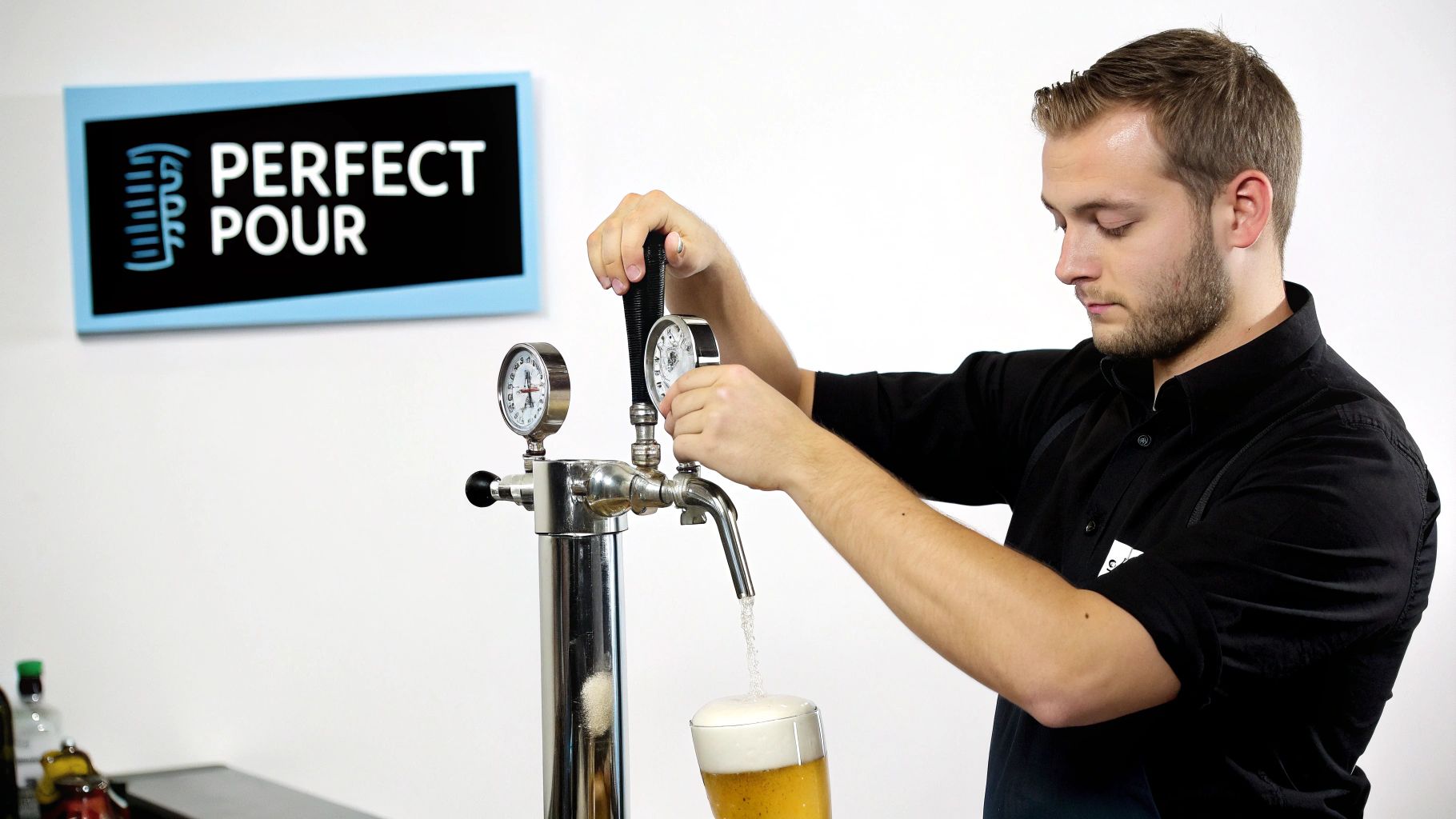
Getting all the hardware in place is a huge step, but your draft beer system installation isn't quite done. The real craft begins now, turning all that shiny new restaurant equipment into a machine that consistently makes you money. This next phase is all about "balancing"—the careful process of tuning your system to pour a perfect, profitable pint, every single time.
This balancing act is a delicate science, a constant give-and-take between temperature, pressure, and resistance. It’s the difference between a professional setup and one that just spits out foamy, unsellable beer. And if your pours are all foam, you’re literally watching profit go down the drain.
The Science of a Perfect Pour
Think of balancing your system like a formula where three key variables have to work together perfectly. When you get it right, you ensure the CO2 that's dissolved in the beer stays that way until it hits the customer's glass.
- Temperature: Beer holds its carbonation better when it's cold. Your walk-in cooler needs to stay at a consistent 38°F. If it gets any warmer, the CO2 will start to break out of the liquid, and that means foam.
- Resistance: The beer line itself creates friction, which is a good thing—it slows the beer down. This resistance is measured in pounds per foot and changes based on the line's diameter and what it's made of.
- Pressure: The CO2 pressure you apply has to be just strong enough to push the beer past the line resistance and gravity, getting it to the faucet at a controlled rate of about 2 ounces per second.
An LA bar right by the beach will need a different pressure setting than a brewery up in the mountains. Even something as simple as the length of your beer lines completely changes the equation.
A great rule of thumb is to start with a base pressure of 12-14 PSI for most standard ales and lagers kept at 38°F. From that starting point, you can fine-tune based on your system's specific resistance and how carbonated the beer is.
First Clean and Staff Training
Before a single drop of beer is served to a customer, the whole system needs a deep clean and sanitization. This first flush gets rid of any oils, dust, or residues left over from manufacturing. You can't serve beer through a dirty line on day one; it will absolutely ruin the flavor and your reputation right out of the gate.
Once the system is sparkling clean, it’s time to get your team up to speed. Good staff training is just as important as the installation itself. Your investment is only safe if the crew knows how to use and look after it.
Your training checklist should definitely cover:
- Changing Kegs Correctly: Show them how to safely un-tap an empty keg and tap a fresh one without making a mess or wasting beer.
- Daily Cleaning Procedures: Simple end-of-night rinses and faucet cleaning routines are non-negotiable for preventing gunk buildup.
- Spotting Trouble: Teach your staff to recognize the first signs of a problem—like a pour slowing down or suddenly getting foamy—so you can fix it before it gets worse.
Whether it’s a hazy IPA in the Arts District or a crisp lager in a San Gabriel Valley restaurant, consistent quality always comes from a well-trained team.
The global draught beer market is huge and getting bigger, projected to jump from USD 43.5 billion in 2025 to USD 76.7 billion by 2034. For any Los Angeles venue, including food trucks using smaller mini-keg systems, tapping into this growth means having an efficient setup. A professionally balanced system can slash waste by 15-20%, which goes straight to your bottom line. You can dive deeper into the market trends shaping the industry to learn more.
Calculating Your Costs and Maximizing ROI
Let's talk numbers. A professional draft beer system isn't just another line item on your restaurant equipment list; it's a major business investment. Getting a handle on everything from the initial spend to the long-term profitability is crucial, whether you're outfitting a Los Angeles food truck or a full-scale restaurant.
The upfront cost can swing wildly depending on what you need. A simple two-tap, direct-draw setup for a smaller space might only run you a few thousand dollars. But if you're planning a sophisticated 20-tap glycol system for a large Koreatown hotspot that pulls from a walk-in cooler, you're easily looking at tens of thousands.
Breaking Down the Upfront Investment
The sticker price for a draft system is way more than just the tower and a few faucets. You have to account for every single component, plus the expert labor needed to make it all work seamlessly.
Here’s a look at the main expenses you should be budgeting for:
- Core Equipment: This is your draft tower, faucets, trunk line, the glycol power pack (if you're going that route), gas regulators, and all the keg couplers.
- Refrigeration: Often the biggest single cost is the cold storage itself. This could be a compact commercial kegerator or a full-sized walk-in cooler. Opting for modern, energy-efficient commercial refrigerators can seriously cut down your utility bills over time.
- Gas System: You’ll need to either buy or lease CO2 tanks (and maybe nitrogen for stouts), plus set aside a safe, secure spot to store them.
- Professional Labor: This is not a weekend DIY project. A pro installer's fee might make up 20-30% of your total budget, but it’s money well spent to guarantee your system is perfectly balanced and won't spring a leak.
The Path to Profitability and ROI
While the initial check you write might feel steep, a well-managed draft beer program delivers some of the best profit margins you'll find anywhere in the restaurant world. It all comes down to the simple math of kegs versus bottles and cans.
A standard half-barrel keg gives you 1,984 ounces of beer. That works out to roughly 124 (16 oz) pints. Even after you factor in a little foam and spillage, your cost per pint from a keg is dramatically lower than packaged beer. It’s not uncommon to see margins on draft beer hit 80%, turning those taps into powerful money-makers.
A draft beer system is one of the fastest ways to see a return on your equipment investment. For a typical Los Angeles bar, a professionally installed system can often pay for itself in under a year through higher profit margins and reduced product waste.
Making the Investment Manageable
For new businesses or anyone trying to protect their cash flow, that upfront cost doesn't have to be a dealbreaker. Many Los Angeles equipment suppliers offer financing programs that make getting a pro-level draft system much more attainable.
Think about these options:
- Equipment Financing: This is a straightforward loan. You buy the system and pay it off in installments over a set period.
- Lease-to-Own Programs: With this setup, you make regular lease payments and get the option to buy the equipment when the term is up. It’s a smart way to match your expenses to your revenue while you build up business credit.
By taking advantage of these financial tools, new LA food trucks and restaurants can tap into a high-margin revenue stream from day one without gutting their working capital. That kind of smart planning turns your draft system into a profitable asset from the very first pour.
Answering Your Draft Beer System Questions
Even the most buttoned-up installation plan has a few question marks. It’s just part of the process. I get calls all the time from LA restaurant and food truck owners who are in the middle of a build-out and need some quick advice.
Let’s walk through some of the most common questions that come up. Getting these details right from the start is what separates a profitable tap system from a problematic one.
Can I Just Install This Myself to Save Some Cash?
I get it, the temptation to DIY a commercial setup to save money is strong. But honestly, it’s almost never a good idea. A professional installer has spent years understanding the delicate balance between pressure, temperature, and line resistance—things that are absolutely critical in a climate like Los Angeles.
One tiny mistake in balancing your system can lead to endless foaming, which is literally wasted beer and lost profit pouring down the drain. Those initial savings disappear fast.
Professionals are also insured and know the local LA health and safety codes inside and out, especially when it comes to CO2 tank safety. If you’re putting a simple kegerator in a food truck, you might be okay. For any bar or restaurant with a walk-in cooler and multiple taps, hiring an expert is a smart business decision, not an expense.
How Often Do I Need a Pro to Service My System?
Your staff should be handling the daily and weekly line cleaning, no question. But just like your commercial refrigerators and freezers, your draft system needs professional preventative maintenance to keep it running for the long haul.
Here's a good schedule to stick to:
- Every Quarter: Have a technician come out to inspect your glycol chiller, check every single connection for leaks, and make sure your gas regulators are giving you a true reading.
- Once a Year: It’s crucial to get a professional deep clean. They’ll use a more powerful, acid-based line cleaner to break down stubborn mineral deposits, or what we call "beer stone," that regular cleanings can't touch.
Sticking to this schedule will keep your beer tasting exactly how the brewer intended and prevent those dreaded emergency repair calls.
The biggest point of failure I see in new draft beer systems isn't a faulty tower or a bad chiller. It’s the small stuff—the overlooked connections. A single clamp that isn’t quite tight enough or a faucet seal that’s not perfect can create a slow leak that quietly bleeds profits for months before anyone notices.
What Are the First Red Flags I Should Look For?
Your bartenders are your first line of defense. They’re pouring beer all day, every day, so they’ll be the first to notice when something is off.
Train your team to keep an eye out for these early warning signs:
- Sudden Foaming: A tap that poured perfectly yesterday is suddenly all foam today. This usually points to a temperature spike in the walk-in or a sudden drop in gas pressure.
- Slow Pours: If a beer starts trickling out, the first thing to check is that the coupler is fully engaged on the keg. The next likely culprit is a CO2 tank that's about to kick.
- Off-Flavors: Any hint of a sour or just "weird" taste is a major red flag for a sanitation problem. That line needs to be shut down and cleaned immediately.
When your staff knows how to spot these issues, you can fix small problems before they become big, expensive ones and make sure every customer gets a perfect pint.
Ready to build a draft system that becomes a profit center for your Los Angeles restaurant, bar, or food truck? At Los Angeles Restaurant Equipment, we provide the professional-grade commercial refrigerators, kegerators, and bar equipment you need to get the job done right. Explore our selection and get a quote at https://losangelesrestaurantequipment.com today.