

Manitowoc Ice Maker Troubleshooting: An LA Restaurant Owner's Guide
When your Manitowoc ice maker decides to take a break during a slammed Friday night dinner rush, every second counts. Whether you're running a bustling food truck in Silver Lake or a high-end Japanese restaurant in Little Tokyo, the fix is often something simple—a tripped breaker, a water valve that got bumped shut, or a filter that's overdue for a change. Let's walk through how to quickly figure out if you're dealing with a five-minute fix or something that needs a pro.
Quickly Diagnosing Your Manitowoc Ice Maker Problem
In the LA restaurant world, from a high-volume KBBQ spot in Koreatown to a packed beachfront cafe in Santa Monica, equipment going down isn't just a hassle; it’s a hit to your profits. When that Manitowoc machine stops dropping ice, you need to find the problem—fast. This isn't just about ice makers; it applies to all your critical restaurant equipment, including commercial refrigerators and freezers.
This first part of Manitowoc ice maker troubleshooting is all about checking the basics before you start tearing things apart. You'd be surprised how often the culprit is something easy, saving you the time and expense of a service call.
Check the Obvious First
It might sound too simple, but in the chaos of a busy kitchen, the most common issues get overlooked. Before you panic, do a quick walkthrough.
Is the machine still plugged in securely? Did the high-draw from the commercial freezer on the same line trip a circuit breaker? It happens all the time in fast-paced Chinese and Thai food kitchens.
Next, trace the water line. Make sure the shut-off valve is cranked all the way open. Even a partially closed valve will starve the machine of water, slowing production to a crawl or stopping it completely. Always verify the simple stuff first.
Interpreting Your Machine's Signals
Your Manitowoc isn't just sitting there silently; it's trying to tell you what's wrong. Those lights on the control panel are your first clue.
A steady green light usually means everything is running as it should. If you see a flashing yellow or red light, that's the machine flagging a specific issue. Your user manual will have a chart that decodes these signals, but the main takeaway is that a blinking light is your starting point. For a more detailed look at why a machine might stop producing ice, our guide on what to do when your ice machine is not making ice is a great resource.
The Impact of the LA Environment
Kitchens in Los Angeles can be brutal on equipment. The high ambient heat, especially during a summer heatwave, can seriously kneecap your ice maker's performance. Air-cooled Manitowoc units, common in LA's diverse restaurants, need a steady flow of cool air to get rid of heat from the condenser.
If your kitchen is always hot and stuffy, your ice machine is working overtime just to keep up. This doesn't just mean less ice per day; it puts a ton of strain on the compressor and other key parts, leading to breakdowns.
Take a look at where your machine is placed. Is it shoved into a corner with no room to breathe? Is it right next to the fryer or the range, soaking up all that heat? These environmental factors are often the real root of the problem. Giving the unit proper clearance and ventilation is one of the best preventative steps you can take for all your restaurant equipment.
Decoding Common Manitowoc Error Codes and Safety Limits
When your Manitowoc ice machine suddenly stops making ice, it’s not just being difficult—it's trying to tell you something. The control board uses a specific language of flashing lights and error codes to communicate exactly what’s wrong. For a busy Los Angeles restaurant, deciphering these signals during a dinner rush can feel impossible.
Think of these alerts less as a puzzle and more as a direct message from your machine. These safety limits are built-in protection, designed to shut the unit down before a small issue causes major damage to expensive parts like the compressor. Knowing what these codes mean is the first step in any real Manitowoc ice maker troubleshooting.
The All-Too-Common Service Limit #1
If you run a high-volume spot in LA, chances are you've seen the dreaded Service Limit #1. It's especially common in the popular NEO models. This alert pops up after the machine has tried and failed to complete a freeze cycle three times in a row, with each attempt taking longer than 45 minutes.
This isn't just about the machine being slow; it's a full-on protective shutdown. The control board knows something is fundamentally wrong, preventing a successful harvest. The culprit could be anything from a dead water pump that isn't circulating water over the evaporator to a more complex refrigeration problem. For a deeper dive into this specific error, you can find visual troubleshooting tips and explanations.
Understanding Other Safety Shutdowns
Beyond the freeze cycle, your Manitowoc is keeping an eye on a few other critical steps. If any of them take too long, the machine will shut itself down to prevent damage.
- Long Harvest Cycle: The ice sheet isn't releasing from the evaporator plate. This usually points to heavy scale buildup from Southern California’s hard water, a faulty harvest assist part, or a weak dump valve.
- Long Water Fill Cycle: It's taking too long for the water trough to fill up. The first things to check are a clogged water filter, a partially closed water valve somewhere in the line, or a failing water inlet valve on the machine itself.
- High Condenser Temperature: This one is for air-cooled models, which are crammed into almost every hot LA kitchen, from Mexican taco shops to Korean BBQ joints. It’s a clear sign the condenser is overheating. Check for a dirty condenser coil, a fan motor that isn't spinning, or just plain bad ventilation around the machine.
A safety limit shutdown is your machine’s way of asking for help. Just turning it off and on again might get it running temporarily, but ignoring the root cause will eventually lead to a much more expensive failure.
This flowchart gives you a simple, visual guide for where to start. Before you even think about error codes, it walks you through the absolute basics.
It’s a great reminder to rule out simple things—like a tripped breaker or a loose plug—before you start tearing panels off.
Having a handle on these codes can be a game-changer. For example, if your machine gives you a "long harvest cycle" error, you know to immediately look for scale buildup before you even pick up the phone. Even better, when you do call a technician, telling them the exact safety limit code helps them show up with the right parts, turning a potential multi-day disaster into a quick, one-visit fix.
The blinking lights on your control board aren't random; they're a diagnostic code. This table breaks down what those flashes mean so you can quickly identify the problem and know what to do next.
Manitowoc Safety Limit Codes And What They Mean
| Number of Flashes | Potential Problem | Immediate Action For LA Restaurant Staff |
|---|---|---|
| 1 Flash | Long Water Fill Cycle | Check the main water supply valve. Inspect and replace the water filter if it's clogged. |
| 2 Flashes | Long Freeze Cycle (Safety Limit #1) | Check for a clean evaporator and proper water circulation from the pump. |
| 3 Flashes | Long Harvest Cycle (Safety Limit #2) | Inspect the evaporator for scale buildup. Ensure the harvest assist mechanism is working. |
| 4 Flashes | High Condenser Temperature | Clean the condenser fins. Ensure there is at least 6 inches of clearance around the machine. |
Being able to read these codes takes the guesswork out of troubleshooting. Instead of just saying "it's broken," you can pinpoint the exact cycle that's failing, which saves everyone time and money.
Solving Common Ice Production Issues
Once you've figured out what your Manitowoc’s error codes are trying to tell you, it's time to get your hands dirty and fix the most common ice production headaches. Whether your machine has completely stopped making ice, is running painfully slow, or is spitting out cloudy, hollow cubes, you can often solve these problems yourself without a pricey service call.
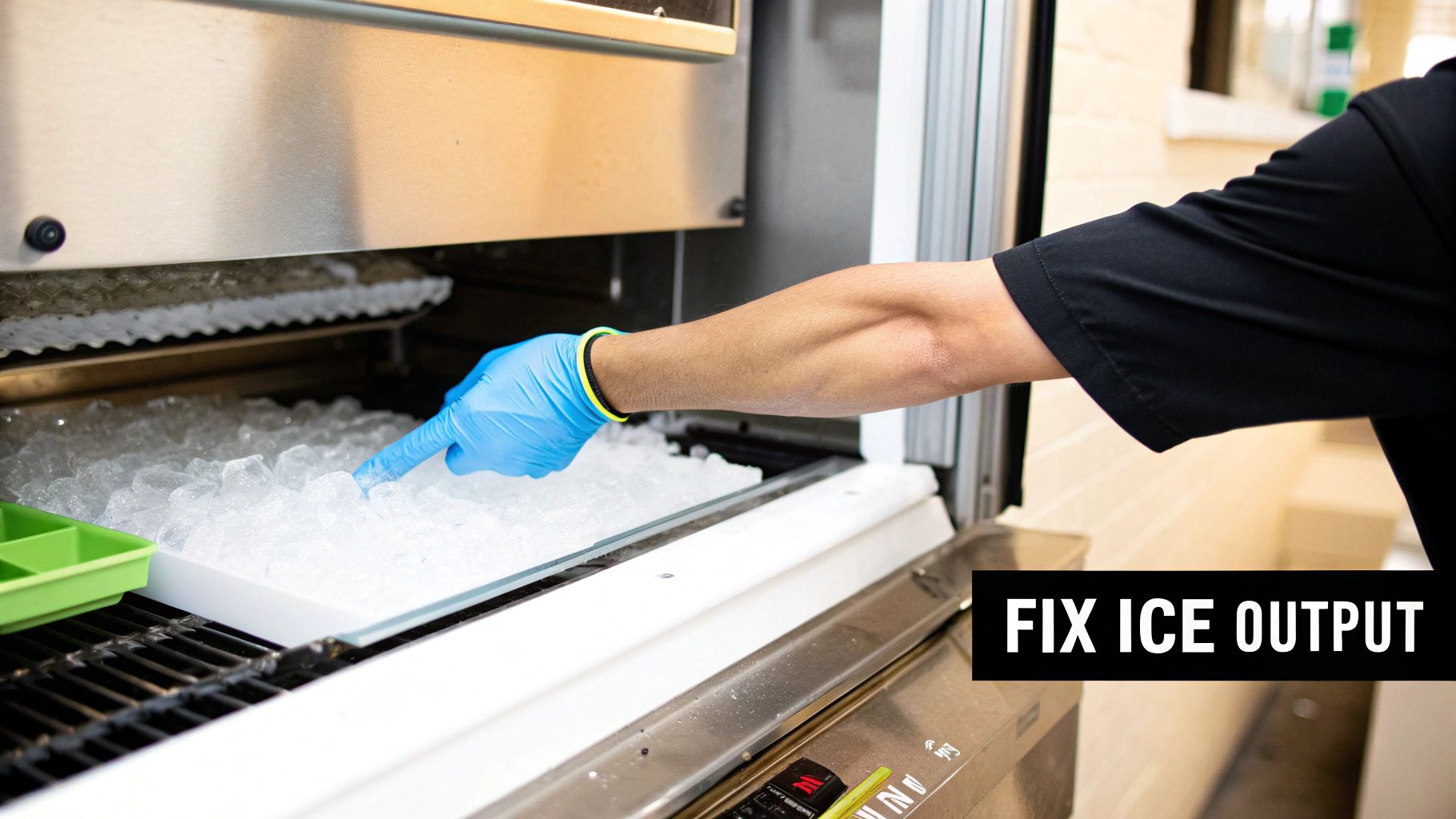
This part of Manitowoc ice maker troubleshooting is all about moving from diagnosis to action. A few simple checks can bring a struggling machine back online, giving your kitchen staff the confidence to handle issues as they pop up.
When Your Machine Produces No Ice At All
If your Manitowoc has gone silent and isn't dropping a single cube, the fix is often simpler than you'd think. Before you panic about a major mechanical failure, start by checking the basics that control the ice-making cycle.
First things first, make sure the water supply is on and the filter isn't clogged. An ice machine without water is just a noisy box. Next, take a look at the water curtain. This plastic sheet has a tiny magnet that tells the control board it's closed, giving the green light to start making ice. If it's stuck open, cracked, or just knocked out of place, the machine will wait forever.
Also, get a look at the evaporator plate—the grid where water freezes into cubes. If it's caked in scale or slime, it can't get cold enough to do its job, which brings the whole process to a halt. A clean evaporator is absolutely critical.
Tackling Slow Production and Poor Ice Quality
A machine that can't keep up during a Los Angeles heatwave or a packed Saturday night is a major drag. If production has slowed to a crawl or the ice is small, cloudy, or hollow, the problem is usually tied to airflow and water flow.
Start by checking the air filter and condenser coils on your air-cooled unit. In a busy kitchen, these get coated in grease and dust, basically choking the machine and preventing it from cooling down the refrigerant. Clean filters and coils are a must for good performance.
Commercial ice machines are notorious for refrigeration issues, often stemming from simple maintenance oversights. In fact, they were identified as the root cause in 8-10% of all service calls in major US markets like Los Angeles. Common culprits include dirty condensers blocking airflow, low water pressure, or high inlet water temperatures, all of which can lead to incomplete ice cubes or safety shutdowns.
Another key part to inspect is the ice thickness probe. This small metal sensor tells the machine when the ice is ready to be harvested. If it gets dirty with scale or gets bumped out of alignment, it starts sending bad signals. This can make the machine harvest too soon (giving you thin, hollow ice) or too late (slowing down production).
Practical Fixes for Inconsistent Ice Cubes
When your restaurant relies on perfect ice—whether it’s crystal-clear cubes for cocktails in a Mexican restaurant or solid ice for Thai iced tea—inconsistent quality is a deal-breaker. Here’s what to check.
- Cloudy Ice: This is almost always a dead giveaway for impurities in the water or a dirty machine. Make sure your water filter is doing its job and run a full cleaning and sanitizing cycle.
- Hollow or Small Cubes: This usually points to a lack of water during the freeze cycle. Look for a water inlet valve that's partially clogged or a weak water pump that isn’t pushing enough water over the evaporator.
- Ice Sheet Sticking During Harvest: If you hear the ice slab trying to drop but it just won't let go, you're probably dealing with heavy scale buildup on the evaporator plate. The mineral deposits act like glue. The only fix is a descaling cycle with a nickel-safe cleaner.
By working through these checks, you can handle many of the most common ice production problems on your own. For a wider look at these issues, take a look at our guide on commercial ice maker troubleshooting for more tips.
How Your Los Angeles Environment Affects Your Ice Maker
Your restaurant's environment is a massive factor in how well your ice machine performs, and let's be honest, Los Angeles can be unforgiving. The challenges operators face here—from a sweltering Thai Town kitchen to a packed food truck in the San Fernando Valley—put a unique kind of strain on commercial equipment. A Manitowoc ice maker isn't just a machine; it's a workhorse, and its surroundings will make or break it.
The most obvious villain is the Southern California heat. High ambient air temperatures will slash your daily ice output and force the compressor to work dangerously hard. An air-cooled machine needs the surrounding air to cool its condenser, and when that air is already hot, the whole system struggles to keep up.
Think about it: a Manitowoc unit rated to produce 600 pounds of ice a day might only give you half of that during a brutal summer heatwave. This isn't a mechanical failure; it's the machine reacting directly to its environment.
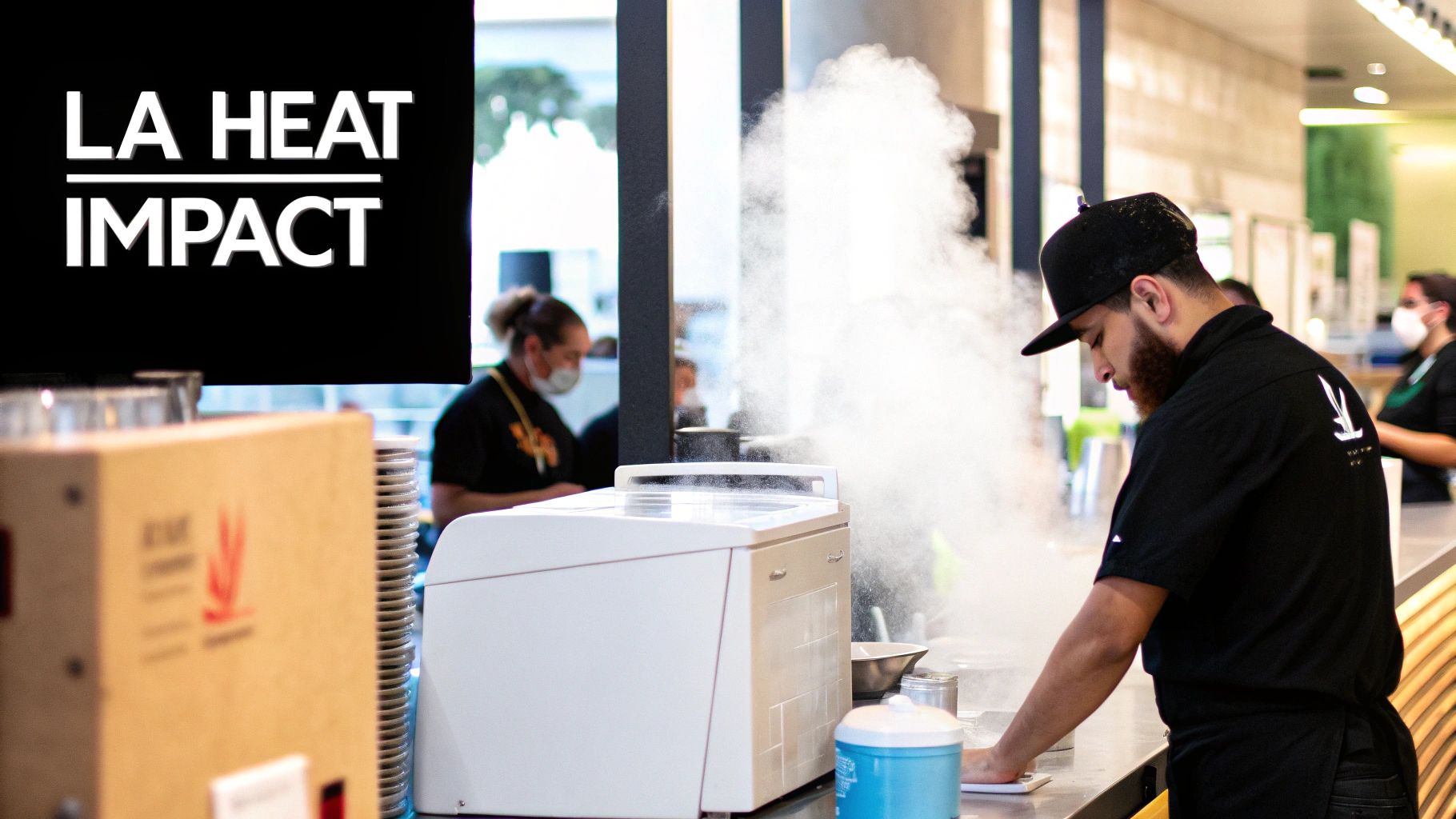
The Battle Against Heat and Poor Ventilation
For air-cooled ice makers, which are what you'll find in the vast majority of LA kitchens, proper ventilation is non-negotiable. Shoving one of these units into a tight cabinet or a corner with no room to breathe is just asking for trouble. The machine ends up sucking in its own hot exhaust, leading to overheating, less ice, and eventually, a dead compressor.
Your ice maker is like an athlete—it needs to breathe to perform. That's why your kitchen layout is so crucial for Manitowoc ice maker troubleshooting:
- Give It Space: Always leave at least six inches of clearance on all sides that need airflow. This is the bare minimum to let cool air in and hot air out.
- Location, Location, Location: Don't put your ice maker right next to a fryer, range, or convection oven. The radiant heat from that equipment will cook your machine.
- Think About Airflow: A cramped, hot kitchen with bad ventilation will choke any air-cooled equipment you have, from your commercial refrigerators to your ice machine.
High temperatures are a constant battle for L.A. restaurant operators, and it's shocking how much they can impact your ice production. Here’s a quick look at how rising air and water temperatures can tank your Manitowoc’s daily yield.
Ambient Temperature Impact On Daily Ice Production
| Air Temperature (°F) | Water Temperature (°F) | Estimated Daily Ice Production (% of Max) |
|---|---|---|
| 70 | 50 | 100% |
| 80 | 60 | 90% |
| 90 | 70 | 78% |
| 95 | 75 | 65% |
| 100 | 80 | 55% |
As you can see, a hot kitchen can easily cut your ice production in half. This is vital info for anyone trying to get through a summer service rush.
Manitowoc ice machine production plummets with temperature swings, a critical stat for L.A. restaurant operators juggling coastal heat waves. Take the IDF-0600A air-cooled model: it can produce a maximum of 632 lbs of dice ice per 24 hours at an ideal 50°F water and 70°F air temperature. However, at a more realistic 90°F air temperature, that output drops by over 50%. You can explore more about how ambient conditions impact performance in these detailed production guides.
Tackling Southern California's Hard Water Problem
Besides the heat, Los Angeles is famous for its hard water. The high concentration of minerals like calcium and magnesium might not be bad for you, but it’s a killer for ice machines. As water freezes on the evaporator plate, those minerals get left behind, forming a crusty layer called scale.
This scale buildup acts like a blanket, making it harder for the evaporator to get cold enough to make ice efficiently. Over time, it causes all sorts of problems, from slow production and hollow cubes to complete harvest failures where the ice sheet just won't let go.
To fight this, a good water filtration system isn't just a nice-to-have—it's essential. Installing a dedicated scale-inhibiting filter for your ice machine is one of the smartest investments you can make. It protects your restaurant equipment and guarantees you’re serving clean, high-quality ice, whether it's for boba in a San Gabriel Valley cafe or margaritas in a downtown Mexican restaurant.
Your Essential Preventive Maintenance Checklist
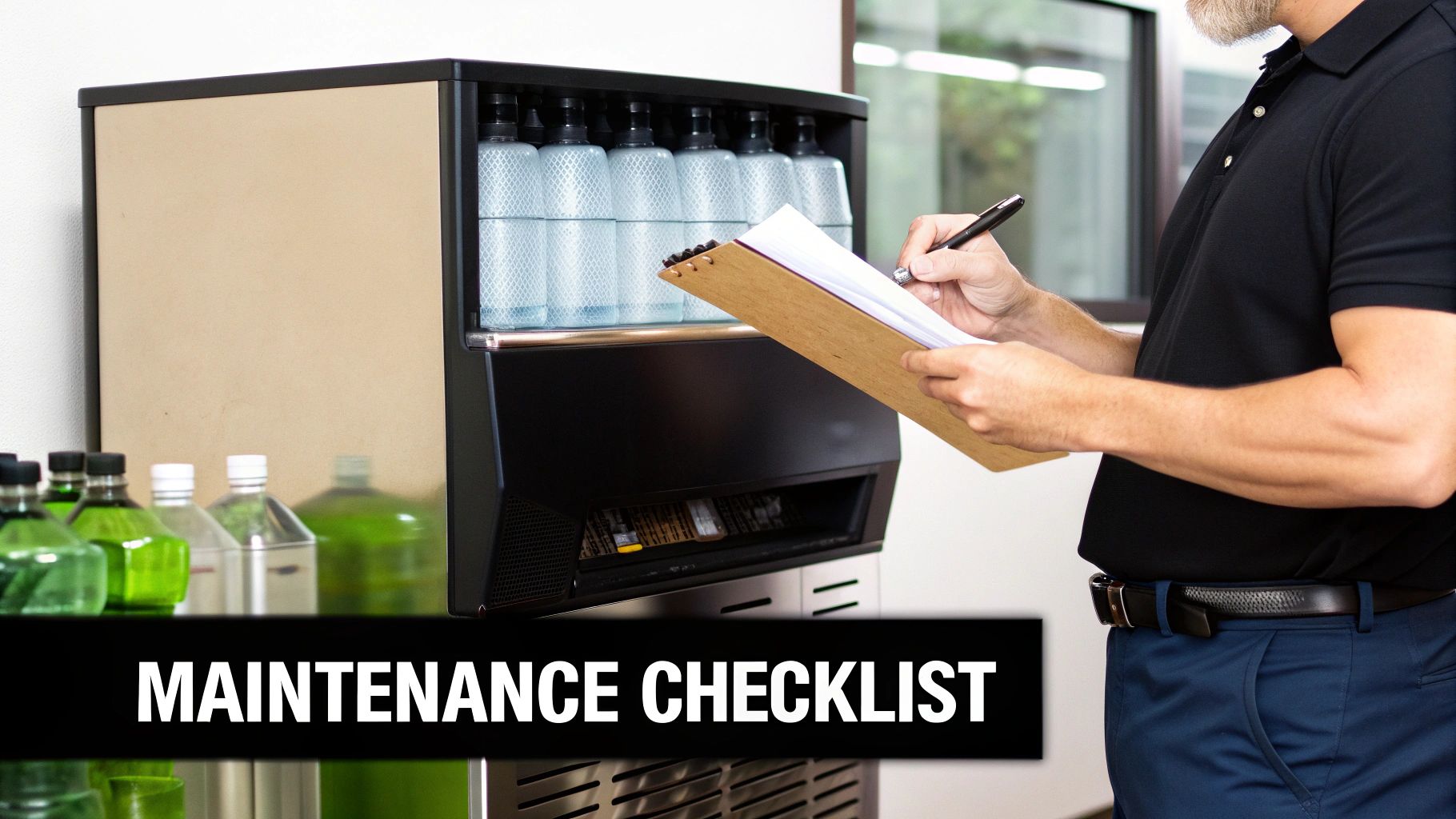
Let's be honest, the best way to handle Manitowoc ice maker troubleshooting is to make sure you never have to do it. A little preventive care goes a long way in avoiding the panic of a dead machine during a dinner rush, especially in a demanding Los Angeles restaurant. A simple, consistent maintenance schedule is your best defense, protecting your investment and keeping the health inspector happy.
This isn't just about preventing a breakdown; it's about the quality of your ice and the efficiency of your machine. Whether you're running a high-volume Hollywood kitchen or a busy food truck, a steady supply of clean ice is non-negotiable. Think of regular maintenance as a huge return on investment—it saves you from emergency service calls and adds years to your machine's life.
Daily and Weekly Checks
Your kitchen staff can be your first line of defense. These quick, simple checks can spot a small problem before it spirals into a major headache, and they only take a few minutes.
Daily Habits (Less than 5 minutes):
- Visual Bin Inspection: Take a quick peek inside the ice bin at the start of every shift. Look for any foreign objects, slime, or mold. Make sure the scoop is clean and stored in its proper holder, not buried in the ice.
- Check Ice Quality: Glance at the first few batches of ice coming out. Are the cubes clear and solid? If they look cloudy or feel hollow, that’s an early warning that something is off.
Weekly Tasks (10-15 minutes):
- Wipe Down Exterior Surfaces: Grab a food-safe stainless steel cleaner and wipe down the outside panels and door. It keeps your kitchen looking professional and hygienic.
- Inspect and Clean Air Filters: On air-cooled models, these filters are crucial. Slide them out and give them a good wash with warm, soapy water. A dirty, clogged filter is one of the top reasons a machine overheats and production slows to a crawl.
Monthly and Semi-Annual Routines
Deeper cleaning is where you really fight back against long-term wear and tear, especially with LA's notoriously hard water. These routines focus on the internal parts doing all the heavy lifting.
A well-maintained Manitowoc evaporator, with its nickel-plated copper core, can easily last for 20+ years. But if you skip the cleaning and descaling, that lifespan can get cut down dramatically, leading to poor ice quality and some seriously expensive repair bills.
Do yourself a favor and set a recurring reminder on your calendar for these tasks. It’s a small bit of admin work that pays off big time in reliability.
Deeper Cleaning and Inspections
These steps are more involved, but they're absolutely critical for tackling the unique environmental challenges we see here in Southern California.
Monthly Maintenance:
- Run a Full Cleaning Cycle: Use a Manitowoc-approved, nickel-safe ice machine cleaner to run a complete cleaning cycle. This is what flushes out all the slime and organic gunk from the internal water system.
- Inspect Water Lines: Look around the back of the machine at all the water connections. Check for any drips or signs of a leak. Even a slow drip can cause water damage over time.
Semi-Annual Maintenance (Every 6 Months):
- Descale the Machine: This is non-negotiable in Los Angeles. Hard water scale is the enemy; it builds up on the evaporator and chokes the machine's ability to freeze and harvest ice efficiently. Use a nickel-safe descaler to dissolve all those mineral deposits.
- Clean the Condenser Coil: Even with clean filters, the condenser coil on your machine will get dusty. A professional should carefully clean the delicate fins to ensure it can get rid of heat properly.
If you want a full walkthrough of the cleaning process, you can learn more about how to clean a Manitowoc ice maker in our detailed guide. Following this checklist turns maintenance from a reactive chore into a proactive strategy, keeping your machine running smoothly day in and day out.
Answers to Your Top Manitowoc Troubleshooting Questions
When you're in the middle of a dinner rush, the last thing you need is your ice machine giving you trouble. Los Angeles restaurant owners often have the same questions when trying to diagnose their Manitowoc units. Here are some straightforward answers to get you back up and running.
Why Did My Ice Machine Suddenly Get So Loud?
A sudden change in noise is a clear signal that something's off. On air-cooled units, the first thing to check is the fan motor—failing bearings are a common source of new, loud sounds. Another potential issue is the water pump, which might start to rattle or whine if it's struggling or clogged with mineral deposits.
If you hear a loud clank during the harvest cycle, that often means the ice slab is struggling to slide off the evaporator plate. That's a classic symptom of scale buildup, a constant battle given Southern California's hard water.
Are Most of These Problems Something I Can Fix Myself?
Absolutely. Many of the most common hiccups are things you can handle in-house. A clogged water filter, a dirty air condenser, or even a water curtain that's out of alignment are usually simple fixes that just require some basic cleaning and a few adjustments. The best way to manage these is to catch them early with a regular maintenance routine.
But you have to know when to draw the line. If you suspect a problem with the refrigeration system, like a refrigerant leak or a bad compressor, it’s time to call in a professional. Same goes for complex electrical parts like the control board. Trying to fix those without the right tools and training can lead to much bigger, more expensive problems—or even create a safety hazard.
How Often Do I Really Need to Clean My Machine?
In a busy Los Angeles kitchen, you can't skip the cleaning schedule. Your ice machine needs a full cleaning and sanitizing cycle at least every six months. This means running it through with a Manitowoc-approved, nickel-safe cleaner and then a sanitizer.
With the right care and consistent maintenance, the nickel-plated copper evaporator—which is the heart of your machine—can easily last for 20+ years. If you skip these essential cleaning and descaling steps, you can drastically shorten its lifespan and end up with some very costly repair bills.
On top of that, the air filter on air-cooled models should be cleaned weekly, and the outside of the machine should be wiped down daily. Because LA's water is so hard, descaling the machine every six months is non-negotiable if you want to prevent performance-killing mineral buildup.
What’s the Difference Between Cleaning and Descaling?
This is a really important point. Cleaning and descaling are two completely different jobs that tackle two different problems.
- Cleaning: This uses a solution to get rid of slime, mold, and other organic gunk that can build up in the water system. It’s all about food safety and hygiene.
- Descaling: This uses a different, acid-based solution to break down and dissolve mineral deposits (scale) that hard water leaves behind. This is all about mechanical performance.
You have to do both. A machine can look perfectly clean inside but still be choked with invisible scale on the evaporator, making it run hard and produce less ice. Always run these as two separate cycles, and never, ever mix the two chemicals.
For all your commercial kitchen needs, from reliable Atosa commercial refrigerators and freezers to the essential smallwares that keep your line moving, Los Angeles Restaurant Equipment is here to support your success. We offer competitively priced, professional-grade equipment with free freight delivery and flexible financing options designed for the LA foodservice community. Explore our full catalog and get the gear you need to thrive.
Find your next essential piece of equipment at https://losangelesrestangelesrestaurantequipment.com.