

Choosing Under Counter Fridge Sizes for LA Restaurants
When you're outfitting a commercial kitchen in Los Angeles, you quickly learn that standard under counter fridge sizes usually fall between 24 to 72 inches wide. They're almost always between 34 and 36 inches tall, designed specifically to slide right under most commercial countertops. Nailing these measurements is the first step to a kitchen that just works, whether it's in a food truck or a high-end restaurant.
Matching Your Kitchen with the Right Undercounter Fridge
In the always-on Los Angeles food scene, every square inch of your kitchen is prime real estate. Whether you're running a busy Koreatown BBQ spot, a tight taco food truck in Venice Beach, or a high-volume Japanese restaurant, picking the right restaurant equipment can make or break your service. An undercounter refrigerator is more than just a place to keep things cold; it's a key part of your kitchen's flow.
The right size means you can store ingredients where you need them, cut down on prep time, and keep the line moving during a dinner rush. A unit that's too small will have your team constantly running to the walk-in freezer, while one that’s too big is just a waste of valuable space and electricity. Think of this guide as your blueprint for navigating the world of commercial refrigerators and freezers.
Key Considerations for LA Kitchens
Before you even pull out the tape measure, it’s worth thinking about how a new commercial refrigerator will fit into your daily grind. For any LA restaurant owner, the choice is about more than just dimensions.
- Optimizing Workflow: Where you put your fridge directly impacts how fast your cooks can build a plate. A well-placed unit cuts down on wasted steps and keeps your kitchen from getting congested.
- Maximizing Storage: From fresh produce for Thai curries to marinated meats for Mexican al pastor, your fridge has to hold what your menu demands, all within a small footprint.
- Boosting Service Speed: When your team can grab chilled ingredients in a second, ticket times get shorter and customers stay happy—something you can't afford to compromise on in LA.
Picking the right under counter fridge sizes is really about aligning your restaurant equipment with how you want your kitchen to run. This decision is a core part of an effective commercial kitchen layout and design, making sure every piece of the puzzle works together to help your business succeed.
Getting a handle on the common dimensions is the foundation for building a smarter, more efficient kitchen. Let's break down what those sizes look like in the real world.
Standard Undercounter Fridge Dimensions at a Glance
To make things easier, here’s a quick look at the most common commercial undercounter refrigerator sizes you'll find on the market. This table should help you quickly see which category might be the best fit for your available space.
| Category | Typical Width (Inches) | Typical Depth (Inches) | Typical Height (Inches) | Common Use Case |
|---|---|---|---|---|
| Compact Single-Door | 24" - 30" | 24" - 30" | 34" - 36" | Bar back, prep station, Los Angeles food trucks |
| Standard Two-Door | 48" - 60" | 24" - 32" | 34" - 36" | Main cookline, salad/sandwich prep, restaurant bar |
| Large Three-Door | 60" - 72" | 24" - 32" | 34" - 36" | High-volume kitchens, large prep areas, pizza shops |
| Shallow Depth | 24" - 72" | 22" - 24" | 34" - 36" | Tight spaces, narrow walkways, front-of-house areas |
Remember, these are the industry standards. You'll always want to check the manufacturer's spec sheet for the exact dimensions before making a purchase, but this gives you a great starting point for planning your layout.
Decoding Dimensions and Usable Capacity
When you're staring at a spec sheet for an undercounter fridge, the numbers can feel a little abstract. But for a Los Angeles restaurant owner, those dimensions are everything. They tell you exactly how many fresh ingredients you can prep for your signature Thai green curry or how many local craft beers you can chill for the Friday night rush. It’s not just about the space the unit takes up—it’s about the real, usable space inside.
Think of it like parking a Los Angeles food truck. The truck itself has to fit in a specific spot, but it’s the layout inside that determines how much product you can actually serve. An undercounter refrigerator works the same way. The external dimensions—width, depth, and height—have to fit your kitchen’s floor plan, but the internal cubic footage is what really brings value to your operation.
From Width to Doors to Drawers
The most common widths for commercial units are 24", 36", 48", 60", and 72". That number usually dictates what kind of door setup you’re getting:
- 24" - 36" Units: These typically come with a single door. They're perfect for a small prep station or tucked behind a bar.
- 48" - 60" Units: You’ll usually find a two-door setup here, which is great for keeping different types of ingredients separate.
- 60" - 72" Units: These are the big guys, often with three doors to provide maximum storage for a high-volume kitchen.
But the inside isn't just an empty box. The compressor's location can eat into your storage room, and choosing between doors and drawers completely changes how your team works. Drawers are fantastic for organizing pre-portioned items in a Koreatown BBQ spot, while doors give you the flexibility to store larger containers of Mexican salsa or kimchi.
The goal is to match the refrigerator's internal design to your menu's needs. A unit with the perfect external dimensions is useless if the inside can't support your workflow during a busy service.
This diagram breaks down the essential dimensions that define every under counter fridge.
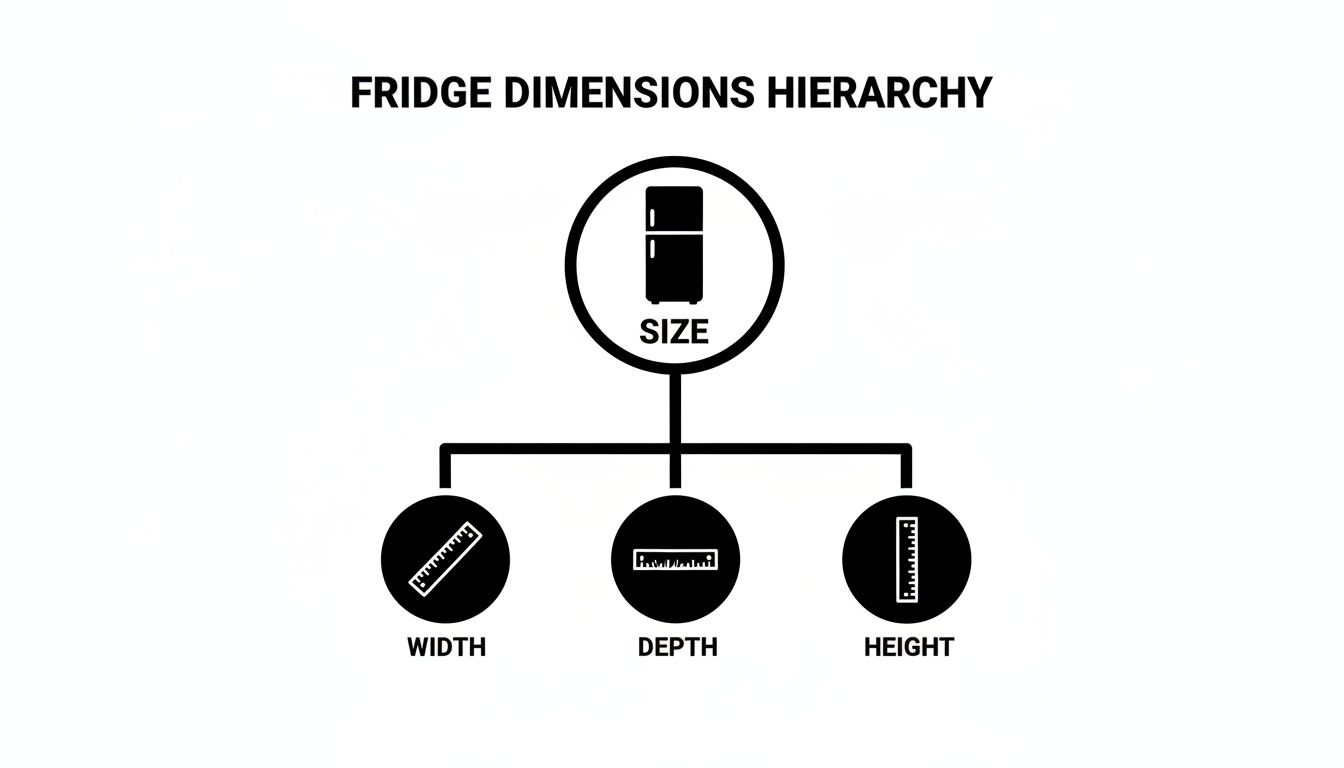
As you can see, the overall size is a product of its width, depth, and height. Each one plays a critical role in how the unit will fit and function in your kitchen.
Finding the Sweet Spot in Capacity
For most restaurant managers, it all comes down to balancing the unit's footprint with how much it can hold. In fact, models that offer 5-10 cubic feet of space are the industry gold standard, making up about 50% of revenue in 2024. These mid-sized units are the workhorses of the industry.
They're often around 24 inches wide by 24 inches deep, designed to slide perfectly under standard counters. Common widths like 38.1 cm, 45.7 cm, or 61 cm match the cutouts you’ll find in most LA kitchens.
Ultimately, understanding the link between a fridge’s outside dimensions and its inside capacity is what helps you make a smart investment. When you look past the basic measurements, you can choose the perfect undercounter refrigerator that will genuinely support your day-to-day operations and keep your kitchen running smoothly.
How to Measure Your Kitchen for a Perfect Fit
A simple measurement mistake can turn into a huge headache. We’re talking costly returns, frustrating project delays, and renovations you didn't plan for. In a fast-paced Los Angeles kitchen, there's no room for error. This checklist will make sure you get it right the first time, whether you're outfitting a historic downtown spot or a brand-new food truck.
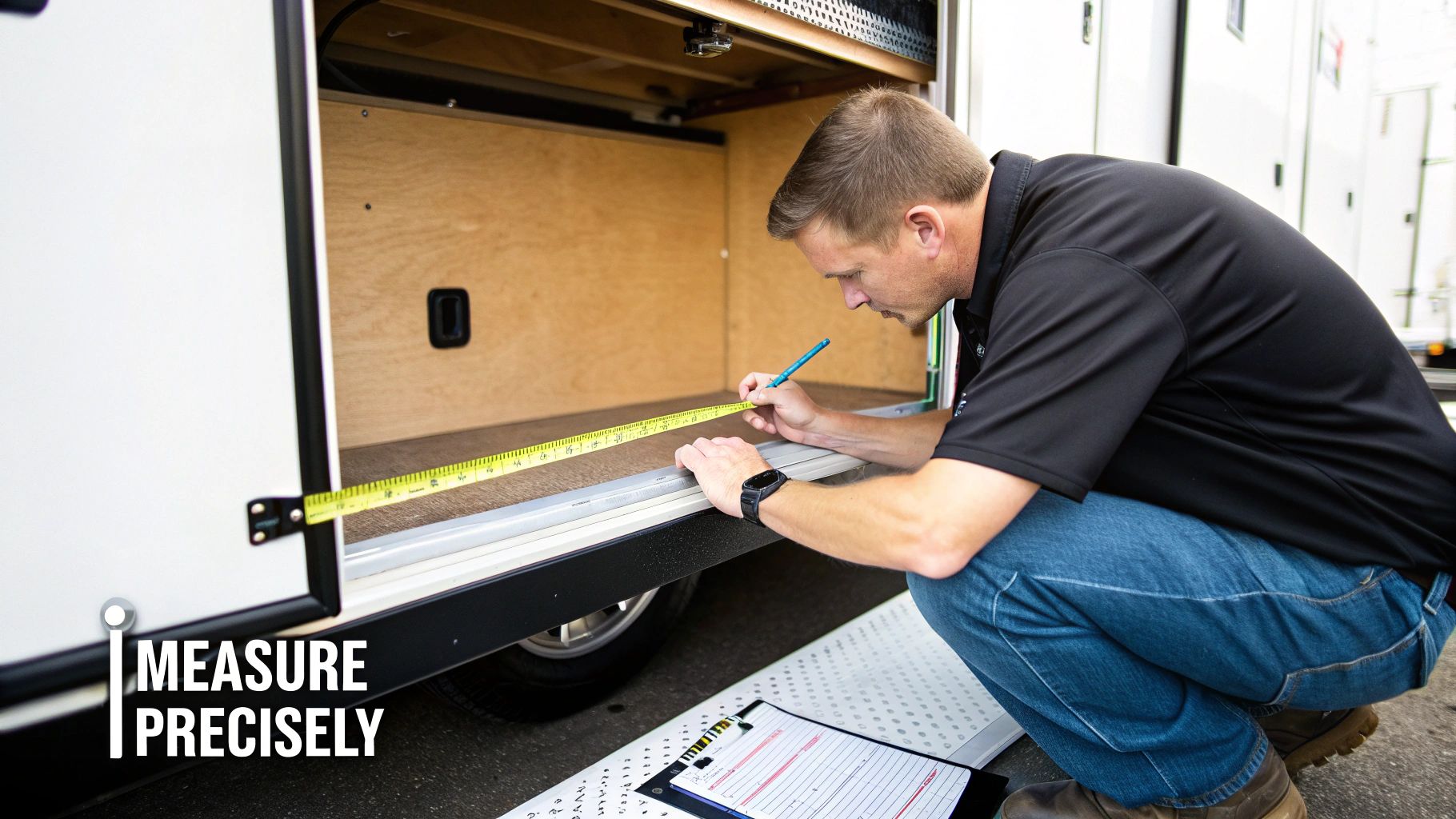
Nailing the basic width, height, and depth of the cutout is just step one. The real secret to a smooth installation is thinking about all the little details that are so easy to miss.
Beyond the Basics: A Measurement Checklist
To get that perfect fit, this essential kitchen appliance buying guide is a great resource that stresses just how important accurate measurements are. Always follow the "measure three times" rule. Measure the height, width, and depth once at the front of the opening, again in the middle, and a final time at the back. This simple step accounts for any quirks in the walls or flooring, which is a common problem in many older L.A. buildings.
Use this checklist to guarantee a smooth installation:
- Ventilation Clearance: First things first, check the spec sheet. Rear-breathing units absolutely need 2-4 inches of open space behind them for proper airflow. If you’re working with a tight, fully enclosed space, a front-breathing model is your best bet.
- Door Swing Radius: Think about the flow of your kitchen. In a narrow galley or a food truck, will the fridge door swing open without blocking a walkway or smacking into other restaurant equipment? Measure the door's full arc before you buy.
- Delivery Pathway: This is the one everyone forgets. Can you physically get the unit into the kitchen? Measure every doorway, hallway, and tight corner on the path from the delivery truck to its final home.
- Utility Locations: Find the exact spot of your electrical outlets and any plumbing connections. You need to make sure the unit’s power cord can reach the outlet easily. Using an extension cord is often a health code violation, so don't even think about it.
Accounting for LA's Unique Kitchens
Kitchens in Los Angeles have their own special challenges. A food truck is a puzzle of tight constraints where every single millimeter matters. On the other hand, a historic building might have beautiful character but floors that are anything but level.
A successful installation isn't just about making the unit fit the hole; it's about making it work within the dynamic environment of your kitchen. Overlooking something as simple as floor level can cause performance issues down the line.
Before you make that final purchase, grab a level and check the installation area. If the floor has a slope, you’ll need to plan on adjusting the unit’s feet to make it sit perfectly level. This is non-negotiable—it’s crucial for the compressor to run efficiently and for the doors to seal tight, which prevents energy waste and keeps your food safe. A little foresight here can turn a stressful installation day into a simple, straightforward upgrade.
Sizing Your Fridge for LA's Diverse Food Scene
In Los Angeles, the right kitchen equipment isn't just another item on a list—it's a core part of your business strategy. A one-size-fits-all approach to undercounter fridges just won't cut it when you're navigating LA's wild and wonderful culinary landscape. The perfect unit for a slammed Downtown LA bar is worlds away from what a Thai street food truck needs to keep things flowing.
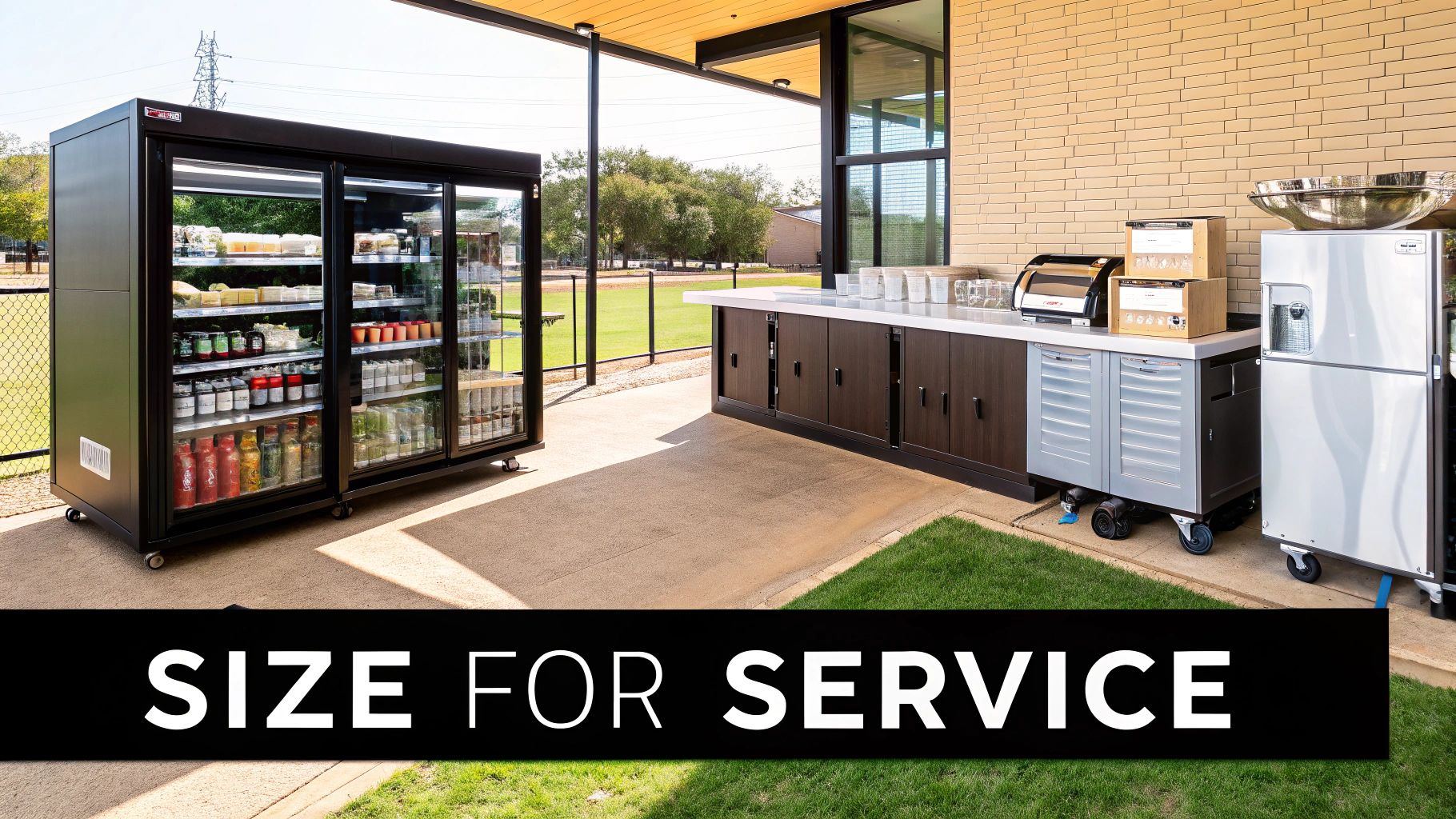
By looking at a few real-world scenarios, you can get a better feel for how different dimensions and features directly impact how smoothly your kitchen runs. This helps you think beyond the spec sheet and pick a commercial refrigerator that truly handles the demands of your menu, volume, and unique space.
The High-Volume Downtown Bar
Picture a buzzing bar in the heart of Downtown LA on a Friday night. Speed is everything. Bartenders are in constant motion, grabbing craft beers, mixers, and garnishes. For this kind of environment, a 60-inch or 72-inch three-door glass merchandiser is the only way to go.
- Glass Doors: Staff can spot what they need instantly without opening anything, saving precious seconds and keeping the cold air in during a relentless rush.
- High Capacity: A wider unit gives you plenty of room for a diverse drink selection, meaning fewer trips to the main walk-in cooler or freezer to restock.
- Workflow Integration: Placed right under the bar, it becomes the command center for drink service, making every single order faster from start to finish.
The Compact Thai Food Truck
Now, let's switch gears to one of the many Los Angeles food trucks, perhaps one parked in a busy lot, slinging authentic Thai or Chinese food. Here, space is the ultimate luxury, and every square inch has to count. A 24-inch or 36-inch single-door unit with drawers is the smart play.
This kind of setup is perfect for holding prepped ingredients like chopped lemongrass, chilies, and fresh herbs, all neatly organized in food pans. The drawers give you immediate, organized access, which is an absolute game-changer for building dishes quickly in a tight space. This compact size lets the operator create an efficient prep station without eating up floor space needed for other essential cooking gear.
Choosing the right restaurant equipment from day one is fundamental to your success. For a full rundown of what you'll need, our commercial kitchen equipment checklist offers a solid starting point for any new or existing food service business in Los Angeles.
The Specialized Sawtelle Japanese Restaurant
Finally, think about a full-service Japanese restaurant over in Sawtelle, where precision and freshness are non-negotiable. This kind of spot often needs multiple, specialized cooling stations to protect the integrity of different ingredients. It’s not about one big commercial refrigerator, but several smaller ones placed strategically.
A sushi station would thrive with a dedicated 48-inch two-door undercounter refrigerator to keep pristine cuts of fish. The tempura station might have its own 24-inch unit for vegetables and seafood, while the appetizer line uses another for prepped salads and sauces. This distributed approach keeps ingredients at their ideal temperature right where they're needed, supporting both food safety and the high-quality standards that Japanese cuisine is famous for.
Dodging Common Installation and Spec Sheet Headaches
You’ve done the hard work—you measured your space and found a unit that fits your Los Angeles restaurant’s needs. But the last step is where things can go sideways if you're not careful. Making sure the installation goes off without a hitch is critical, and that starts with understanding the spec sheet for your restaurant equipment.
Think of the spec sheet not just as a list of dimensions, but as the instruction manual for your refrigerator's long, happy life. The details in there are what separate a smooth setup from a costly disaster. For example, knowing where the compressor is located tells you everything about where it can live. A rear-breathing model needs a few inches of breathing room behind it, while a side-breathing unit needs space on its flank. If you're outfitting a tight LA food truck, a front-breathing model is your best friend—it can be pushed right up against a wall without breaking a sweat.
Reading Between the Lines on a Spec Sheet
Beyond the basics, the spec sheet holds a few other non-negotiable details that can make or break your kitchen’s flow. Getting these right from the start saves you from day-one emergencies.
- Electrical Needs: Always check the NEMA plug type. There's nothing worse than discovering your unit requires a special plug that your standard wall outlet can't handle. That mistake means an expensive, last-minute call to an electrician.
- Refrigerant Type: Look for modern, efficient refrigerants like R290. It’s a natural hydrocarbon with a low environmental impact that also helps lower your electricity bill—a welcome bonus in sunny LA.
- Leveling and Airflow: Those old downtown buildings often come with uneven floors, which can stop your refrigerator door from sealing properly. When that happens, the compressor works overtime. Always use a level to adjust the unit's feet. Also, make sure nothing is blocking the grilles; obstructed airflow is one of the top reasons for overheating in a busy commercial kitchen.
A solid warranty is your ultimate safety net. It’s the manufacturer's way of saying they stand behind their product, and for you, it’s peace of mind.
Why a Strong Warranty Matters
Dropping a chunk of change on new restaurant equipment is a big deal, especially when you consider the global undercounter refrigerator market hit a massive USD 3.42 billion in 2024. That figure is expected to jump to USD 6.27 billion by 2033, which just shows how essential these workhorses are. This growth is a perfect reason for restaurant owners to protect their investment by upgrading to reliable commercial refrigerators and freezers like those from Atosa, available right here at Los Angeles Restaurant Equipment. You can learn more about these market trends and what they mean for your business.
A great warranty means you're not on your own if something goes wrong. For instance, Atosa products come with a two-year parts and labor warranty and a five-year compressor warranty. That kind of coverage gives you access to a network of professionals who can get you back up and running fast, saving you from costly downtime and protecting your bottom line.
Frequently Asked Questions About Undercounter Fridge Sizes
Outfitting a new restaurant in Los Angeles means asking a lot of questions about restaurant equipment. Getting the right undercounter fridge can feel tricky, but figuring out the specs is key to making sure your new unit helps your kitchen flow instead of getting in the way. We get a lot of the same questions from LA restaurant and food truck owners, so let's clear them up.
What Is the Standard Height of an Undercounter Fridge?
Most commercial undercounter refrigerators are made to slide right under a standard 36-inch high countertop. To make that happen, the units themselves are usually between 34 and 35.5 inches tall.
That little bit of extra space is on purpose. It gives you just enough room for proper airflow and makes installation way easier. It’s a good idea to measure your counter height in a few different spots—from the floor to the bottom of the counter—to catch any uneven spots, which is pretty common in LA buildings. Always look at the manufacturer’s spec sheet for the exact height and how much clearance they recommend.
How Much Ventilation Space Does an Undercounter Fridge Need?
Giving your commercial refrigerator room to breathe is a must if you want it to run efficiently and last a long time. The space you need depends on the model, especially if it’s a front-breathing or rear-breathing unit.
- Front-Breathing Models: These are perfect for tight, built-in spaces. They pull and push air through the front grille, so they don’t need much space on the sides or back.
- Rear-Breathing Models: These units usually need at least 2-4 inches of open space at the back and on the sides to let air circulate properly.
If you don't leave this space, the compressor can overheat, which will jack up your energy bills and could lead to a breakdown right in the middle of a dinner rush. Check the installation manual for the specific guidelines.
Can I Use a Residential Undercounter Fridge in My Restaurant?
Putting a residential fridge in a commercial kitchen is a really bad idea and almost always a health code violation. Commercial refrigerators, like the ones from Atosa, are built tougher with powerful compressors and stronger materials to handle the heat and constant use of a pro kitchen.
They get back down to a safe, cold temperature much faster after the door has been opened, which is crucial for food safety when you’re busy. Plus, using a home unit for business will void the warranty instantly, leaving you high and dry if something goes wrong.
For more general advice on refrigerators that goes beyond just size, you can find answers to common refrigerator questions.
How Do I Choose Between Doors and Drawers?
The choice between doors and drawers really just comes down to your kitchen's workflow and what's on your menu. Neither is better than the other; they just do different jobs.
Doors are great for flexibility and storing bigger, bulky things like bottles, big sauce containers, or large pans of prepped ingredients for Chinese or Mexican food. You can move the shelves around to fit items of all different heights.
Drawers, on the other hand, are all about organization and speed. They are perfect for keeping smaller, portioned items neatly arranged, like on a sandwich prep line in a café or for separating banchan in a Koreatown BBQ spot. Your staff can see everything at a glance without having to bend over, which can seriously speed things up during peak hours in a packed LA kitchen.
Ready to find the perfect undercounter unit for your LA establishment? Los Angeles Restaurant Equipment offers a wide selection of Atosa commercial refrigerators and freezers designed for any kitchen size or workflow. Explore our collection today and get free freight delivery.