

A Practical Guide to Commercial Kitchen Layout Design in LA
Think of your commercial kitchen layout as the engine of your Los Angeles restaurant. It's what drives your speed, keeps things safe, and ultimately, fuels your profitability. A smart design isn't just about where you put the oven; it’s a strategic plan that makes sure your physical space is perfectly in sync with your culinary vision, whether you're running a Thai food spot or a busy Mexican taqueria.
A well-designed layout guarantees a smooth journey from ingredient delivery to the final plate heading out to a customer, setting you up for operational success right from the start.
Matching Your Kitchen Layout to Your LA Concept
The foundation of any great kitchen layout is your restaurant's unique concept. Before you even start browsing for restaurant equipment, you need to nail down the core of your operation. A buzzing Korean BBQ spot in Koreatown has entirely different needs than a high-volume Los Angeles food truck cruising Venice Beach.
Your menu is what really dictates the design. A complex, multi-course Thai menu, for instance, requires very distinct zones for prep, high-heat wok cooking, and careful plating. On the other hand, a streamlined Japanese ramen shop is all about a powerful, linear cooking line and efficient stations for holding broth. Go through every item on your menu—this will tell you exactly what equipment you need and how much room it's going to take up.
Defining Your Service Model and Volume
Next up, you have to get real about your service model and how many people you expect to serve. What does a peak Friday night rush look like for you? The answer to that question will determine the scale of your entire kitchen.
- Quick-Service & Los Angeles Food Trucks: These models are everywhere in LA and live and die by speed. Your layout has to be built for a rapid, assembly-line workflow. That means compact, multi-functional equipment and minimal movement for your staff to pump out orders.
- Full-Service Restaurants: A full-service Chinese restaurant in the San Gabriel Valley needs a more complex setup. It requires enough room for multiple chefs, large prep areas, and a clear separation between the hot line and the expo window to make sure every dish is sent out perfectly.
A well-planned kitchen is more than just a place to cook; it's a financial asset. The global demand for professional kitchen design services hit $20.5 billion in 2023 and is projected to hit $32.8 billion by 2032. This isn't just a trend. It shows that people in the industry get it: a great layout can cut energy use by up to 30% and boost your team's productivity by as much as 50%.
Aligning Equipment with Your Cuisine
The food you serve determines the heart of your kitchen: the cooking line. A Mexican restaurant is going to build its layout around flat-top griddles for tortillas and commercial refrigerators to keep salsas fresh. In the same way, a pizzeria’s entire flow depends on the right oven.
For high-volume pizza spots in LA, knowing the ins and outs of different models is a game-changer. You can take a look at our guide on commercial rotating pizza ovens to see just how much specialized equipment can shape your workflow.
Your kitchen layout needs to be a direct reflection of your LA brand. It should give your team everything they need to execute your vision, whether you’re serving fusion bowls from a food truck or crafting an elegant dining experience.
Kitchen Layouts for Popular LA Restaurant Types
Discover which kitchen layout best supports different Los Angeles restaurant concepts, from high-volume food trucks to fine dining.
| Layout Type | Best For | LA Example Scenario | Key Advantage |
|---|---|---|---|
| Assembly Line | Quick-Service, Food Trucks, Pizzerias | A build-your-own-bowl concept in Santa Monica or a taco truck in East LA. | Maximizes speed and output for simple, repetitive menus. |
| Island | Large, High-Volume Kitchens, Fine Dining | A bustling fine-dining Japanese restaurant in Beverly Hills with multiple chefs. | Creates a central hub for communication and workflow, often for the lead chef. |
| Zone-Style | Full-Service, Hotels, Catering Kitchens | A large SGV Chinese restaurant with dedicated stations for wok, fry, and prep. | Organizes the kitchen by function, preventing bottlenecks and cross-contamination. |
| Galley | Small Spaces, Food Trucks, Cafes | A narrow coffee shop in Silver Lake or a compact Korean food ghost kitchen downtown. | Makes the most of limited space by placing stations along two parallel walls. |
Choosing the right layout from the get-go saves you countless headaches and lost revenue down the line. It's about creating a space where your team can thrive and your concept can come to life efficiently.
Designing a Seamless Workflow with Kitchen Zones
A truly efficient Los Angeles restaurant kitchen has a rhythm. It's a natural, almost choreographed flow that keeps the chaos at bay and gets orders out the door. This rhythm doesn't happen by accident; it's the result of a smart layout built around dedicated zones.
The key is to stop thinking of your kitchen as one big room and start seeing it as a series of interconnected workstations. This approach creates a logical path for food, from the moment ingredients are delivered to the second a finished dish hits the pass. It’s a strategy that cuts down on wasted steps, prevents chefs from bumping into each other during a rush, and seriously reduces the risk of cross-contamination.
Everything starts with your menu and how many customers you expect to serve. Those two factors dictate your entire layout.
This chart breaks down the fundamental steps of the design process, showing how your menu analysis directly informs the final layout.
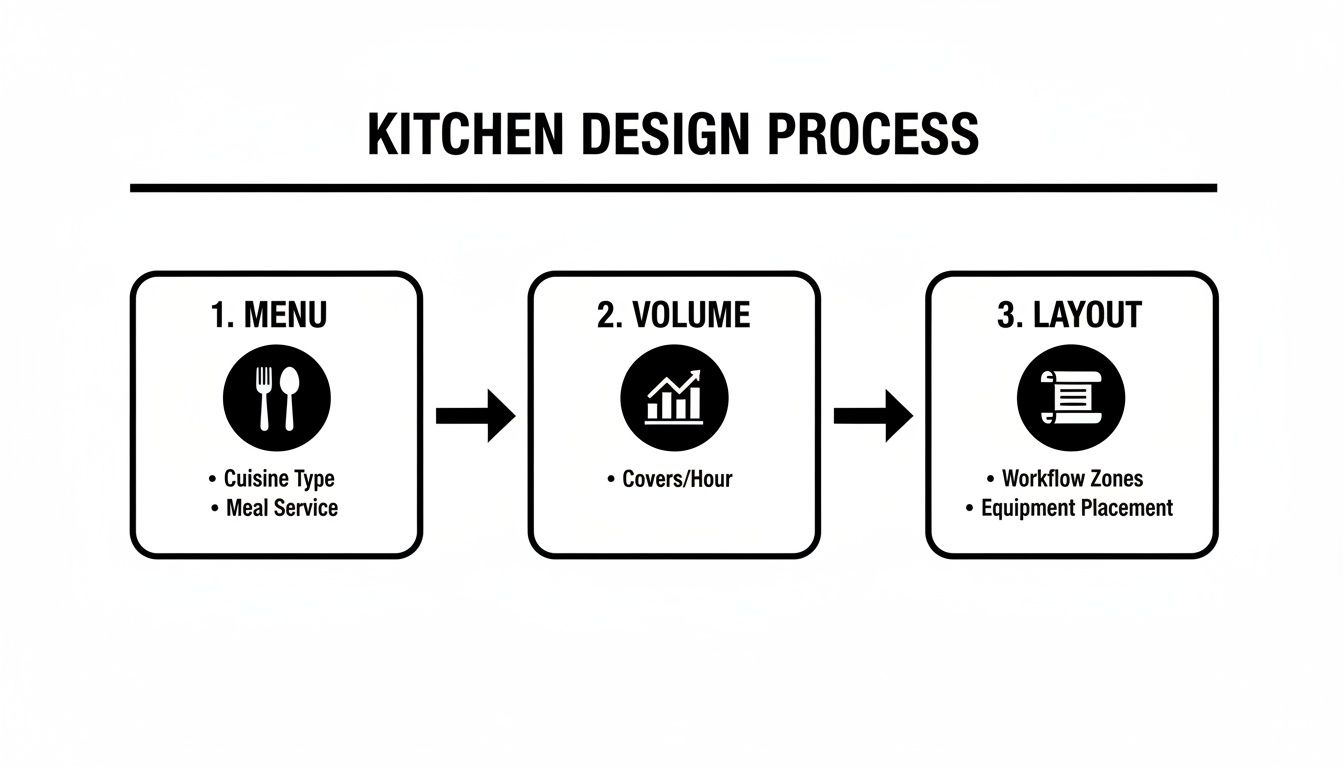
As you can see, a solid design always begins with your food concept, long before any blueprints are drawn.
The Five Critical Kitchen Zones
Every successful kitchen, whether it's a Thai Town favorite or a busy downtown ghost kitchen, is built around five core areas. The real goal is to arrange these zones to mirror the journey your food takes from raw ingredient to finished plate.
- Receiving and Storage: This is where everything starts. It needs to be near your back door for easy deliveries. This zone holds your dry storage shelves and, critically, your cold storage—think walk-in commercial refrigerators and freezers.
- Food Preparation: From storage, raw ingredients move to the prep area. This spot needs plenty of counter space, prep sinks, and specific restaurant equipment like mixers or slicers. You'll often see this broken down even further into "wet" and "dry" or "raw" and "cooked" prep stations.
- The Cooking Line: The heart of your kitchen. This is where the magic happens. The layout of your cooking line—with its ranges, fryers, and griddles—is completely determined by your menu.
- Service and Plating Area: Once cooked, food comes here for final plating and a quality check before it heads to a customer. This area, often called "the pass," has to be easily accessible for both the cooking line and your front-of-house staff.
- Dishwashing Station: To keep things clean and safe, the dish return should be separate from any food prep and cooking areas. It needs a clear workflow for scraping, washing, sanitizing, and air-drying before dishes go back into service.
Zone Design in Action: Two LA Scenarios
How you lay out these zones depends entirely on your concept. A Japanese sushi bar in Little Tokyo, for example, is going to dedicate a huge amount of space to its cold prep and service areas, likely putting them right out front for customers to see. The hot cooking line might be tiny and tucked away in the back, since most of the menu is served cold. The whole workflow revolves around pristine fish moving from specialized commercial refrigerators straight to the sushi chef.
Contrast that with a Korean BBQ spot in K-Town. Its entire layout is focused on the hot line and powerful ventilation. The cooking zone is massive, designed for high-volume grilling. The prep areas are built to handle huge batches of marinated meats and all the banchan (side dishes), which means they need extensive refrigeration and counter space.
Optimizing your kitchen workflow isn't just about making life easier; it's about performance. A well-designed layout can boost a kitchen's operational efficiency by as much as 50%.
Getting your cold storage right is especially important. For most LA restaurants, a reliable refrigeration system is completely non-negotiable. To help you figure out what you need, you can explore our detailed comparison of a walk-in cooler and freezer combination and see how these crucial units can anchor your entire storage zone.
Choosing and Placing Your Restaurant Equipment
The restaurant equipment you choose is the heart and soul of your kitchen. For any Los Angeles restaurant, this means finding tools that not only squeeze into your floor plan but are also a perfect match for your menu.
Think of your equipment as the foundation for every dish you serve. A Chinese restaurant in the San Gabriel Valley absolutely needs high-BTU wok ranges to get that crucial wok hei flavor. Down the road, a Mexican restaurant in East LA is going to lean heavily on large griddles for tortillas and specialized commercial refrigerators built to keep produce and salsas perfectly chilled.
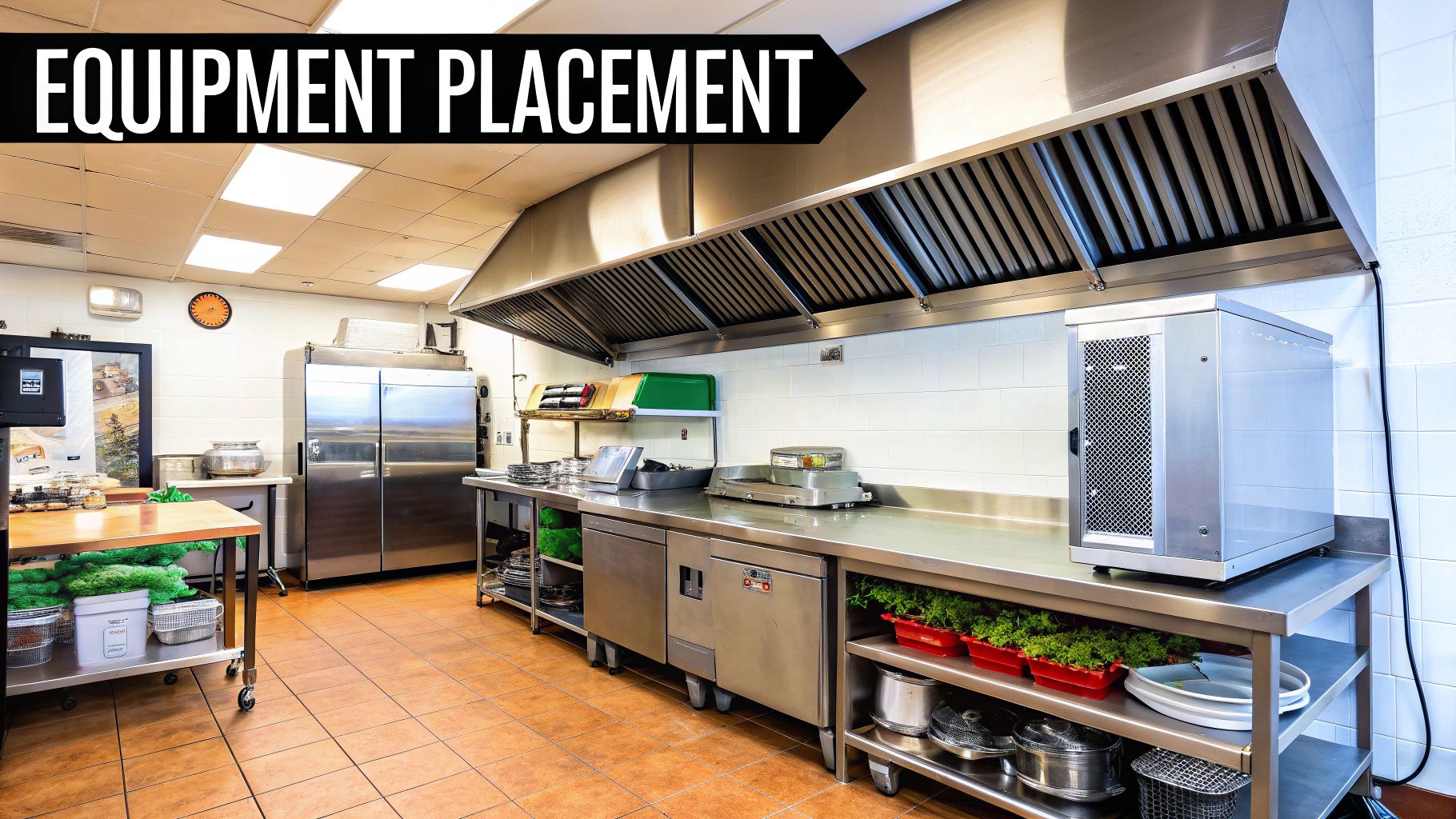
This is where a lot of new owners stumble—they buy for their opening day budget instead of their potential volume. Undersized restaurant equipment will absolutely cripple your kitchen during a rush. It leads to long ticket times and, sooner or later, a very expensive and disruptive upgrade. My advice? Always invest in equipment that can handle your busiest night, not just your first.
Strategic Equipment Placement For Safety And Flow
Once you’ve got your gear, figuring out where it all goes is the next big puzzle. This isn’t just a game of Tetris; it's a careful dance between workflow, safety, and LA County health codes. The entire goal is to build a space where your staff can move like a well-oiled machine, without any wasted steps or dangerous bottlenecks.
Heavy-duty cooking equipment—your ranges, ovens, and fryers—must live under a proper ventilation hood. That's non-negotiable for fire safety and air quality. Before you even think about finalizing the layout, double-check where all your utility hookups are. Moving gas, water, and electrical lines later on is a budget-killer.
A pro tip I always share: remember the "landing zone" rule. Every piece of cooking equipment, from a convection oven to a charbroiler, needs a heat-proof counter space right next to it. This gives your cooks a safe, immediate spot to set down sizzling hot pans and trays.
Clearance is another huge deal. The manufacturer will tell you exactly how much space you need between the equipment and any walls or other surfaces. Following those specs, along with keeping aisles clear for easy movement and cleaning, is essential for passing your health inspection and keeping your team safe.
Maximizing Space In LA Food Trucks
Nowhere is smart equipment placement more critical than in a Los Angeles food truck. Every single square inch is precious real estate. This tight environment demands multi-functional, space-saving gear and a layout that trims every last bit of fat from the workflow.
For a food truck slinging Korean fusion tacos, this could mean using under-counter refrigerators instead of uprights to free up valuable prep surfaces. An induction cooktop might get the nod over a gas range because it throws off less heat and is easier to clean in a cramped space.
To make sure you're covering all your bases without overstuffing your truck, it's a good idea to work off a detailed commercial kitchen equipment checklist.
LA Food Truck Essential Equipment Checklist
For a Los Angeles food truck, every equipment choice is a compromise between capability and space. This table highlights the essentials that pack the most punch in a small footprint.
| Equipment Category | Must-Have Items | Space-Saving Tip |
|---|---|---|
| Cooking Line | A compact gas griddle, countertop fryer, and a two-burner range are typical for most concepts. | Choose multi-function units like a combination oven or a griddle-charbroiler combo to save valuable hood space. |
| Cold Storage | Under-counter or worktop commercial refrigerators and freezers are essential for preserving ingredients. | Utilize refrigerated prep tables that combine cold storage with a workspace on top, doubling their utility. |
| Sanitation | A three-compartment sink for washing and a separate handwashing sink are required by law. | Select sinks with the smallest possible footprint that still meet health code dimensions to preserve counter space. |
| Preparation | Stainless steel prep counters, a food processor, and an immersion blender cover most needs. | Install wall-mounted shelving above prep areas to keep small wares and ingredients off the counters. |
Ultimately, choosing the right restaurant equipment for your menu and placing it with a sharp eye on workflow and safety will turn your kitchen from just a space into a powerful asset for your restaurant.
Meeting LA County Health Codes and ADA Rules
You can have the most brilliant commercial kitchen layout on paper, but it’s worthless without an approval stamp from the Los Angeles County Department of Public Health. Let's be honest, navigating the maze of regulations can feel like a nightmare, but it's a step you absolutely cannot skip. These rules are there to keep your staff and customers safe from the moment you open.
Failing an inspection means you’re looking at expensive delays and frustrating redesigns. It’s so much easier—and cheaper—to build these rules into your plan from the start. Think of the health code less as a barrier and more as a professional blueprint for a safe and functional kitchen, whether you're opening a Thai restaurant or just getting a food truck on the road.
Mastering LA County Health Department Mandates
The LA County health code is known for being incredibly specific, covering everything from the materials on your countertops to exactly where you place your sinks. So many new restaurant owners make the costly mistake of ignoring these details.
Your plan needs to demonstrate a solid grasp of sanitation and workflow. For instance, all surfaces in your food prep zones must be smooth, non-porous, and easy to clean. There's a reason stainless steel is the gold standard. You'll find that wood is almost always a no-go in prep areas because it's too porous.
Ventilation is another huge checkpoint. If you have equipment that produces greasy vapor—like ranges, griddles, or fryers—you need a Type 1 hood with a proper fire suppression system. The size and power of that system depend entirely on the restaurant equipment underneath it, making it a cornerstone of your plan.
I can't tell you how many inspections fail in Los Angeles because of bad sink placement. The code is strict: you need a three-compartment sink for warewashing, a separate handwashing sink in every main work area, and often a dedicated food prep sink. They all have clearance rules and you can't just use one for another's purpose.
Here are a few other critical points your design has to nail:
- Flooring: Your floors need to be tough, grease-resistant, and have coved bases where they meet the wall. That curved edge stops grime from building up in the corners.
- Lighting: You need bright, adequate lighting over every prep and cooking station. It's a must for food safety and preventing accidents.
- Storage: Dry storage areas have to be well-ventilated, and every shelf must be at least six inches off the floor. This makes cleaning underneath possible and applies to your walk-in commercial refrigerators and freezers, too.
Ensuring Accessibility with ADA Compliance
On top of the health codes, your kitchen also has to comply with the Americans with Disabilities Act (ADA). Many people think ADA only applies to dining rooms and restrooms, but it extends to employee workspaces to ensure everyone has an equal opportunity. Building an accessible kitchen isn't just about the law; it's about creating an inclusive workplace.
When it comes to the back of house, ADA compliance is all about making the workspace usable for employees with disabilities. This directly impacts your layout, especially when it comes to spacing and reach.
Here are the key ADA points to work into your kitchen layout:
- Aisle Width: Main pathways in the kitchen need to be at least 36 inches wide so a wheelchair can pass through. For areas with more traffic or turns, 42-48 inches is even better.
- Work Surface Height: You should plan for a section of your work surfaces to be at an accessible height, which is usually between 28 and 34 inches from the floor, with space for knee clearance underneath.
- Reach Ranges: Controls on equipment, storage shelves, and sinks must be placed within easy reach, so no one has to dangerously stretch or lean to do their job.
Baking these requirements into your commercial kitchen layout design from day one is non-negotiable. It ensures you’re building a space that’s not just efficient and safe, but also fair to all potential employees. Getting it right the first time saves you money, avoids massive headaches, and positions your Los Angeles restaurant for a much smoother opening.
Future-Proofing Your Kitchen Design
A great kitchen layout isn't just about what you need on opening day; it's about building a space that can grow with you. Thinking ahead means designing a kitchen that’s more efficient, saves you money in the long run, and connects with the values of modern Los Angeles diners. It all comes down to weaving smart technology and sustainable practices into your kitchen’s DNA from the very first blueprint.
The restaurant world is always evolving, and right now, sustainability and technology are leading the charge. This isn't just a small trend—the commercial kitchen market is expected to see a staggering USD 1 billion in growth between 2024 and 2028. A huge part of that is driven by automation and robotics making kitchens more efficient. You can get the full scoop on the growth of the commercial kitchen market on prnewswire.com.
Integrating Smart Restaurant Equipment
The kitchen of tomorrow is a connected kitchen. We're seeing more and more IoT (Internet of Things) enabled restaurant equipment that gives you real-time data on everything from freezer temps to energy use. Imagine a fridge that pings your phone if a door is left open or an oven you can start preheating from your car.
Planning for this is about more than just buying the slickest new gear. You have to design your infrastructure to support it from the get-go.
This means thinking about:
- Robust Electrical Systems: Make sure you have plenty of circuits and outlets to handle all your modern appliances without tripping a breaker during the dinner rush.
- Strategic Data Ports: Plan for hard-wired Ethernet ports near your key restaurant equipment. A direct connection is almost always more reliable than Wi-Fi in a busy, steamy kitchen.
- Strong Wi-Fi Coverage: For the devices that do rely on it, a powerful and secure network is non-negotiable for communication and software updates.
A little foresight here saves you from a massive, costly retrofit down the line when you're ready to adopt the next big thing in kitchen tech.
Designing for Sustainability in Los Angeles
In LA, both diners and regulators are zeroed in on environmental responsibility. A sustainable kitchen design can become a core part of your brand while also hitting your bottom line where it counts: your utility bills.
Here's a key takeaway for any LA restaurateur: sustainability isn't just a feel-good choice; it's a sharp business move. By prioritizing eco-friendly design, you cut long-term operating costs and build loyalty with a community that cares.
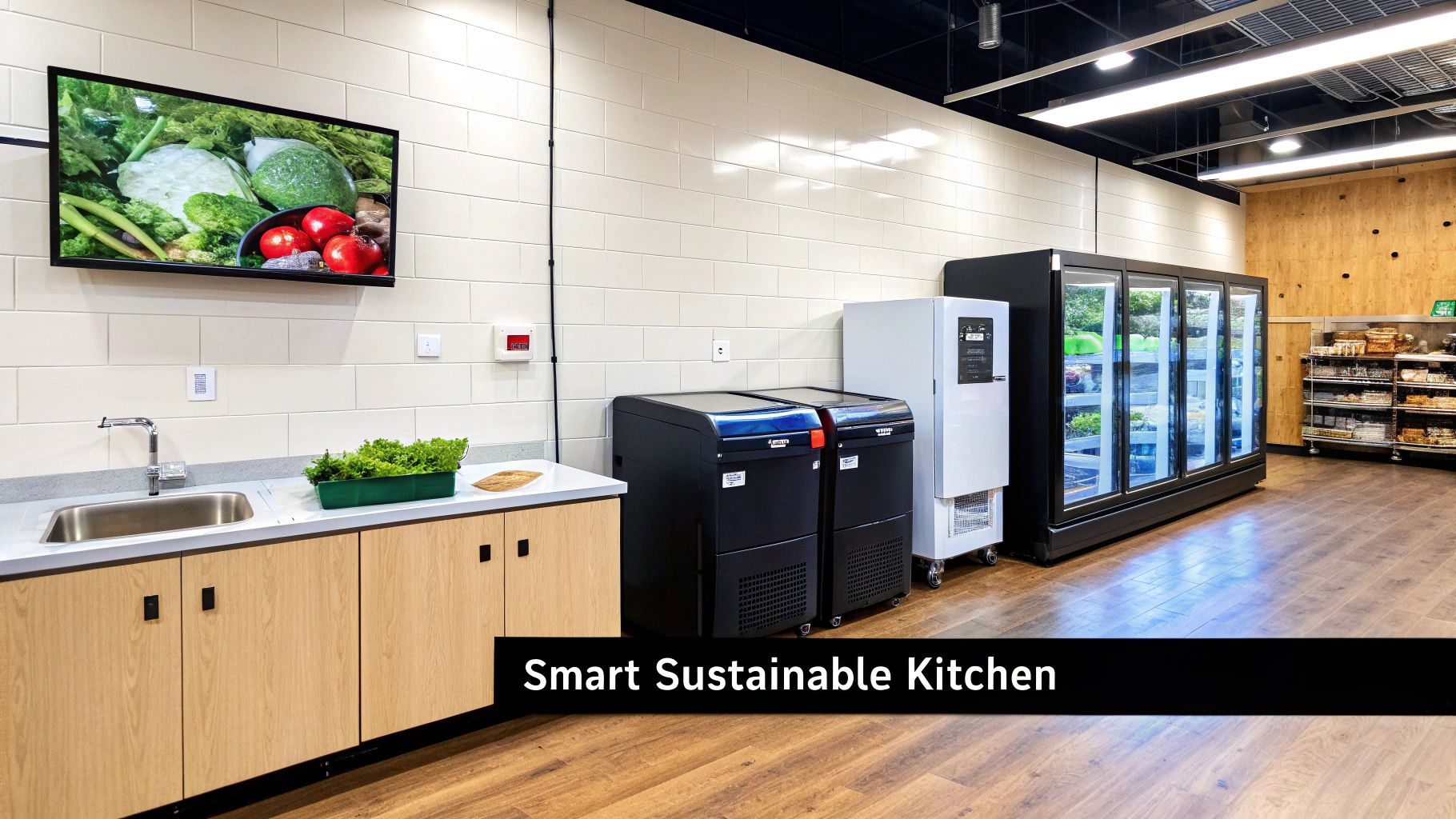
Start with your major appliances. Always look for ENERGY STAR® rated commercial refrigerators, freezers, and ovens. They are often way more efficient than standard models, which means a smaller carbon footprint and lower electricity bills every single month.
But it goes beyond the big equipment. Think about these design principles:
- Water-Saving Fixtures: Low-flow faucets and pre-rinse spray valves are small changes that can save you thousands of gallons of water a year.
- Smart Waste Management Flow: Designate a clear, accessible area for waste sorting. Making it dead simple for staff to separate recycling, compost, and trash is essential for staying compliant with LA's strict recycling ordinances.
- LED Lighting: Switch everything over to energy-efficient LED bulbs. They use a fraction of the energy and last so much longer than old-school bulbs.
Building a future-proof kitchen is all about anticipating where the industry and your community are headed. By thoughtfully planning for smart systems and sustainable practices, you’re not just building a kitchen for today—you're getting ready for whatever comes next.
Your LA Kitchen Design Questions Answered
When you're in the thick of planning a new restaurant or food truck in Los Angeles, the questions about your commercial kitchen layout design can feel overwhelming. Getting the right answers from the start can save you a mountain of time, money, and headaches down the road. Let's tackle some of the most common questions LA operators have.
What Is the Biggest Mistake to Avoid in a Food Truck Kitchen Layout?
The single most common—and costly—mistake is forgetting that people, not just restaurant equipment, have to work in that tiny space. New Los Angeles food truck owners get so focused on jamming in every piece of cooking gear they can that they completely overlook workflow. The result is a cramped, inefficient, and frankly unsafe kitchen.
You have to think in a straight line. The best approach is a galley-style layout that creates a clear path from cold storage (like your under-counter commercial refrigerators) to the prep station, over to the cooking line, and finally out the service window. Other deal-breakers include skimping on ventilation, not planning for enough water storage (both fresh and grey), or failing to map out accessible power sources. Any one of those can shut you down before you serve a single customer.
The golden rule for a food truck is this: every piece of restaurant equipment must justify its footprint. If it isn't absolutely essential for your menu and your workflow, it doesn’t belong.
How Much Should I Budget for Commercial Kitchen Equipment in Los Angeles?
This is a tough one because the answer really depends on your concept, your space, and whether you're buying new or used restaurant equipment. Think of your budget as the financial foundation of your entire kitchen.
To give you a ballpark idea, here's what we typically see in LA:
- Small Cafe or Quick-Service Spot: You’re likely looking at a range of $30,000 to $75,000.
- Mid-Size, Full-Service Restaurant: The budget here usually lands between $75,000 and $200,000+.
- High-End or Large-Scale Operations: These projects can easily climb past $300,000.
Remember, a few key items will eat up a big slice of that budget. A proper ventilation hood system, for instance, can run anywhere from $10,000 to $30,000+ with installation. Walk-in commercial refrigerators and freezers are another major cost, as is your main cooking line. My best advice? Always tack on an extra 10-15% contingency fund for the things you don't see coming, like surprise delivery fees or specialized installation work required by code.
Do I Need a Professional Designer for My LA Restaurant Kitchen?
I get this question all the time. While you can technically try to design your own kitchen, it's a huge risk I wouldn't recommend unless you've done this many times before. Hiring a professional kitchen designer or a restaurant consultant who knows the LA scene inside and out isn't an expense—it's an investment.
These experts live and breathe the tangled web of LA County health codes, building regulations, and ADA requirements. More importantly, they understand the practical realities of a busy kitchen. A good designer will help you squeeze maximum efficiency out of every square foot, which means lower labor costs for years to come. They also have connections with suppliers and contractors, and their professional plans are what get your permits approved without endless delays. The money you spend on a designer is almost always saved by avoiding costly mistakes during construction.
What Are the First Steps in Planning a Commercial Kitchen Layout?
Before you even glance at a floor plan or equipment catalog, you need to step back and get the big picture right. Jumping straight into blueprints is a surefire way to end up with a kitchen that just doesn't work.
Start with these fundamentals first:
- Nail Down Your Menu and Concept: Your menu is the real blueprint. It dictates everything—what restaurant equipment you need, how much storage you’ll require, and how the whole kitchen should flow. The needs of a Japanese sushi bar are completely different from a Korean BBQ joint.
- Figure Out Your Volume: Be honest and realistic about how many customers you expect to serve. This number tells you exactly how much capacity your kitchen needs to handle a dinner rush without imploding.
- Draw a Bubble Diagram: This is a simple, low-tech sketch. Just draw circles on a piece of paper for each main work zone: receiving, storage, prep, cooking, service, and warewashing. Then, draw lines to show how staff and food will move between them. This basic exercise is crucial for visualizing the flow for any successful commercial kitchen layout design before you lock anything into a rigid plan.
Only after you’ve worked through these big-picture steps should you move on to picking out specific restaurant equipment and drafting detailed plans for your Los Angeles kitchen.
For a comprehensive selection of professional-grade equipment tailored to the needs of LA's diverse culinary scene, Los Angeles Restaurant Equipment offers everything from Atosa commercial refrigerators to complete cooking lines. Explore our catalog and find the reliable tools you need to bring your vision to life. Visit us at https://losangelesrestaurantequipment.com.