

A Guide to Undercounter Refrigerator Sizes for LA Kitchens
Undercounter refrigerators generally come in sizes from 24 to 72 inches wide, 24 to 36 inches deep, and 34 to 36 inches high, designed to tuck neatly under most commercial countertops. Picking the right size is a make-or-break decision for any Los Angeles restaurant, a careful balancing act between the space you have and the cold storage you absolutely need.
Why the Right Size Undercounter Fridge Matters
Choosing an undercounter refrigerator isn't just about plugging a hole in your kitchen layout; it’s about making every square inch work for you. Think of it like a high-stakes game of Tetris in a packed Los Angeles restaurant—every piece of restaurant equipment has to fit just right to keep the kitchen flowing. A unit that’s too big will steal precious prep space, while one that’s too small will cause inventory headaches right in the middle of a dinner rush.
This one choice can define your kitchen's entire workflow. A sprawling Koreatown BBQ joint needs a wide, multi-door commercial refrigerator to keep all its marinated meats chilled and ready. On the other hand, a compact food truck dishing out Thai street food in Venice Beach needs a slim, shallow-depth model that saves aisle space without skimping on cold storage. The real goal is to turn those tight spots into powerhouse work zones.
Matching Size to Your Operation
The perfect dimensions hinge entirely on what you’re serving. A high-end Japanese sushi bar in downtown L.A. needs smaller, dedicated units for precise temperature control over delicate fish. A bustling Mexican taqueria, however, would get more mileage out of a worktop refrigerator that doubles as a durable prep surface for chopping cilantro and onions.
For Los Angeles kitchens, where every foot of real estate counts, getting the undercounter refrigerator size right isn't a luxury—it's a core business strategy. The right unit means less running around for your staff, faster service for your customers, and a healthier bottom line.
This focus on smart operations is a great financial move. It's not just about fitting the equipment in the space, but also about long-term savings—much like how operators look into other efficient equipment choices for reducing energy costs.
A Growing Market for Compact Cooling
It’s no secret that these compact workhorses are in high demand. The global market for undercounter refrigerators hit an incredible US$ 4.5 billion, proving just how vital they are to the foodservice industry. Experts see that number climbing to US$ 7.1 billion by 2033, thanks to a booming hospitality sector.
For restaurant owners in L.A., this means having access to reliable commercial refrigerators and freezers from brands like Atosa, whose undercounter refrigerators come with a two-year parts and labor warranty and five years on the compressor. That kind of dependability is non-negotiable during peak hours. You can dive deeper into this growing market and its trends to see where the industry is headed. Here at Los Angeles Restaurant Equipment, we’re here to help you sort through the options and make an investment that truly works for you.
Understanding Standard Dimensions: Height, Width, and Depth
Getting a handle on undercounter refrigerator sizes is all about translating the numbers on a spec sheet into real-world kitchen flow. A few inches one way or the other can be the difference between a smooth service and total chaos. Let's break down the three big ones—height, width, and depth—to see how they really play out in a bustling Los Angeles kitchen.
Think of these dimensions as the blueprint for your kitchen layout. Nailing them from the start saves you from installation nightmares and guarantees the unit fits right into your prep line or bar setup. For a busy Thai restaurant, that means picking a model that can hold all your fresh herbs and sauces without getting in anyone's way.
This map shows how focusing on the right undercounter refrigerator sizes leads directly to a smarter, more efficient kitchen.
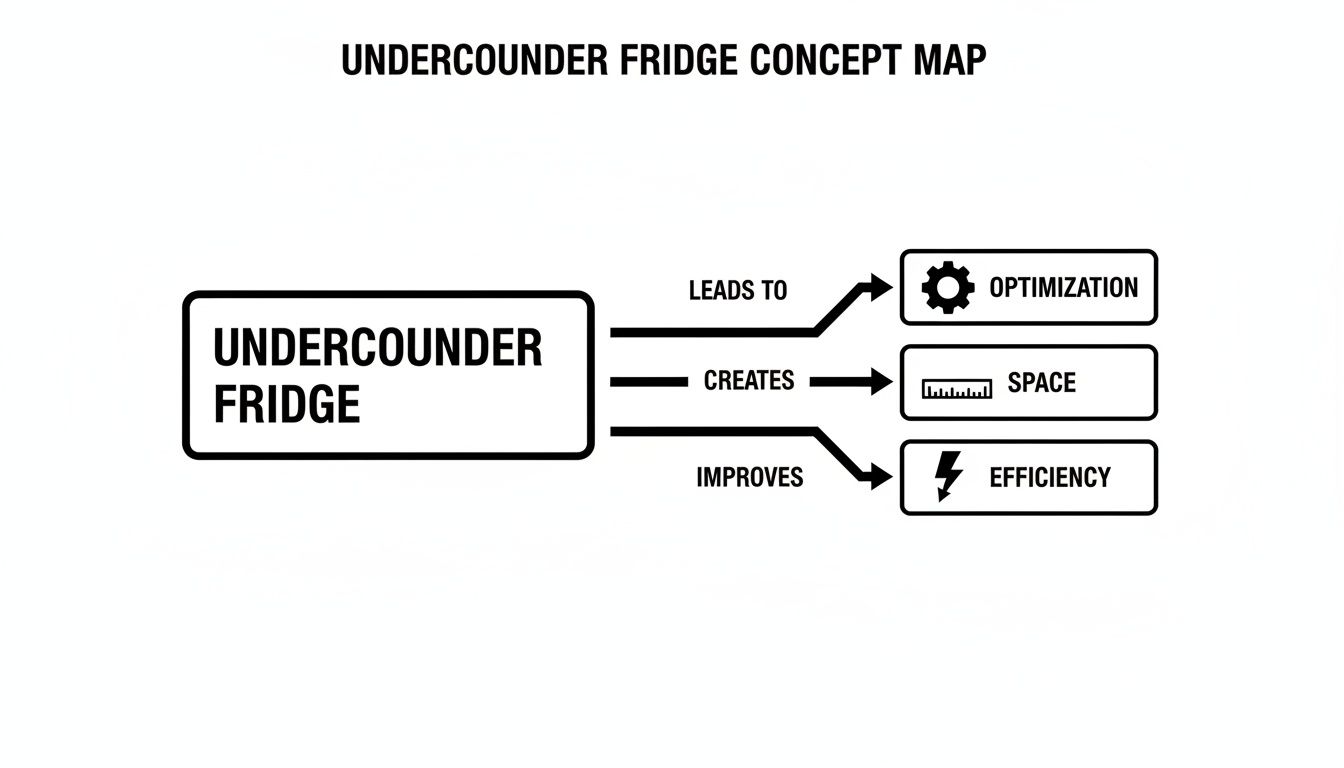
As you can see, these elements all work together. Get one right, and it helps the others, creating a workspace that’s more productive and a lot less stressful.
The Critical Role of Height
Height is probably the most straightforward measurement, but it’s also the most critical. The vast majority of commercial undercounter refrigerators are built to slide right under a standard 36-inch high countertop. It's an industry-wide standard that gives you that clean, built-in look and makes the most of your space.
The units themselves usually stand between 34 to 35.5 inches tall. That little bit of wiggle room is crucial—it leaves a small gap for airflow and makes the actual installation process much easier. Here in Los Angeles, accessibility is also a big deal, so many places need to think about ADA-compliant models. These units are a bit shorter, typically 32 to 34 inches high, to allow comfortable wheelchair access to the counter above.
Finding the Right Width for Your Needs
Width is where you’ll find the most variety, and it directly impacts your fridge’s footprint and how much you can store inside. The options go from slim single-door units all the way up to massive triple-door models built for high-volume chaos.
- Compact Single-Door Models (24-30 inches): These are the champs of tight spots. A 24-inch unit is perfect for a small coffee station or an LA food truck where every single inch counts.
- Versatile Two-Door Models (36-60 inches): This range is the sweet spot between size and storage for many businesses. A 48-inch model is a common sight in quick-service spots, offering easy access to ingredients without hogging the whole prep line.
- High-Capacity Three-Door Models (60-72 inches and up): When you just need to store as much as possible, these are your go-to. A 72-inch triple-door fridge is a bartender's best friend, holding hundreds of bottles and cans to keep up with a packed Friday night.
Navigating Refrigerator Depth
Depth is the dimension that has the biggest impact on your kitchen’s walkways and workflow. Deciding between a standard or shallow-depth model can completely change how your team moves around a tight space.
The decision on depth is a strategic one. Standard depth offers more internal storage, but a shallow-depth model can create a wider, safer aisle in a cramped kitchen, boosting staff efficiency and reducing accidents.
Standard-depth units are usually between 30 to 32 inches deep. They give you the most cubic feet of storage and are a great fit for kitchens with plenty of room. A full-service Mexican restaurant, for example, might use a standard-depth worktop model to hold big pans of prepped ingredients right under the assembly station.
On the other hand, shallow-depth models are typically around 24 to 28 inches deep. Shaving off just a few inches can be a total game-changer. Picture a narrow Los Angeles food truck galley; a 24-inch shallow depth fridge lets two chefs squeeze past each other without a problem. It’s a small detail that makes a huge difference in how fast orders get out. These models are also great for front-of-house bars where bartenders need to move fast. Choosing the right undercounter refrigerator size always comes down to balancing what you need to store with the space you actually have.
Looking Beyond Dimensions to Capacity and Configuration
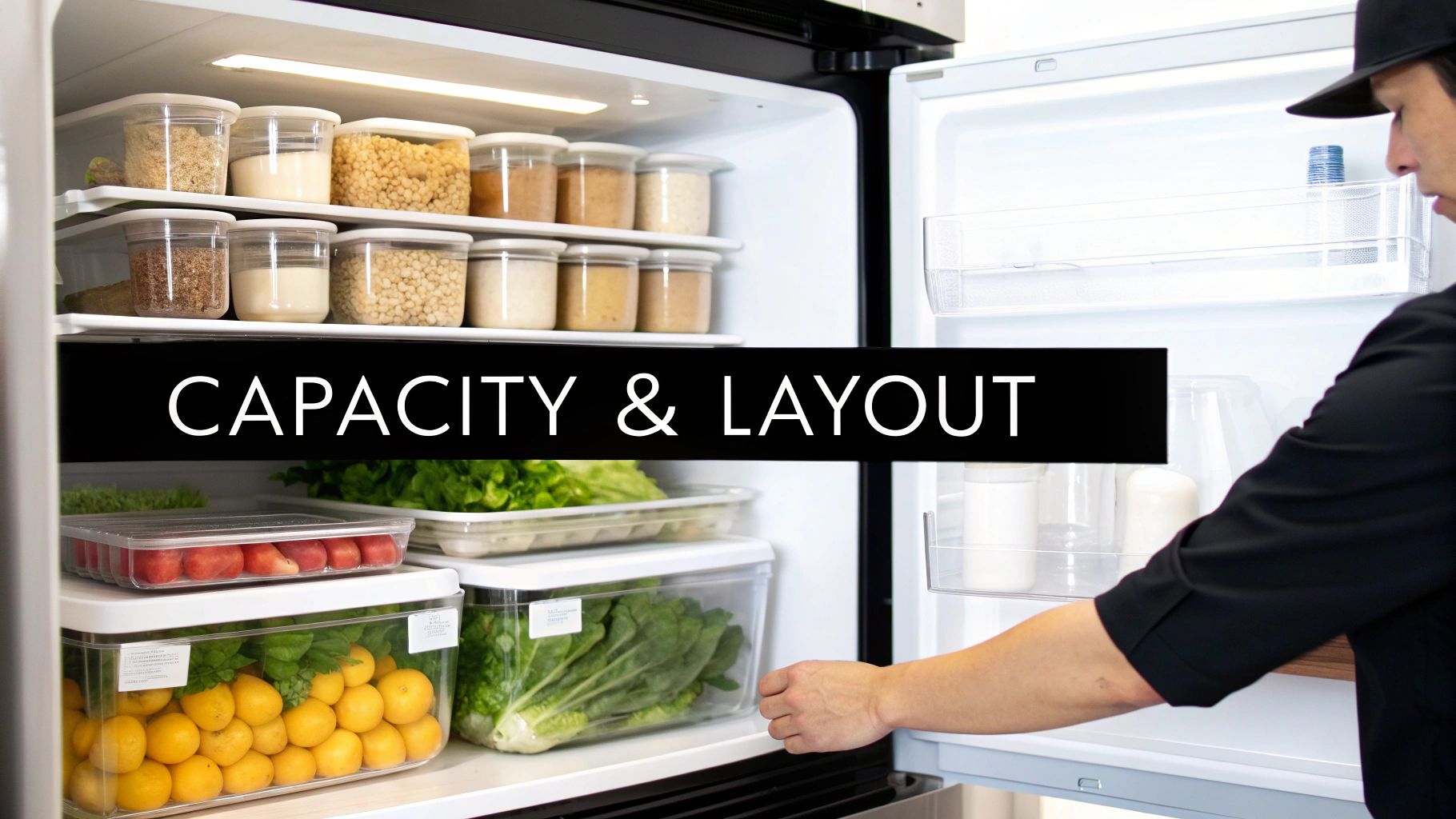
Sure, the outside measurements tell you if a fridge will slide into your space, but the real magic happens inside. A unit’s internal capacity and layout are what will make or break your kitchen’s efficiency. It’s like a chef’s knife roll—the size of the roll doesn’t matter as much as how well it organizes your tools when you’re in the middle of a chaotic dinner rush.
Don't let the exterior fool you. You could have two units with the exact same footprint but wildly different amounts of usable storage, which is measured in cubic feet. The thickness of the insulation, where the compressor is tucked away, and the overall interior design all play a huge role in how much you can actually fit inside. This is why you have to look past the tape measure.
Matching Configuration to Cuisine
The layout of an undercounter unit—whether it has doors, drawers, or a combination—can give your workflow a massive boost. The best setup for you comes down to your menu and how your kitchen staff preps food.
For instance, a Chinese restaurant in the San Gabriel Valley could speed up service significantly with drawer units. They’re perfect for organizing pre-portioned dim sum or wonton ingredients, letting a chef grab what they need without missing a beat. Each drawer is its own little station, keeping the line humming.
On the other hand, a trendy craft beer bar in Silver Lake has a totally different set of needs. They’re juggling a constantly changing inventory of bottles, cans, and small kegs of all shapes and sizes. For them, a glass-door model with adjustable shelving is the only way to go. It gives them the flexibility to rearrange the space and lets bartenders see what’s in stock with a quick glance.
The internal layout of your undercounter refrigerator is a direct reflection of your operational strategy. Drawers are for speed and organization of uniform items, while shelves offer versatility for a changing inventory.
This decision impacts more than just storage; it directly affects how fast your team can get orders out the door, especially when the restaurant is packed.
Doors vs Drawers What Works for Your LA Kitchen
Picking between doors and drawers is a crucial step in outfitting your kitchen with the right restaurant equipment. Each style has its own strengths, designed for specific tasks and kitchen layouts.
Door Models Are Best For:
- Bulk Storage: Great for holding bigger, odd-shaped things like sauce buckets, milk jugs, or large heads of lettuce.
- Flexibility: Adjustable shelves mean you can easily make room for different products as your menu changes.
- Visibility: Glass-door versions work well for front-of-house bars or cafés, showing off what you have to offer.
Drawer Models Are Best For:
- Organization: The best choice for separating ingredients into neat, tidy pans (think cheeses, sliced meats, or prepped veggies).
- Speed: A chef can pull out a whole drawer and see everything at once, which is way faster than opening a door and digging around.
- Consistency: Perfect for assembly line setups, like the sandwich station in a busy Downtown LA deli.
The importance of this choice is huge. Commercial undercounter refrigeration is a massive US$ 1,343.6 million market, and the hospitality industry is responsible for nearly 35% of that demand. In L.A.’s busy food truck and fast-casual scene, undercounter fridges with medium capacities (51-300 liters) make up 60% of all units, which shows just how vital that balance of size and efficiency is. You can see more data on how capacity drives the market on Grand View Research.
At the end of the day, the right configuration helps you serve customers better and faster. Making a smart choice here also means your unit runs more efficiently, a key part of any sustainable business. You can learn more by checking out our guide on energy-efficient commercial refrigerators. When you think strategically about capacity and layout, your undercounter fridge becomes more than just a cold box—it becomes a powerhouse for kitchen productivity.
Your Essential Pre-Purchase Measurement Checklist
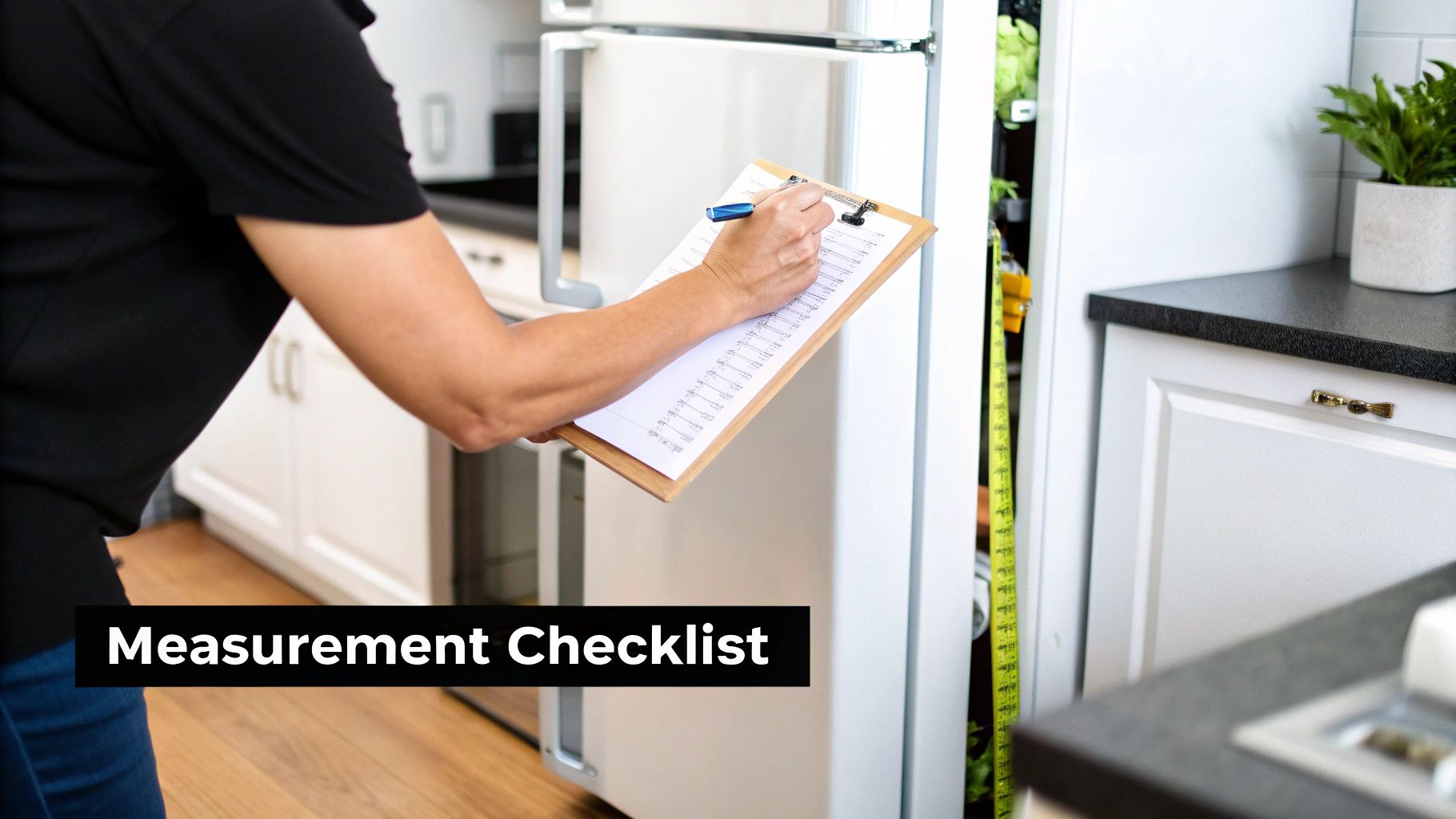
Buying an undercounter refrigerator that doesn’t fit is more than just an annoyance. It's a costly mistake that can grind your whole kitchen operation to a halt. To dodge the headache of returns and project delays, a solid measurement checklist is your best friend.
This isn’t just about the spot where the unit will live. You need to think about its entire journey, from the delivery truck all the way to its final home under the counter.
Measure the Installation Space First
Before you get your heart set on a specific model, grab your tape measure. You need precise numbers for the cabinet opening or the space you've designated. A quarter-inch can be the difference between a perfect fit and a major problem, so double-check everything.
- Height: Measure from the floor to the bottom of the countertop in three spots—left, center, and right. Always use the smallest of these three numbers as your maximum height.
- Width: Do the same thing side-to-side. Measure the width at the top, middle, and bottom of the opening. Again, your working number is the smallest one.
- Depth: Measure from the back wall out to the front edge of the nearby cabinets. This is key to making sure the unit won’t jut out and block a busy walkway.
Plan for Critical Ventilation Gaps
A compressor burning out from poor airflow is a classic, and totally preventable, kitchen nightmare. These commercial refrigerators and freezers work hard, and they need room to breathe. Without proper ventilation, the compressor will overheat, run inefficiently, and eventually fail, costing you big on repairs and spoiled inventory.
Proper ventilation isn't just a good idea; it's a must-have for your equipment's health and performance. Always check the manufacturer's spec sheet for their required clearance.
As a rule of thumb, plan for at least 1-2 inches of clearance at the back and on the sides. Many newer models, however, are front-breathing, meaning they pull and push air through a grille on the front. These are fantastic for tight Los Angeles kitchens because they often require zero clearance on the sides and back.
Map the Entire Delivery Path
The final, and most often forgotten, step is measuring the delivery path. That shiny new fridge has to get from the street to your kitchen, and any tight spot can stop the whole process cold. Walk the entire route with a tape measure and look for potential obstacles.
To make sure you don't miss a thing, we've put together a quick checklist. Run through these points before you click "buy," and you'll save yourself a world of trouble on delivery day.
Essential Clearance and Measurement Checklist
| Measurement Task | Why It's Critical | Pro Tip |
|---|---|---|
| Cabinet Opening (H/W/D) | This determines the maximum external dimensions your new unit can have. | Measure in three different places (top/middle/bottom) and use the smallest measurement. |
| Ventilation Space | Prevents compressor overheating, ensures energy efficiency, and extends the unit's lifespan. | Check the spec sheet! Front-breathing models need less clearance and are great for tight fits. |
| Exterior Doorways | Your unit has to get into the building first. A too-narrow door is a dead end. | Remember to account for the door itself and any trim that might narrow the opening. |
| Interior Hallways & Corners | A straight shot is rare. Tight turns can be a delivery-day disaster. | Measure the narrowest point of the hallway and check diagonal space for navigating corners. |
| Stairwells (if any) | Width, height, and landing space are all potential choke points for bulky equipment. | Don't forget ceiling clearance on the stairs. A low-hanging fixture can stop a delivery. |
| Kitchen Entry | The final hurdle. Make sure the path into the kitchen itself is clear. | Temporarily moving a prep table or other restaurant equipment can make all the difference. |
Taking a few minutes to walk this path can save you from that frustrating moment when the delivery team shows up with a great new fridge that just can't get through the door. For busy Los Angeles restaurant owners, getting it right the first time saves time, money, and a ton of stress.
Choosing the Right Size for Your Los Angeles Business
In Los Angeles, every restaurant, cafe, and food truck has its own unique rhythm. The right undercounter refrigerator isn't just a piece of equipment—it's what keeps that rhythm going. Matching the unit to your business model can transform a chaotic kitchen into a smooth, high-performance engine.
It’s about looking past generic dimensions and thinking about how that fridge will work in your specific spot. Let's dig into some real-world scenarios across the demanding L.A. food scene to see how picking the perfect size can boost speed, keep things organized, and ultimately, make you more money.
The LA Food Truck: A Mobile Powerhouse
If you're running one of the many Los Angeles food trucks, from Santa Monica to the Arts District, you know that space is everything. Every single inch counts. Your restaurant equipment has to be compact, tough, and incredibly efficient.
The sweet spot for a food truck is usually a 24 to 27-inch single-door model, often with a shallow depth around 24 inches. This smaller footprint leaves more room in the aisle, so your crew isn't constantly bumping into each other. A worktop model is a fantastic choice here, since its stainless steel top gives you another much-needed surface for prep. Durability is also a big deal—you need a unit built to handle the bumps and vibrations of the road.
For operations where space is tight, like food trucks, optimizing every inch is key. You can find more great operational ideas by checking out these solutions tailored for food trucks.
The High-Volume Bar: Keeping Service Flowing
Picture a packed bar in Koreatown on a Saturday night. Bartenders are flying, and they don't have a second to waste digging for ingredients or restocking bottles. In this kind of fast-paced environment, it’s all about capacity and quick access.
The go-to solution is a wide, 60 or 72-inch three-door undercounter model. These beasts offer massive storage for beers, mixers, garnishes, and wine. Glass doors are a popular pick because bartenders can spot what they need without opening every door, which keeps the cold air in and the service moving. Plus, multiple doors mean multiple bartenders can grab what they need at the same time, preventing a traffic jam behind the bar.
The Quick-Service Cafe: Merging Prep and Storage
A quick-service cafe in Silver Lake that's slinging artisanal sandwiches and salads lives and dies by the speed of its prep line. The secret is having every ingredient perfectly chilled and right at your fingertips. This is where a 48-inch two-door worktop refrigerator becomes the kitchen's MVP.
This size hits the perfect balance, giving you plenty of cold storage below a durable prep surface. You can assemble orders on top while the refrigerated cabinets or drawers below hold everything from sliced meats and cheeses to fresh veggies. Drawer setups are especially great for this, letting staff grab pre-portioned items in a flash and seriously cutting down ticket times.
Choosing the right unit is a strategic investment in your kitchen's workflow. A well-placed worktop model in a cafe or a multi-door unit in a bar doesn't just store food—it actively speeds up service.
The Full-Service Restaurant: Strategic Station Placement
In a full-service restaurant, different stations have completely different needs. A one-size-fits-all approach just won’t cut it. Instead, smart L.A. restaurateurs put specific undercounter units at different spots along the line to create a seamless workflow.
- Garde Manger Station: A 36-inch two-door unit with drawers is perfect for organizing salad greens, dressings, and cold appetizers.
- Pastry Station: A dedicated 27-inch single-door model can keep a precise temperature for delicate creams and chocolates, away from the heat of the main line.
- Grill Line: A 48-inch drawer model right by the grill can hold pre-portioned steaks and fish, keeping them safely chilled and ready for the fire.
This targeted strategy makes every station self-sufficient, cutting down on wasted steps and cross-traffic in a busy kitchen. The demand for this kind of specialized gear is huge. The commercial undercounter and worktop refrigeration market was valued at USD 11,402.25 million, with the hospitality sector making up 42% of that. If you're exploring options, our guide on the best commercial refrigerator brands is a great place to start.
In the U.S., units between 10-18 cubic feet account for 65% of all commercial installations—it's the sweet spot that balances footprint and storage. For our Los Angeles Restaurant Equipment clients, Atosa undercounters are a perfect fit, and they come with five-year compressor warranties. We even offer free delivery and flexible financing to help new businesses get up and running.
Making Every Square Inch Count in Your Kitchen
In a city like Los Angeles, every foot of space comes at a premium, and the restaurant equipment you choose can literally make or break your business. This guide has laid out why picking the right undercounter refrigerator isn't just a simple measurement task—it's a strategic move that hits your workflow, service speed, and bottom line. It’s about thinking beyond the tape measure to nail down the perfect capacity, configuration, and placement for your unique spot.
When you get it right, a cramped kitchen transforms into a powerhouse of efficiency. Don't let the wrong unit create bottlenecks that slow you down during that chaotic dinner rush. Whether you're running a Thai food truck, a Korean BBQ joint, or a packed bar, the perfect undercounter fridge is out there, ready to unlock your kitchen's true potential.
For a deeper dive into maximizing your workspace, check out our guide on designing a small restaurant kitchen layout.
The right undercounter refrigerator isn't just another piece of equipment; it's a partner in your kitchen's success. It streamlines prep, supports your staff, and makes sure every ingredient is perfectly chilled and ready to go.
Ready to find that perfect fit? Give the experts at Los Angeles Restaurant Equipment a call for some personalized advice. We’re here to help you select the commercial refrigerators and freezers that will help your business thrive in the competitive LA food scene. Your ideal kitchen is just one smart choice away.
Frequently Asked Questions
When you're outfitting a restaurant in Los Angeles, every detail counts. Here are some quick, clear answers to the most common questions we hear from restaurant owners, chefs, and food truck operators about picking and installing the right undercounter refrigerator.
What Is the Standard Height of an Undercounter Refrigerator?
Most commercial undercounter refrigerators are built to slide right under a standard 36-inch high countertop. The units themselves usually stand between 34 and 35.5 inches tall. That little bit of extra space is crucial, leaving you just enough room to maneuver the unit into place and make small adjustments.
If you need to meet accessibility standards, ADA-compliant models are also easy to find. These are a bit shorter, typically ranging from 32 to 34 inches high, which makes for comfortable counter access for any staff or customers in wheelchairs.
How Much Clearance Does an Undercounter Refrigerator Need?
You absolutely have to give your fridge room to breathe. Proper ventilation is non-negotiable if you want to prevent compressor burnout and keep the unit running efficiently. As a general rule, plan for at least 1-2 inches of clearance around the back and sides to let the air flow.
Many modern units, however, are front-breathing, which is a lifesaver in the tight kitchen spaces you often find across L.A. These models pull air in and push it out through a grille on the front, so they need little to no clearance on the sides or back. This lets you install them completely flush with your other cabinets.
Always check the manufacturer's spec sheet for the exact clearance numbers. Following those guidelines is critical for the life and performance of your equipment—and it's almost always a condition of your warranty.
Can I Use a Residential Undercounter Fridge in My Restaurant?
We strongly advise against putting a residential undercounter fridge in any commercial kitchen, whether it's in a restaurant, a food truck, or a small café. Commercial-grade units, like the ones from Atosa, are NSF-certified for food safety. They're built with tough, heavy-duty parts made to handle the chaos of a professional kitchen.
A residential model just won't keep up. It will likely fail from the constant use, you'll void its warranty, and it could cause you big problems during a health inspection. Commercial refrigerators are designed to hold their temperature even when the doors are opened constantly, a challenge that residential units just aren't built for.
Are Drawers or Doors Better for an Undercounter Unit?
This really comes down to your menu and how your kitchen team works. Doors are the versatile, all-around choice and are generally more budget-friendly. They're great for storing a mix of items in different shapes and sizes, like sauce containers, drink bottles, or bulk produce.
Drawers, on the other hand, are all about organization and speed. They're perfect for holding pre-portioned ingredients in pans, letting a chef on a busy line grab exactly what they need in a split second. Many L.A. kitchens, from bustling Mexican taquerias to precise Japanese sushi bars, use a smart combination of both to make every station as efficient as possible.
At Los Angeles Restaurant Equipment, we get the unique pressures of L.A.'s foodservice scene. Our team can help you choose the perfect undercounter refrigerator sizes and setups to make your kitchen's workflow smoother and more efficient. Check out our full lineup of Atosa commercial refrigerators and freezers today at https://losangelesrestaurantequipment.com and get the dependable gear your business deserves.