

Commercial Kitchen Layout Ideas for Modern LA Restaurants
The secret to a successful Los Angeles restaurant isn't just the menu—it's the kitchen layout. The smartest commercial kitchen layout ideas are all about creating a logical workflow, a seamless path that takes ingredients from the delivery door straight to the dining room table. A good design cuts down on wasted steps, keeps staff from bumping into each other, and cranks up both speed and safety.
The Blueprint for a High-Efficiency LA Kitchen
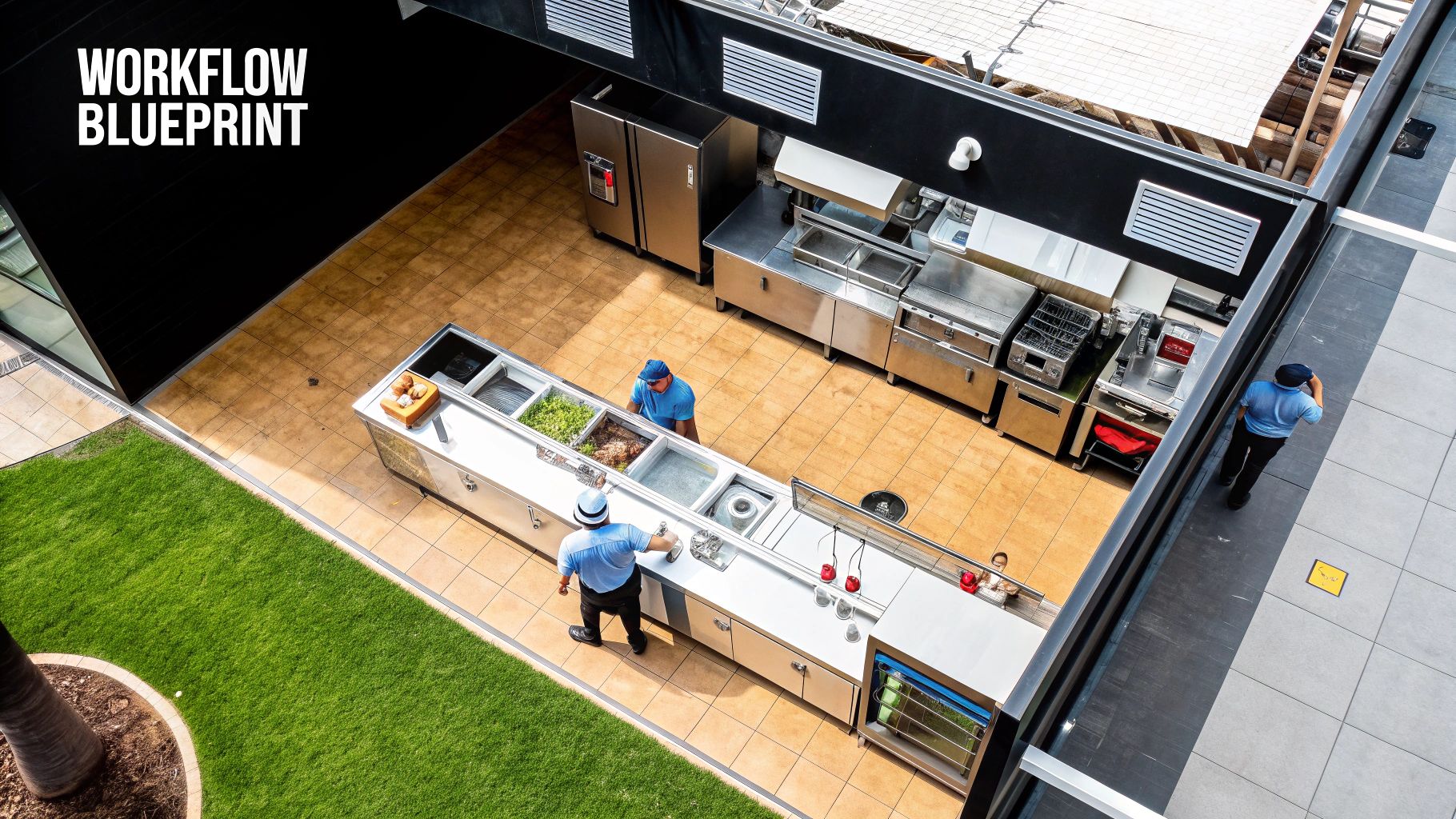
It doesn’t matter if you’re slinging Thai food from a Los Angeles food truck in Venice or plating high-end Japanese cuisine in Beverly Hills; the rules of efficient kitchen design are universal. You want to create a flow that mirrors the journey of your food, and it all starts the second a supplier knocks on your back door.
Fresh produce and proteins should go directly into dedicated commercial refrigerators and freezers right by the receiving area. This keeps the cold chain intact. From there, ingredients flow to prep stations, then over to the hot line for cooking, and finally to the service pass where dishes are plated and picked up. The best kitchens make this path short, direct, and completely clear of obstacles.
Foundational Kitchen Layouts
The foundation of any great LA kitchen is picking a layout that actually fits your menu and service style. Each one offers a different way to manage the chaos.
- Island Layout: This setup puts your main cooking line—think ranges and griddles—on a central island, with everything else pushed to the perimeter walls. It’s a fantastic choice for large, busy kitchens where multiple chefs need to communicate and the head chef needs a clear line of sight.
- Zone-Style Layout: With this approach, you carve out distinct areas for specific tasks. You might have a Garde Manger for cold dishes, a separate bakery station, and a dedicated grill station. It’s perfect for spots with complex menus, like a Koreatown BBQ joint that needs specialized prep areas to keep things organized.
- Assembly Line Layout: This is all about linear efficiency. Stations are arranged in a straight line, following the exact order of production. It’s the powerhouse behind fast-casual Mexican food spots and Los Angeles food trucks where speed and consistency are everything.
"A well-designed kitchen is more than just a place to cook—it's the engine of your restaurant. Optimizing the flow from your commercial freezer to the service line isn't a luxury; it's a direct investment in your profitability and your team's sanity during a chaotic Saturday night rush."
Ergonomics and Smart Design
Beyond the basic footprint, modern kitchen design is all about ergonomics. Flexible, ergonomic layouts are proving to be a game-changer, slashing labor costs and injury rates in kitchens everywhere. A 2025 analysis from Power Knot showed that simple ergonomic principles—like placing frequently used griddles and ranges within easy arm's reach—can cut staff movement by a staggering 40%. In fast-paced LA restaurants and food trucks, that’s a massive boost in productivity. You can learn more about these efficiency trends over at Power Knot.
This smart-placement philosophy should apply to every single piece of equipment. Using a detailed commercial kitchen equipment checklist from the very beginning ensures you account for every essential item. At the end of the day, a thoughtfully planned kitchen doesn’t just make operations smoother; it creates a safer, less stressful workplace for your team, which is a huge advantage in LA’s tough hiring market.
Matching Kitchen Layouts to Your LA Restaurant Concept
Choosing the right layout for your specific concept is the first, and most important, step. This quick guide breaks down which layout works best for different types of Los Angeles eateries.
| Layout Type | Best For (LA Concept) | Key Workflow Benefit | Example Cuisine |
|---|---|---|---|
| Island | High-volume fine dining (Downtown LA) | Centralized command and open communication | Modern Californian, French |
| Zone-Style | Restaurants with diverse menus (Koreatown) | Specialized stations prevent cross-contamination | Korean BBQ, Japanese Sushi |
| Assembly Line | QSRs and food trucks (Echo Park) | Maximizes speed and order consistency | Mexican (Tacos/Burritos), Chinese |
| Galley | Compact cafes and small kitchens (Silver Lake) | Efficient use of extremely limited space | Coffee Shops, Thai Food Trucks |
Taking the time to match your layout to your vision will pay off every single service, preventing headaches and helping your kitchen run like a well-oiled machine.
Designing Layouts for LA’s Diverse Cuisines
In Los Angeles, your menu dictates your kitchen design—never the other way around. Think about it: a high-volume Thai kitchen in Hollywood churning out wok-fired noodles has completely different needs than a meticulous Japanese sushi bar in Little Tokyo. Tailoring your commercial kitchen layout ideas to your specific cuisine is hands down the most important call you'll make.
This is about getting way past generic templates. You need to design a space that's a perfect match for your unique cooking style. The right layout makes every action smoother, from prep to plating, making sure your team can nail the menu, even during the craziest dinner rushes.
Assembly Line Power for Mexican Restaurants
For a hopping Mexican restaurant in East LA, speed and consistency are everything. The assembly-line layout is the undisputed champ for concepts built around tacos, burritos, and bowls. This setup arranges every station and piece of equipment in the exact order of preparation.
Picture the flow: an order ticket prints. The first stop is the griddle for warming tortillas and searing proteins. From there, it moves down a long, refrigerated Atosa prep table, where staff layer on rice, beans, salsas, and all the toppings. Finally, the order gets wrapped and passed to the expo window.
This straight-line approach cuts down on wasted steps, smashes bottlenecks, and lets multiple cooks work on different orders at the same time without tripping over each other. Key pieces of restaurant equipment for this setup are:
- High-capacity griddles to handle the constant demand for meats and tortillas.
- Multi-pan refrigerated prep tables that keep dozens of fresh ingredients perfectly chilled and right at your fingertips.
- Deep fryers for essentials like chimichangas or crispy taco shells.
It's this logical flow that’s the real secret to getting delicious, custom orders out to hungry customers in just minutes.
High-Heat Wok Stations for Thai and Chinese Kitchens
The heart of any great Thai or Chinese kitchen is the wok station. This is a zone built for pure, intense heat and lightning-fast cooking. A zone-style layout is perfect here, carving out a dedicated area for high-temp cooking that's separate from your other prep and storage areas.
The wok station is the engine of a successful Asian restaurant. It demands powerful ventilation to handle the smoke and heat, instant access to refrigeration for fresh ingredients, and a design that puts the chef's speed and safety first.
You have to plan this zone carefully. High-BTU wok ranges are a must, and they need to be paired with an oversized ventilation hood that can keep up. Right next to it, you'll want under-counter commercial refrigerators packed with prepped veggies and proteins. The whole point is to let a chef pivot—not walk—between the fire and their ingredients.
This layout also cleverly keeps the intense heat and steam from the woks away from other parts of the kitchen, like your cold prep stations or storage zones with commercial freezers.
The Linear Flow of a Los Angeles Food Truck
Designing a kitchen for a Los Angeles food truck is a masterclass in efficiency. You're working with maybe 150-300 square feet, so a galley or assembly-line layout isn't just a good idea—it's the only idea. Everything is arranged along two parallel walls or one long counter, creating a clear, straight workflow from the back to the front.
Take a Korean BBQ taco truck, for example. The layout might start with a compact Atosa freezer and refrigerator in the back. Next up is a small prep area with sinks and cutting boards, followed by the cooking line—a griddle, a fryer, and steam wells. The very last stop is the service window, where orders are put together and handed out. Every single piece of equipment has to be compact, often multi-functional, and securely bolted down for the road.
Compact Precision for Bar Kitchens
Bars all over Los Angeles are upping their food game, moving beyond pretzels and peanuts to offer real menus. This calls for smart, tight kitchen designs that can produce high-quality small plates without needing a massive kitchen footprint. A small zone or galley layout is the way to go.
Here, multi-functional restaurant equipment is your best friend. An under-counter refrigerator with a prep top saves a ton of space. A countertop convection oven and an induction burner can handle a surprisingly wide range of dishes. The whole kitchen has to be self-contained, letting one or two people run the entire menu from a small, dedicated zone. It's the perfect way to boost your revenue without sacrificing the floor space you need for paying customers.
Mapping The Essential Kitchen Work Zones
A truly efficient kitchen isn't just a room with appliances; it's a carefully choreographed system of interconnected work zones. Thinking about your commercial kitchen layout ideas in terms of zones is the key to preventing chaos during a slammed Los Angeles dinner service. Each zone has a distinct purpose, and the flow between them dictates your kitchen's overall speed and effectiveness.
This process chart shows the fundamental flow from your menu concept to your final kitchen layout.
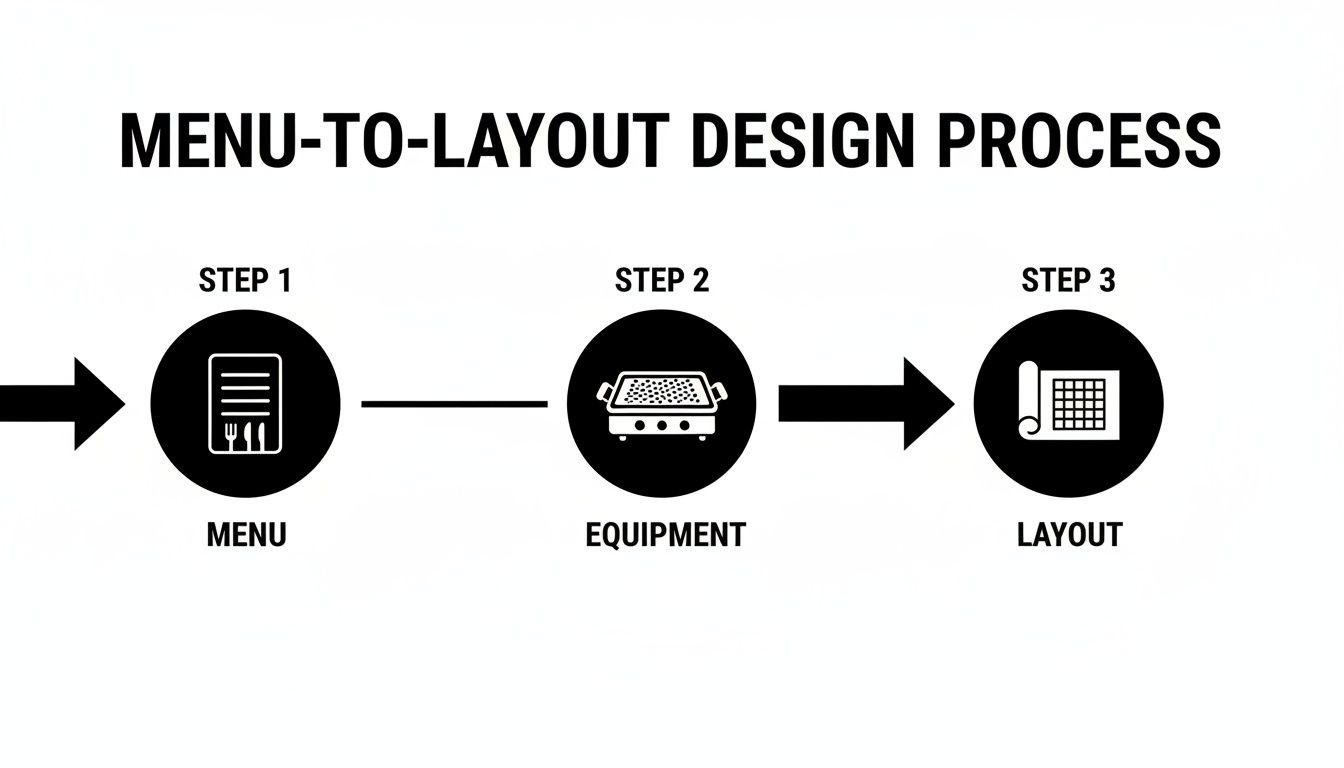
This visualization really hammers home a core principle I've seen play out dozens of times: your menu always comes first. It directly tells you what equipment you need, which in turn defines your layout.
Receiving And Storage
The journey of every dish begins at your back door. Your receiving and storage zone should be positioned right there to minimize the distance you have to haul heavy, bulky deliveries. As soon as supplies arrive, they need a home.
This area is dominated by your cold storage. Large commercial freezers and refrigerators should be as close to the receiving door as possible. This is non-negotiable for maintaining the cold chain for temperature-sensitive items like meat and seafood—a critical step for both food safety and quality. Dry goods shelving should also live here, keeping everything organized and inventoried in one spot.
Food Prep Zone
Once ingredients leave storage, they move to the food prep zone. Smart design means creating distinct areas within this zone to prevent cross-contamination, a major focus for LA County health inspectors. You need a dedicated space for raw proteins and a separate one for produce.
This is where your work surfaces become critical. High-quality, durable stainless steel kitchen prep tables are the backbone of any prep station, providing the sanitary and resilient surfaces needed for high-volume work. For a Thai restaurant in LA, this area would be filled with the sounds of chopping vegetables, while a Japanese spot would have a meticulously clean space for slicing fish.
The invisible lines between your work zones are what keep your kitchen flowing smoothly. When a chef can pivot from the prep table to the stove instead of walking across the kitchen, you're not just saving seconds—you're preventing collisions, reducing fatigue, and getting plates out faster.
The Cooking Line
Often called the "hot line," this is the heart of the kitchen—the high-energy zone where the real action happens. All your primary cooking equipment, from ranges and griddles to deep fryers and charbroilers, lives here.
Placement is everything. Equipment should be arranged logically based on your menu. For a Chinese restaurant specializing in stir-fry, powerful wok ranges will be the centerpiece. For a classic American diner, the flat-top griddle is king. Everything must be situated under a powerful ventilation hood to manage heat, smoke, and grease.
Service And Warewashing Zones
The final two zones complete the circle. The service zone, or "the pass," is the critical link between the kitchen and the dining room. It’s where dishes are garnished, inspected by the expo, and handed off to servers. This area needs to be organized and well-lit to ensure every plate goes out looking perfect.
Finally, the warewashing zone is for cleaning everything that comes back. To avoid contaminating clean dishes, this area should be located away from the food prep and cooking zones. It’s a noisy, wet area that needs its own space to function without disrupting the rest of the kitchen's workflow. Proper zoning ensures dirty dishes follow a one-way path, keeping the entire operation clean and efficient.
Placing Your Restaurant Equipment for Peak Workflow
You’ve mapped out your kitchen zones, and now it’s time to get granular. Placing individual pieces of equipment is where your layout ideas become a physical reality. This is the part of the process where small tweaks can create massive boosts in efficiency, turning a decent layout into a truly great one.
Think of it this way: your kitchen is a stage, and your chefs’ movements should be as choreographed and efficient as possible. Strategic placement is all about mirroring the natural flow of your most popular dishes, minimizing steps, and making the entire process intuitive for your team.
Sizing Up Your Cold Storage
Your commercial refrigerators and freezers are the heart of your inventory system, and getting the sizing right is crucial. It all depends on your menu and how often you get deliveries. A farm-to-table spot in Los Angeles with daily produce drops won't need the same bulk cold storage as a high-volume Thai restaurant that orders specialty ingredients less frequently.
Here are a few pointers I’ve picked up over the years for placing cold storage:
- Dock to Walk-In: Position your walk-in cooler and large freezers as close to your receiving door as you can. This simple step cuts down on the time and effort needed to haul heavy boxes and, more importantly, protects the cold chain for food safety.
- Keep it on the Line: Under-counter and reach-in refrigerators should be right there on the cooking line. A line cook making salads shouldn’t have to take a cross-kitchen journey just to grab fresh greens. It’s a workflow killer.
- The Ice Machine Crossroads: If you have a bar, try to place the ice machine where both bartenders and kitchen staff can get to it easily. This prevents bottlenecks and keeps everyone out of each other's way during a busy service.
Engineering an Ergonomic Hot Line
The hot line is where speed and precision are everything. You have to arrange your cooking equipment in a sequence that makes sense for your menu. For a classic L.A. burger joint, that flow might look like griddle, then fryer, and finally the assembly station.
Don't forget the physical toll on your staff. Ranges, fryers, and griddles should be set up to reduce unnecessary twisting and reaching. Smart placement minimizes physical strain, which is a big deal for keeping good staff in the competitive Los Angeles market. This thinking also applies to your ventilation—the hood system has to cover all your heat- and grease-producing equipment, and its location often dictates the entire hot line's layout. Remember to follow LA Health Department codes, which usually require at least six inches of clearance between equipment and walls for proper cleaning.
Technology and the Modern LA Kitchen
Smart tech is fundamentally changing how Los Angeles kitchens run. It’s no longer a novelty; it’s a necessity for efficiency. In fact, 73% of restaurant operators are increasing their tech spending to handle labor shortages.
We're seeing the design services market heading toward $2,500 million as kitchens adopt IoT ovens and smart fridges. Top-tier equipment, like Atosa's freezers with 5-year compressor warranties, allows for remote monitoring that can slash food waste by 25%. In L.A., where delivery is king after online orders grew 200% post-2020, operators are using hybrid layouts to optimize spaces between 600-1,200 sq. ft., blending dine-in with ghost kitchen capabilities. You can dive deeper into these emerging commercial kitchen trends to see where the industry is headed.
Proper equipment placement isn't just about fitting everything in. It's about creating a system where every piece of restaurant equipment supports the next, turning individual actions into a seamless operational dance that produces consistently great food.
Connecting the Dots with Utility Hookups
Finally, you can't ignore the technical side of things. Your dream layout is ultimately limited by where you can get gas, water, and electricity. You absolutely have to plan these connections early in the design process. This is even more critical for a food truck, where your entire power and water supply is self-contained.
Forgetting to map out a floor drain for the dish pit or placing a high-voltage oven where only a standard outlet exists will lead to expensive, time-consuming fixes. Work closely with your contractors from day one to make sure your layout and utility map are perfectly in sync.
Maximizing Space in Food Trucks and Compact Kitchens
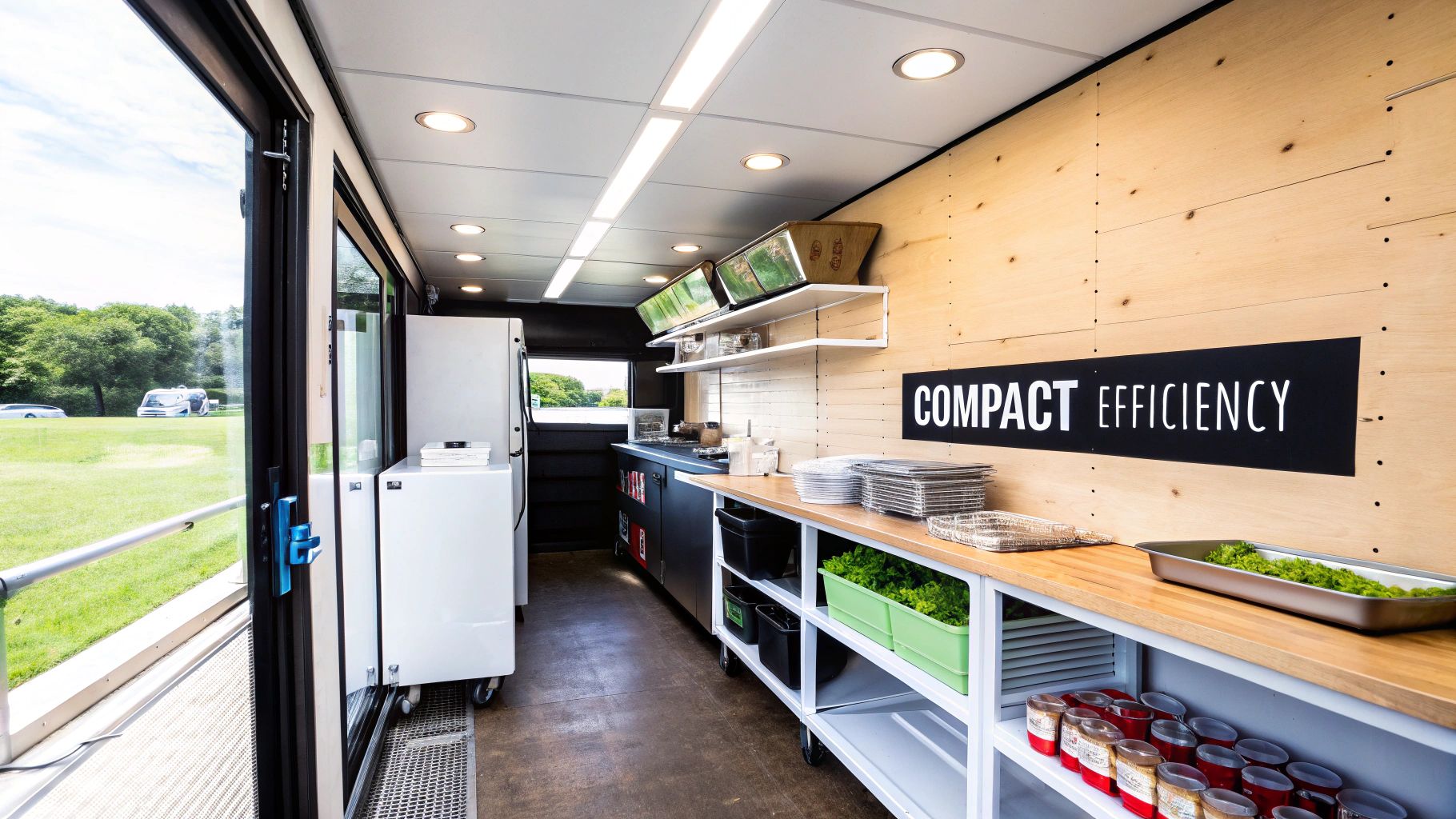
Los Angeles is the undisputed capital of food truck culture, where culinary creativity thrives in spaces no bigger than a parking spot. But designing a kitchen on wheels—or any seriously compact kitchen—is a true test of planning. Every single square inch has to be functional, safe, and built for speed.
This is where your commercial kitchen layout ideas shift from big zones to a laser-focused, linear workflow. In a space that's often less than 200 square feet, you just don't have room for wasted movement. The galley layout, with equipment lining two parallel walls, is the go-to for a reason. It creates a clear, direct path from prep to service.
The Non-Negotiables of Small-Space Design
In a tight kitchen, multi-functional equipment isn't a luxury; it's a survival tool. You don't have the real estate for a separate fridge and prep table, so a refrigerated chef base or an under-counter unit is the only logical move. Everything has to pull double, or even triple, duty.
Think vertically. Wall-mounted shelving, magnetic knife strips, and overhead pot racks are your best friends. They get clutter off your precious counter space, keeping tools within arm's reach without turning into obstacles.
- Under-Counter Atosa Refrigerators: These are absolute workhorses. They fit neatly under your prep surfaces to keep ingredients chilled right where you need them.
- Countertop Cooking Equipment: A countertop griddle or induction burner gives you the cooking power you need without eating up valuable floor space.
- Vertical Shelving: Go up, not out. Use every inch of wall space for storing dry goods, smallwares, and pans.
The real goal is to build an environment where a small team—often just two or three people—can pump out a menu flawlessly without ever taking more than a step or two in any direction.
A Sample Food Truck Workflow
Let's walk through a classic LA food truck layout to see these principles in action. This linear flow is perfect for a simple, high-volume menu like fusion tacos or gourmet sliders.
It starts at the back of the truck with compact, energy-efficient commercial refrigerators and freezers. This is where your bulk ingredients live, right next to the three-compartment sink for warewashing.
Moving forward, you hit the prep station. This includes a small cutting board space and a refrigerated prep table holding all the fresh toppings ready for service.
Next, the hot line runs along one wall, featuring a flat-top griddle, a two-burner range, and a deep fryer, all sitting under a powerful, low-profile ventilation hood. The final stop is the service window, with a small counter for plating orders and taking payments.
A food truck layout is the ultimate exercise in kitchen ergonomics. Every piece of equipment must be chosen for its compact footprint and multi-functionality. Your workflow isn't just a path—it's a tight, efficient loop designed for maximum output in minimum space.
The Rise of Modular Design
In LA's bustling foodservice industry, modular kitchen designs are a game-changer for mobile and brick-and-mortar spots alike. Industry reports show these flexible layouts can slash construction time by 30-50%. That kind of speed is critical, especially when 73% of operators are investing more in tech and design to combat workforce shortages.
Around 45% of owners name layout flexibility as vital for tackling labor issues. It's a big deal. In the U.S., where the average commercial kitchen is 1,000 sq. ft., modular designs are proven to cut cross-traffic by 25%, which boosts both safety and service speed. You can dive deeper with this in-depth market report.
Mastering the art of the compact kitchen requires a different mindset, and our food truck equipment list can guide you in selecting the right pieces for your mobile masterpiece.
Answering Your Commercial Kitchen Layout Questions
Figuring out the logistics of a commercial kitchen design in Los Angeles brings up a ton of questions. It doesn't matter if you're launching a brand-new food truck or gut-renovating a classic restaurant space—getting the right answers is what separates a smooth-running operation from a daily struggle. Let’s dive into some of the most common questions we hear from LA restaurant owners planning their kitchen layouts.
How Much Space Should My Kitchen Take Up?
The old-school rule of thumb says your kitchen should be about 30% of your restaurant's total square footage. Another way to look at it is aiming for five square feet of kitchen space for every seat in the dining room. So, a 100-seat spot in Koreatown would theoretically need a 500-square-foot kitchen.
But honestly, that's just a starting point. Your concept is the real boss here. A delivery-only ghost kitchen might flip that ratio completely, dedicating 80-90% of its entire space to the kitchen. On the other end of the spectrum, a Los Angeles food truck is all kitchen, making every single inch of its typical 150-300 square feet count. The final call should always come down to your menu's complexity and storage needs, not some generic formula.
What Are the Biggest Layout Mistakes to Avoid?
Without a doubt, the single biggest mistake is a bad workflow. When your layout forces staff to constantly cross paths, you get collisions, service grinds to a halt, and the whole atmosphere becomes stressful. It's the cardinal sin of kitchen design.
Another all-too-common error is underestimating how much storage you’ll actually need. If you don't plan for enough cold storage—like properly sized commercial refrigerators—you're basically signing up for cluttered, unsafe workspaces and a chaotic inventory. This isn't just an inconvenience; it hits your food costs and efficiency hard.
A lot of new owners also get their ventilation needs wrong. That mistake leads to a hot, smoky kitchen and, even worse, failed LA County health inspections. Lastly, don't overlook basic ergonomics. A layout that puts unnecessary physical strain on your chefs is a recipe for burnout and high turnover.
How Do I Design a More Energy-Efficient Layout?
An energy-efficient kitchen really begins with smart equipment placement. Your best move is to group all your heat-producing appliances—your ranges, ovens, and fryers—together under one high-efficiency ventilation hood. This keeps the heat concentrated, letting your exhaust system do its job without working overtime.
It's absolutely critical to keep your refrigeration units far away from this "hot zone." When you stick freezers and refrigerators next to a hot cook line, their compressors have to run constantly just to maintain temperature. That's a huge, and completely avoidable, energy drain.
Here are a few more practical tips for an energy-savvy design:
- Pick ENERGY STAR® certified equipment: This is the easiest way to cut your utility bills right from the start.
- Stick to a routine maintenance schedule: Clean refrigerator coils, calibrated ovens, and tight gaskets make sure all your restaurant equipment runs at peak efficiency.
- Install motion-sensor lighting: In walk-ins and storage areas, this simple tech upgrade can make a big dent in your electricity waste.
What's the Real Difference Between a Commercial and Home Kitchen?
The differences are massive, and they really come down to three things: durability, workflow, and regulations. Commercial kitchens are built to take a beating, day in and day out. They’re all about heavy-duty stainless steel surfaces and tough equipment, like commercial refrigerators designed to handle being opened and closed hundreds of times a day.
The workflow is a completely different world, too. A home kitchen might use that friendly "work triangle," but a commercial kitchen is all business, built around an assembly-line or zone-based flow for maximum speed. A chef running a busy Chinese restaurant in the San Gabriel Valley needs a straight line for production, not a social gathering spot.
Most importantly, any commercial kitchen in Los Angeles has to follow a mountain of strict health and safety codes. These aren't suggestions—they're rules that dictate everything from the space between equipment and walls to ventilation standards and sanitation protocols. The requirements are worlds away from anything you'd find in a residential kitchen.
Ready to build a kitchen that’s as ambitious as your menu? Los Angeles Restaurant Equipment provides the professional-grade Atosa refrigerators, freezers, and cooking equipment you need to bring your commercial kitchen layout ideas to life. Get started today at https://losangelesrestaurantequipment.com.