

Cooking Equipment for Food Truck: A Los Angeles Operator's Guide
Kitting out your food truck with the right equipment is probably the single biggest decision you'll make when you're starting out in the competitive Los Angeles market. The goal is to find that perfect sweet spot: cooking equipment for a food truck that can churn out orders during a crazy rush but is also compact enough for your tight space. This means finding workhorse pieces like versatile griddles, high-efficiency fryers, and dependable commercial refrigerators that will become the heart of your mobile kitchen.
Building Your LA Food Truck Kitchen Blueprint
Launching a food truck in Los Angeles isn't just about having a killer menu. It's a whole different beast that requires you to think like an engineer, especially when it comes to your kitchen layout. Unlike a brick-and-mortar restaurant with room to spread out, you’re working within a tiny footprint, usually somewhere between 120 to 200 square feet. This squeeze means every single piece of restaurant equipment has to earn its spot based on size, power draw, and how many jobs it can do.
Think of your truck's interior like a high-stakes game of Tetris. Every component, from the commercial freezer in the back to the flat-top griddle up front, has to slot in perfectly and work together without a hitch. Your blueprint has to be built around your specific menu. If you're slinging Korean BBQ tacos in Koreatown, you'll need powerful charbroilers. Making Thai street food? You're going to need high-heat ranges.
This planning phase is where you build the foundation for a smooth, profitable operation. A well-thought-out blueprint always considers:
- Workflow: How will your crew move from the commercial refrigerator to the prep counter to the cooking line during a chaotic lunch rush in Santa Monica? Every step counts.
- Compliance: Is your ventilation and power setup going to pass the tough Los Angeles County health and safety codes? No cutting corners here.
- Menu Execution: Can the gear you picked actually handle the volume and cooking styles your menu requires? From frying Japanese tempura to shaving Mexican al pastor, your equipment has to keep up.
A Los Angeles food truck is basically a high-output culinary machine crammed into a small box. Whether that machine runs smoothly or breaks down depends entirely on the quality and layout of its parts. Choosing reliable, space-saving cooking equipment isn't just a setup choice; it's a core business strategy.
And don't forget, a complete blueprint goes beyond just the big-ticket items. As you're mapping out your kitchen, you have to think about your day-to-day consumables too. For some great tips on what to choose, check out these insights on eco-friendly takeaway containers. Thinking ahead like this ensures that every part of your business, from cooking the food to handing it to the customer, is set up for success in the competitive LA market.
Assembling Your Core Cooking and Cooling Stations
Think of your food truck kitchen as a finely tuned machine. Every single piece of equipment has to pull its weight, especially when you're slammed during that downtown LA lunch rush. This is where you build the engine of your mobile business, choosing the core hot and cold stations that will make or break your service.
Your hot line is the heart and soul of your operation. For so many of LA's most popular food trucks, the flat-top griddle is the undisputed MVP. It’s a true workhorse, perfect for searing up carne asada, flipping burgers for the beach crowd in Venice, or getting breakfast burritos ready for the morning commute. A solid commercial deep fryer is another must-have, essential for everything from perfect French fries to light and crispy Japanese tempura. The trick is to find compact, high-recovery models made for mobile kitchens that won’t buckle under pressure or kill your generator.
Your cold line is just as critical for keeping things safe and efficient. High-performance commercial refrigerators and freezers are absolutely non-negotiable. In the tight quarters of a food truck, under-counter units and refrigerated prep tables are your best friends. They pull double duty, giving you cold storage and precious prep space, so your ingredients are always chilled and right where you need them.
Matching Equipment to LA Cuisines
The gear you pick is a direct reflection of your menu. You can't just grab any old equipment and expect it to work for every concept in a food city as diverse as Los Angeles. Your equipment list literally tells the story of your food, whether it's Mexican, Japanese, Korean, Chinese, or Thai cuisine.
- Korean BBQ: You absolutely need a powerful charbroiler. It’s the only way to get that authentic smoky char on galbi and bulgogi, making it the star of your hot line.
- Mexican Tacos: A big flat-top griddle is your go-to. It's what you'll use for cooking meats, warming up tortillas, and getting that perfect melt on quesadillas.
- Thai Curries: A multi-burner commercial range is key. You need it to keep pots of curry simmering away while you're stir-frying noodles or veggies in a wok right next to them.
- Japanese Ramen: High-output stock pot burners are a must. They’re built to keep massive pots of broth at the perfect, consistent temperature all day long.
- Chinese Dumplings: A combination of a small range for pan-frying and a dedicated steamer is essential to get that perfect texture.
Getting the right restaurant equipment from day one saves you from expensive mistakes and frustrating bottlenecks down the road. This initial investment is one of the biggest factors for success in the ever-growing LA food truck scene.
To help you get started, this table breaks down some of the most common equipment choices for popular LA food truck concepts.
Hot and Cold Station Equipment for LA Food Trucks
| Equipment Type | Best For (Cuisine) | Key Feature (Space/Power) | LA Operator Tip |
|---|---|---|---|
| Flat-Top Griddle | Tacos, Burgers, Breakfast | Highly versatile, large surface | Get the biggest one your truck can fit and power. It will always be in use. |
| Charbroiler | Korean BBQ, Steaks | Intense, direct heat for searing | Requires excellent ventilation. Check LA health codes for specific requirements. |
| Deep Fryer | Fries, Fried Chicken, Tempura | High-recovery rate | Choose a propane model to reduce the load on your generator. |
| Multi-Burner Range | Thai, Chinese, Soups, Sauces | Flexible for pots and pans | A 4-burner is a good starting point for most sauce-heavy menus. |
| Under-Counter Fridge | All Cuisines | Space-saving, keeps items at hand | Look for units with durable stainless steel tops for extra prep space. |
| Refrigerated Prep Table | Sandwiches, Salads, Tacos | Combines storage and workspace | The ultimate efficiency tool. It will speed up your assembly line tenfold. |
Choosing wisely from this list gives you a solid foundation to build your mobile kitchen around.
The diagram below gives you a simple visual of how these core components fit together.
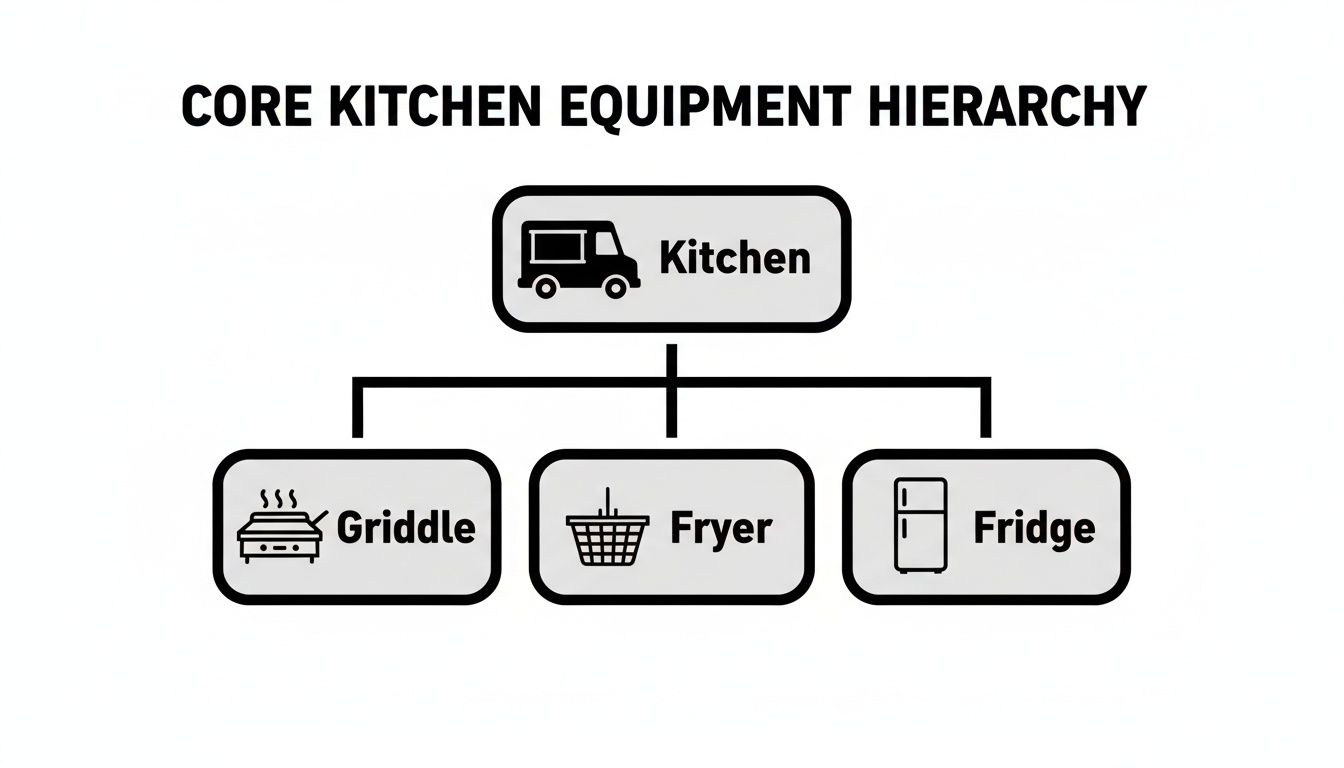
It’s easy to see how these main cooking and cooling stations form the essential pillars that hold up your entire kitchen operation.
Right-Sizing Your Refrigeration and Freezers
When it comes to cold storage, it's all about size and efficiency. The name of the game is getting as much cold space as possible without eating up your valuable floor space. That’s why undercounter commercial refrigerators and freezers that tuck right under your counters are the standard for Los Angeles food trucks.
A refrigerated prep table is easily one of the smartest pieces of gear you can buy for a food truck. It gives you a chilled ingredient rail, a cutting board, and undercounter cold storage all in one spot, making it a breeze to assemble things like sandwiches, salads, or tacos.
This all-in-one approach keeps everything you need chilled, organized, and right at your fingertips, which directly impacts how fast you can serve customers. Making sure your units are energy-efficient is also a huge deal, as it eases the strain on your generator. If you're looking for more options, you can learn more about choosing the right energy-efficient commercial refrigerators for your setup.
The demand for mobile food isn't slowing down, either. The U.S. food truck market is expected to grow from $1.16 billion in 2026 to $1.59 billion by 2031, which is a compound annual growth rate of 6.53%. This shows that people's appetite for food trucks is only getting bigger, making reliable, professional-grade restaurant equipment more important than ever. By carefully picking your core cooking and cooling stations, you’re setting up your LA food truck to meet that demand and succeed.
Powering Your Mobile Kitchen Safely and Reliably
Let's be honest, all that gorgeous, state-of-the-art cooking equipment is just shiny stainless steel decoration without a solid, safe power supply. The stuff you don't see—the gas lines and electrical system—is the real heart of your mobile kitchen. Getting this part right isn't just a good idea; it's absolutely non-negotiable for operating legally and successfully anywhere in Los Angeles.
Think of your power system as your truck’s central nervous system. It’s what sends life to every single appliance, from the charbroiler cranking at high heat to the commercial refrigerator keeping your ingredients safe. One weak link in this chain can shut your whole operation down right in the middle of a profitable lunch rush.
Choosing the Right Fuel for the Job
When it comes to powering heavy-duty cooking gear on a truck, propane is the undisputed king of the food truck world. It’s portable, packs a serious energy punch, and is cost-effective, making it the perfect fuel for a mobile setup. Propane tanks are easy to find, refill, and securely mount, giving you the massive BTUs you need for griddles and fryers without putting a strain on your generator.
If you’re coming from a brick-and-mortar restaurant, you’re probably used to natural gas. But that relies on a fixed pipeline, which just won't work when you're on the move. Getting familiar with propane is a must. For a great breakdown on making the switch, you can learn more about converting from natural gas to propane for your specific appliances.
To really dig into the details and make sure you're choosing the safest and most efficient fuel, it helps to see a direct comparison. Check out this great resource on propane vs. CNG fueling to weigh all the pros and cons.
Calculating Your Electrical Needs
While propane is handling the serious heat, electricity is running everything else. We're talking about your commercial freezer, blenders, lights, and your point-of-sale system. To avoid a disaster mid-service, you have to pick a generator that can handle your absolute peak electrical demand.
First, make a complete list of every single thing on your truck that plugs in. For each item, you need two key numbers:
- Running Watts: The power an appliance uses just to stay on and operate normally.
- Starting Watts: This is the extra jolt of power an appliance needs to kick on its motor. Commercial refrigerators and freezers are the big culprits here, often needing 2-3 times their running wattage to start up.
Add up the running watts for all the equipment you'll be using at the same time. Then, find the single highest starting wattage on your list and add that number to your total. The result is the absolute minimum output your generator needs. To be safe, always add a 20-25% buffer on top of that.
An undersized generator is easily one of the most common—and expensive—mistakes new Los Angeles food truck owners make. It causes tripped breakers, can fry your expensive equipment, and means lost sales. Always, always invest in more power than you think you need.
Safety and Compliance Are Non-Negotiable
Here in Los Angeles, having a professionally installed and compliant power system isn't just a suggestion—it's the law. The Los Angeles County Department of Public Health has very strict codes for gas lines, electrical wiring, ventilation, and fire safety on mobile food trucks.
Your setup absolutely must include:
- Professional Installation: Get a licensed pro to install all gas lines and electrical wiring. This ensures everything is secure, free of leaks, and built to code.
- Proper Ventilation: Your exhaust hood has to be correctly sized for your cooking equipment. It’s critical for pulling out heat, smoke, and grease-filled air, which is a massive fire risk.
- Fire Suppression System: A commercial-grade, automated fire suppression system installed right inside your hood isn't optional; it's mandatory. This is your first line of defense if a fire breaks out.
Never, ever cut corners on these systems. A failed inspection will shut your business down before you sell a single taco. By investing in a safe, reliable, and compliant power infrastructure from the start, you're building a solid foundation for long-term success on the streets of LA.
Designing Your Layout for Maximum Workflow Efficiency
In a Los Angeles food truck, space isn't just a commodity; it's the single most valuable thing you own. A smart, well-thought-out layout is what makes the difference between a chaotic kitchen and a high-output machine that gets orders out fast. The goal is to create a natural workflow that cuts down on extra steps and keeps your crew from bumping into each other during a hectic lunch rush.
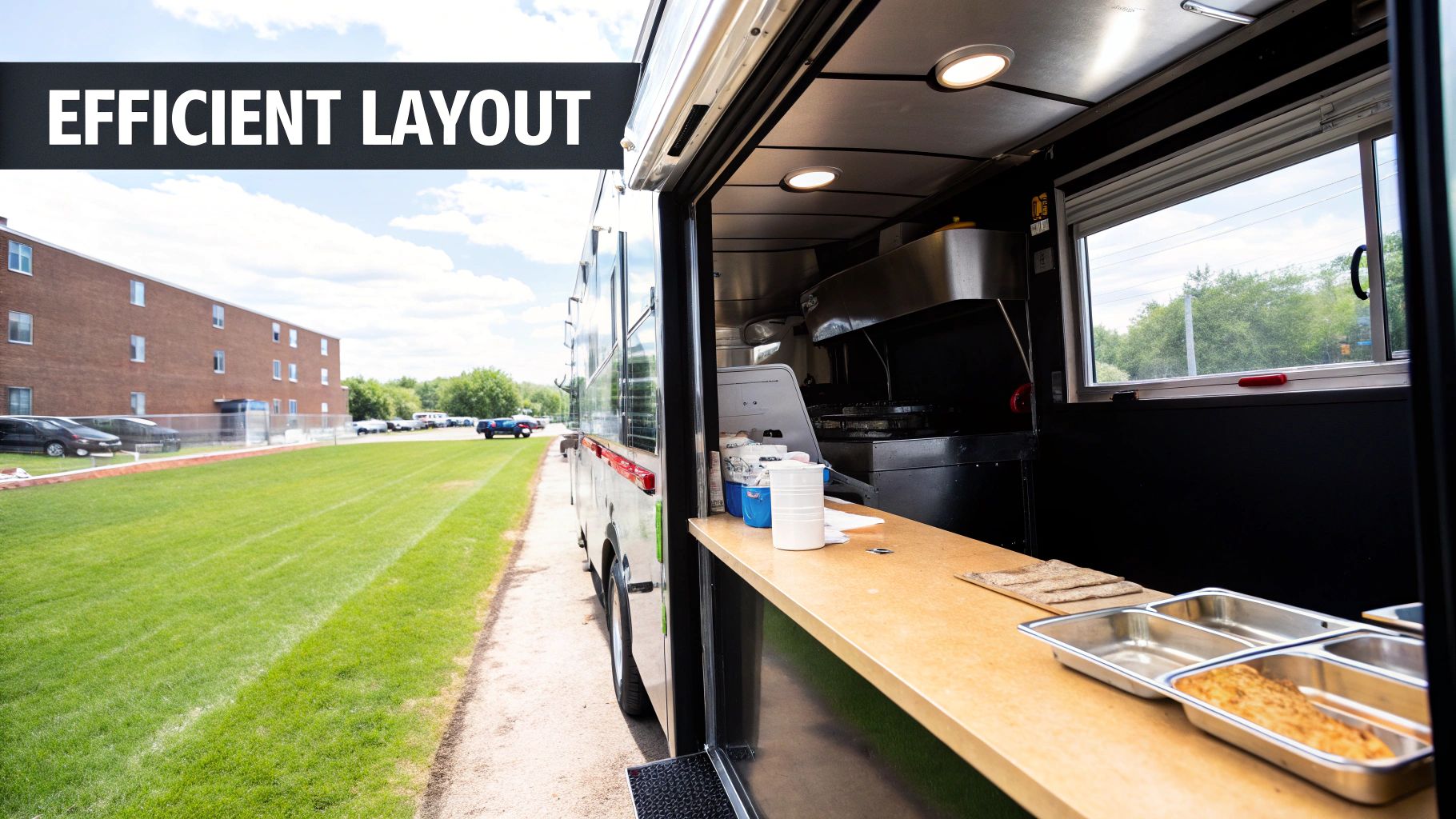
You’ve probably heard of the "kitchen work triangle" in restaurants, which connects the fridge, stove, and sink. In a long, narrow food truck, that triangle stretches out into a straight line. Every single piece of cooking equipment for a food truck has to be placed in a logical order that follows an order from the ticket printer to the service window.
Adapting the Assembly Line Concept
Your layout needs to guide your staff seamlessly. Ingredients come out of the commercial refrigerator, hit a prep station, move down the hot line for cooking, and finally get plated or packaged at the window. This flow is everything when it comes to speed.
A good path prevents bottlenecks and wasted energy. Every step you save a cook is a few seconds shaved off an order time. Over a day, that adds up to more customers served and more money in your pocket. The whole process really begins with where you put your commercial refrigerator and prep tables.
Strategic Placement for LA Cuisines
The perfect layout always comes down to your menu. How you set up your truck for Japanese ramen on the streets of LA will look completely different from one selling Mexican street tacos.
Let's break it down with a couple of real-world examples:
- For a Mexican Taco Truck: Your flow should start with a refrigerated prep table holding your meats, salsas, and toppings. This should be right next to a big flat-top griddle. From there, the griddle needs to be close to the service window for quick assembly and hand-off.
- For a Japanese Ramen Truck: The process starts at the back with powerful stockpot burners for the broth. Next in line is your noodle cooking station, followed by a prep area with refrigerated rails for toppings like chashu pork and soft-boiled eggs, all positioned just before the window.
Think of your food truck layout less like cramming things into a box and more like choreographing a dance. When you get it right, your team moves efficiently, orders fly out, and the whole operation runs like a well-oiled machine, even when things get crazy.
Maximizing Every Square Inch
Once you have the main workflow figured out, smart storage is the next step to keeping your small space functional. Wasted space is wasted potential.
To really make the most of your compact kitchen, try these space-saving moves:
- Go Vertical: Get some wall-mounted shelves installed above your prep counters for dry goods and small kitchen tools. Magnetic knife strips are also a fantastic way to keep tools handy without cluttering up your workspace.
- Undercounter Everything: Use every last bit of space below your counters. Undercounter commercial refrigerators and freezers are an absolute must to keep your floor space clear.
- Multi-Purpose Equipment: Look for equipment that can pull double duty. A refrigerated prep table that gives you both cold storage and a workspace is one of the smartest investments you can make.
By planning your layout around your menu and workflow, you can turn a tight, cramped box into a seriously profitable mobile kitchen ready to compete in the Los Angeles food scene.
How to Finance Your Food Truck Equipment
Getting your hands on the right commercial cooking equipment is a huge step, but it shouldn't empty your bank account before you sell your first taco. For any entrepreneur in Los Angeles, a smart financial plan is just as critical as a killer menu. Outfitting a mobile kitchen costs a lot of money, but thankfully, there are several solid financing options to get the gear you need without going broke.
This is your roadmap to getting professional-grade restaurant equipment while protecting your startup budget. Knowing your options helps you make choices that will keep your business healthy for the long haul.
Buying New Versus Used Equipment
The first big money decision you'll face is whether to buy new or used restaurant equipment. While the lower price tag on used gear is tempting, especially for a new food truck owner, it often comes with hidden problems. Used equipment usually doesn't have a warranty, which means a breakdown could lead to pricey repairs and serious downtime—right when you can't afford it.
New equipment, on the other hand, gives you reliability and peace of mind. It comes with a manufacturer's warranty, a critical safety net for workhorses like your commercial refrigerators and freezers. New gear is also guaranteed to meet current Los Angeles health codes, saving you from compliance nightmares. Think of it as an investment in consistency; you pay more upfront, but you get the assurance that your equipment will show up and perform during every single service.
Leveraging Equipment Financing and Leasing
For most LA food truck operators, financing or leasing is the smartest way to go. These options let you hold onto your precious startup cash for other must-haves like inventory, permits, and marketing. Instead of one massive payment, you'll make manageable monthly payments that fit right into your cash flow.
Here’s a quick look at the benefits:
- Conserve Capital: Keep cash on hand for daily operations and those unexpected costs that always pop up.
- Predictable Payments: Fixed monthly payments make budgeting and managing your money so much easier.
- Build Business Credit: Making your payments on time helps build a strong credit history for your business.
- Access Better Equipment: Financing can help you afford higher-quality, more efficient equipment than you could if you were buying it all with cash.
Equipment leasing is like a financial shock absorber. It lets you get the high-performance gear you need to compete in the tough LA market, but it spreads the cost out so your initial budget doesn't take a massive hit.
Many food truck owners find these options incredibly helpful. For a deeper dive into how this all works, check out this great guide on restaurant equipment financing that walks you through the process.
Demystifying the Procurement Process
Once you’ve got your financing figured out, it’s time to actually buy the equipment. This part can sound complicated, but it really boils down to a few simple steps. The goal is to get the best gear for your truck at a clear price, with a delivery process that doesn't cause any headaches.
Start by getting detailed quotes for everything on your list, from your main griddle down to your under-counter commercial refrigerator. Make sure those quotes include taxes, shipping, and any installation fees so there are no surprises later. After you've locked in your financing and placed the order, coordinate the delivery details carefully. You're working in a tight space, so setting a delivery time that won't disrupt your truck build-out or service schedule is key. Planning this final step makes the whole experience a lot less stressful.
Protecting Your Investment with Warranties and Maintenance
Dropping serious cash on high-quality cooking equipment is a huge milestone for your food truck. But what happens after you swipe the card is just as crucial. Think of your gear as the engine of your Los Angeles business—if it's not running, you're not making money. Protecting that investment isn't just an expense; it's an insurance policy against crippling downtime.
A solid warranty is your first line of defense. The inside of a mobile kitchen is a tough environment. Equipment runs for hours on end in tight, hot spaces, making breakdowns a very real possibility. A weak warranty on that commercial refrigerator or fryer can turn a simple fix into a full-blown financial headache.
Setting the Standard for Warranties
Not all warranties are built the same. When you're comparing restaurant equipment, you want a warranty that proves the manufacturer has real confidence in its product. This is especially true for your most expensive, mission-critical items like commercial refrigerators and freezers.
The gold standard for refrigeration coverage is pretty clear. You should be looking for a warranty that offers two years on parts and labor plus an additional five years on the compressor. This kind of protection covers everything from minor tweaks to major component failures, giving you some serious peace of mind.
That robust coverage means if the compressor—the heart of your fridge—gives out, you won't be staring down a bill that could easily run into the thousands. Beyond the terms, make sure the warranty is backed by an authorized service network. You need qualified technicians who can get to your LA location fast to keep you on the road.
A Practical Maintenance Checklist
Preventative maintenance is the easiest way to get more life out of your gear and dodge those frantic emergency service calls. A few small, consistent habits can save you from massive headaches down the line. Here’s a simple checklist to keep your core equipment in fighting shape.
Daily and Weekly Tasks:
- Fryers: Filter that oil every single day. It makes the oil last longer and your food taste better. Don't forget to wipe down the exterior to keep grease from building up.
- Griddles: Scrape the cooktop clean right after service while it’s still warm. You absolutely must empty and clean the grease trap daily to prevent overflows and fire hazards.
- Refrigerators & Freezers: Wipe down all surfaces, inside and out. Check the door gaskets to make sure they're clean and forming a tight seal—you don't want to be paying to cool the entire truck.
Monthly Checks:
- Refrigeration Coils: Gently clean the condenser coils. When they get clogged with dust and grease, the compressor has to work way harder, jacking up your energy bill and risking a total failure.
- Ventilation Hoods: Pull out the grease filters in your exhaust hood and give them a thorough cleaning. Clogged filters are a huge fire risk and make your hood less effective.
- Gas Hoses & Connections: Do a quick visual inspection of all your gas lines, looking for any cracks or signs of wear. A simple soap-and-water bubble test can help you spot any leaks.
Taking this proactive approach means your kitchen is always ready to go. It builds operational resilience, keeping your Los Angeles food truck running smoothly, serving happy customers, and bringing in revenue day in and day out.
Common Los Angeles Food Truck Equipment Questions
Stepping into the world of food truck kitchens can bring up a lot of questions, especially in a competitive market like Los Angeles. We get it. Here are some of the most common things both new and seasoned operators ask, with answers to help you build out a mobile kitchen that works.
What Is the Most Essential Piece of Cooking Equipment for a Los Angeles Food Truck?
While the perfect answer really depends on your menu, a versatile flat-top griddle is almost always the best place to start. It’s a true workhorse. A good griddle can handle a massive range of items, from breakfast burritos and pancakes to the burgers, quesadillas, and cheesesteaks that are so popular across LA.
Its large, flat surface is perfect for pushing out a high volume of food during those peak lunch and dinner rushes. For so many iconic Los Angeles food concepts, from a Mexican taco truck to a gourmet slider spot, the griddle is the absolute heart of the hot line. Pair it with a solid under-counter commercial refrigerator for your prep station, and you’ve got the foundation for a killer mobile kitchen.
How Do I Calculate Power Needs for My Food Truck?
Figuring out your power needs is crucial. Start by making a list of every single piece of electrical equipment you plan on using at the same time. You'll need to find the wattage for each item, which is usually listed on a sticker on the machine or in its user manual.
Add up all those wattages to get your total running watts. This next part is important: you have to add a 20-25% buffer on top of that total. This extra juice covers the initial power surge that motors in commercial refrigerators and freezers need to start up. That final number is the minimum generator output you should be looking for. It's always a smart move to have a licensed electrician in Los Angeles double-check your math to make sure your setup is both safe and up to code.
When you're outfitting a Los Angeles food truck, buying new restaurant equipment is highly recommended, especially for your most important gear like commercial refrigerators and primary cooking appliances. New equipment comes with a solid warranty, which means a single breakdown won't put you out of business.
Newer gear is also more energy-efficient and guaranteed to pass LA’s tough health code inspections. While used equipment might seem like a bargain at first, the risk of surprise repairs, compliance headaches, and no warranty can cost you way more in downtime and money in the long run.
Ready to outfit your Los Angeles food truck with reliable, professional-grade restaurant equipment? Los Angeles Restaurant Equipment offers a complete selection of Atosa commercial refrigerators, freezers, griddles, and fryers designed for the demands of mobile kitchens. Explore our inventory and get your business rolling at https://losangelesrestaurantequipment.com.