

Essential Equipment for Los Angeles Food Truck Kitchens: A Startup Guide
Outfitting your food truck kitchen is the single most important decision you'll make. Get it right, and you're set up for success in a competitive market like Los Angeles. Get it wrong, and you'll be fighting your own setup during every service.
Your Blueprint for a High-Performance Food truck Kitchen
Launching a food truck in L.A. is all about engineering a kitchen for speed and efficiency. The real challenge isn't just buying equipment; it's picking gear that can power everything from Korean BBQ tacos to authentic Mexican street food, all squeezed into a space that’s smaller than most home kitchens.
Think of your setup as a delicate balance of three critical elements: space, power, and workflow. Every single piece of restaurant equipment, from a high-output griddle to a trusty commercial refrigerator, has to serve this trinity. This guide isn’t a simple checklist. It's the engine blueprint for your mobile restaurant's success in the city's incredible food scene.
The Foundation of a Mobile Kitchen
The right equipment isn't just about cooking. It's about building a system that won't buckle under the pressure of a chaotic lunch rush. Success hangs on smart choices that make every square inch of your truck count.
- Menu-Driven Selection: Your gear has to match your food. A truck slinging authentic Thai food absolutely needs high-BTU burners for proper wok cooking, while a Mexican taco concept is dead in the water without a massive flat-top griddle.
- Compact & Multi-Functional: Always prioritize equipment that pulls double or triple duty. A combination oven, for instance, can bake, steam, and roast, saving you a ton of space compared to buying separate units.
- Durability on the Road: Your appliances have to be tough. We're talking commercial-grade, built to handle the constant vibrations and jolts of a mobile kitchen. Standard restaurant equipment just won't cut it.
Essential Food Truck Kitchen Equipment at a Glance
Getting a handle on the core equipment categories is the first step. This table breaks down the non-negotiables to give you a quick overview of what you'll need to start planning your layout.
| Equipment Category | Primary Function | Example for L.A. Cuisines |
|---|---|---|
| Hot Line/Cooking | Cooking raw ingredients | Flat-top griddle (Mexican), Wok Range (Chinese/Thai) |
| Refrigeration | Cold food storage, prep | Undercounter Refrigerator, Sandwich Prep Table |
| Sanitation | Hand washing, dishwashing | 3-Compartment Sink, Hand Washing Sink |
| Power & Utilities | Running all equipment | Generator, Propane Tanks, Water Heater |
This is just the starting point, but seeing it laid out like this helps you visualize how all the pieces fit together to form a functional, health-code-compliant kitchen on wheels.
This careful selection process is more important than ever as the demand for mobile food keeps climbing. The food service equipment market, valued at a staggering USD 43.34 billion in 2024, is booming, largely thanks to the rise of food trucks and ghost kitchens. This trend is pushing operators to invest in smarter, more efficient tools that cut down on labor costs and improve food safety—two things every mobile vendor in Los Angeles obsesses over. You can explore more data about the food service equipment market and its growth to see where the industry is headed.
Choosing Cooking Equipment to Power Your Menu
The hot line is the very heart of your food truck. It’s where your menu comes alive, and picking the right cooking equipment isn't just about filling a space—it’s about choosing the tools to perfectly execute your vision, especially in L.A.'s fast-paced food scene. Think of your appliances as the direct link between raw ingredients and a happy, paying customer.
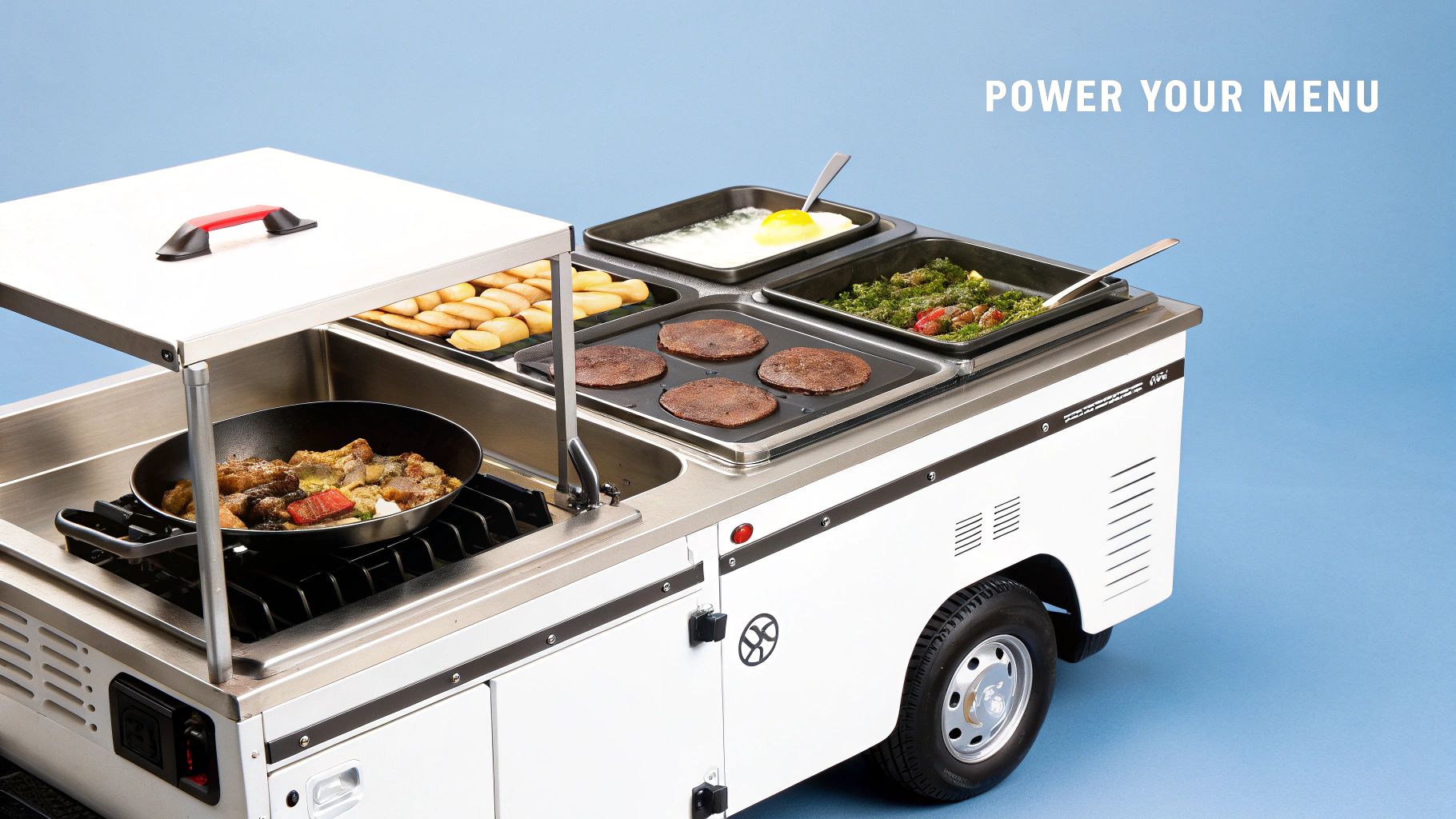
Your cooking setup should be a specialized toolkit. Just like a carpenter wouldn't use a hammer to cut wood, you shouldn’t try to perfect birria tacos without the right griddle. Every piece has to be chosen with purpose to support your specific menu, making sure you can deliver on speed, consistency, and flavor.
This means you need to go beyond a generic checklist and really match your restaurant equipment to the food you want to serve. The goal is to build a hot line that not only fits in your truck but actually powers your unique concept.
Matching Appliances to L.A. Cuisines
In a city celebrated for its incredible food culture, your equipment absolutely has to produce authentic flavors. A one-size-fits-all setup will just leave you struggling to keep up, and the quality of your dishes will suffer.
For a classic Los Angeles Mexican food truck, a multi-zone flat-top griddle is non-negotiable. This thing is a workhorse. It lets you sear carne asada on a high-heat zone while you warm tortillas on a cooler section, all at the same time. You're maximizing your output on one surface, which is a game-changer in a tight space.
But if you're diving into Asian cuisines, your needs are totally different. To get that signature wok hei—the "breath of the wok"—for a killer Thai or Chinese stir-fry, you need a high-BTU commercial range. Your standard burners just won't cut it. A commercial deep fryer is just as important for getting that perfect crunch on Korean fried chicken or Japanese tempura.
A food truck’s footprint is often between 120 to 200 square feet, making every equipment choice critical. Multi-functional, high-output appliances are not just a luxury; they are a necessity for survival and profitability on the streets of L.A.
The Power of BTUs and Multi-Functionality
When you're shopping for cooking gear for your truck, two things matter most: BTUs and versatility. Get these right, and you'll build a much more efficient and powerful mobile kitchen.
BTU (British Thermal Unit) is all about heat output. Higher BTUs mean your equipment heats up faster and recovers its temperature quicker. During a slammed lunch rush, a high-BTU griddle or fryer will stay hot even when you load it with cold food. That keeps your ticket times down and your food quality up.
Versatility is your other best friend. Always look for equipment that can pull double or triple duty.
- Combination Ovens: These can bake, steam, roast, and hold food, replacing several bulky appliances in one go.
- Countertop Charbroilers: Perfect for adding that smoky flavor to burgers or Korean BBQ skewers without sacrificing floor space for a full-sized grill.
- Induction Cooktops: They give you rapid, precise heat, but they also produce less ambient heat inside your truck—a huge plus—and they're incredibly energy-efficient.
Picking the right food truck grill or griddle is one of the biggest decisions you'll make. For a deeper look at your options, check out our guide on selecting the perfect food truck grill.
Ultimately, the best cooking equipment feels like an extension of your team. It should work reliably, produce consistent results, and help you serve incredible food, faster. By matching your appliances to your specific L.A. cuisine, you're not just buying equipment—you're investing in your truck’s success.
Mastering Cold Storage in a Mobile Kitchen
While the sizzle of your hot line grabs all the attention, your cold station is the quiet hero working behind the scenes to keep your food safe and delicious. Getting refrigeration right is a huge challenge in any mobile kitchen, especially under the non-stop Los Angeles sun. It's tempting to think about using a standard residential fridge to cut costs, but that's a rookie mistake that leads straight to failed health inspections and a ton of spoiled food.
Think about it: your Los Angeles food truck is always moving. It’s vibrating, hitting bumps, braking, and turning. A fridge from a home kitchen just isn't built for that kind of abuse. The compressor will give out, and the seals aren't strong enough to hold a food-safe temperature when it’s scorching hot outside.
This is exactly why commercial refrigerators and freezers are a must. They’re built tough, with powerful compressors and durable stainless steel bodies designed to handle life on the road. Most importantly, they’re engineered to get back to the right temperature quickly after the door has been opened—which, during a busy lunch rush, happens constantly.
Choosing the Right Commercial Refrigerators and Freezers
The perfect refrigeration setup for your truck comes down to your menu and how you work. A truck slinging Korean BBQ bowls needs a different layout than one crafting authentic Mexican paletas. The goal is always to maximize your tiny footprint without sacrificing performance.
- Undercounter Refrigerators and Freezers: These are the MVPs of most food truck kitchens. By tucking them right under your prep counters, you save a ton of floor space and keep your most important ingredients right where you need them. They’re ideal for everything from prepped Japanese vegetables to marinated meats for tacos al pastor.
- Sandwich and Pizza Prep Tables: If your menu is all about assembly—tacos, burgers, salads, you name it—these units are a lifesaver. They combine refrigerated storage on the bottom with a set of cold pans on top for all your chopped onions, salsas, cheeses, and toppings. It’s an all-in-one station that makes your workflow incredibly smooth.
- Glass Door Merchandisers: Selling bottled drinks or pre-packaged desserts? A slim glass-door merchandiser is a brilliant move. It keeps everything ice-cold and acts as a silent salesperson, showing off your offerings to customers as they wait to order.
NSF (National Sanitation Foundation) certification isn't just a suggestion; it's a requirement. This sticker tells you the unit is built for easy cleaning and meets strict public health codes. It's one of the first things a Los Angeles health inspector will look for.
Picking the right refrigeration is a big decision, and it’s important to see how different units stack up for a mobile environment.
Comparing Commercial Refrigeration for Your Food Truck
This table breaks down the most common units to help you figure out what makes the most sense for your truck's space, menu, and budget.
| Unit Type | Best For | Key Feature | Space Consideration |
|---|---|---|---|
| Undercounter Refrigerator | Storing prepped ingredients, sauces, and proteins within reach. | Space-saving design that fits under existing counters. | Excellent for tight layouts, maximizes vertical space. |
| Sandwich/Salad Prep Table | Assembly-line menus like tacos, sandwiches, salads, or bowls. | Combines cold storage with accessible top-side ingredient wells. | A must-have for streamlined prep, but requires dedicated floor space. |
| Glass Door Merchandiser | Selling bottled drinks, grab-and-go items, or pre-packaged desserts. | Visual display that encourages impulse buys from customers. | Slim profile, often fits in small, unused vertical spaces. |
| Undercounter Freezer | Storing frozen goods like fries, meats, or ice cream pucks. | Compact frozen storage that keeps key items close to the line. | Essential for menus with frozen items; less flexible than a fridge. |
Ultimately, your choice will depend on a careful balance between what your menu demands and the physical constraints of your truck.
Critical Features for Mobile Refrigeration
When you're looking at brands like Atosa or any other commercial name, don't get lost in the specs. Focus on what really matters in a truck. It boils down to three things: durability, efficiency, and certification.
Investing in quality refrigeration is a huge chunk of your startup budget, but it’s one you can’t skimp on. In the food truck world, customized setups dominate with a 35% market share because one-size-fits-all just doesn't work. With startup costs running anywhere from USD 50,000 to USD 150,000, your kitchen equipment will likely be 40-60% of that total. Refrigeration alone—including those crucial prep tables and undercounter units—can easily make up 20-30% of your equipment spend. You can find more food truck market analysis and data to get a better handle on these investment numbers.
A beefy compressor is key to fighting the heat inside a truck, and stainless steel construction will stand up to the constant jostling of the road. Energy efficiency is also a huge deal. A more efficient commercial freezer or refrigerator puts less strain on your generator, which means you save on fuel and lower the risk of a power outage shutting you down mid-service. For a deeper dive, you can learn about the benefits of energy-efficient commercial refrigerators and see how to pick the best models. Building a cold station that works perfectly from day one is one of the smartest moves you can make for your food truck’s long-term success.
Building Your Food Truck's Support Systems
Your shiny griddle and perfectly prepped cold line might be the stars of the show, but they can't perform without a solid crew working backstage. I’m talking about the unsung heroes of your mobile kitchen: ventilation, power, and water. These are the literal lifeblood of your entire operation, and cutting corners here is the fastest way to get shut down before you even serve your first customer in Los Angeles.
Think of it like building a house. A weak foundation will bring down the most beautiful structure, and it’s no different with a food truck. Inadequate power or a water system that isn't up to code will grind your business to a halt, no matter how amazing your Thai green curry is.
Let’s walk through what it takes to build these systems right. Getting it done correctly from the jump saves you from huge fines, failed inspections, and the absolute nightmare of your equipment dying mid-service.
Keeping the Air Clear and Safe with Proper Ventilation
A food truck kitchen packs an unbelievable amount of heat, smoke, and grease into a tiny box. Without the right ventilation, you’re creating a miserable and dangerous place to work. This is where a commercial-grade exhaust hood and fire suppression system come in—and trust me, they're not optional. They are legal requirements in Los Angeles.
Your exhaust hood is basically a powerful vacuum, sucking all that hot, greasy air up and out of the truck. This not only keeps the kitchen cooler and the air breathable for your staff but also serves as your first line of defense against a grease fire.
The fire suppression system is your emergency backup plan. It's an automated setup with nozzles aimed right at your cooking equipment. If a fire ever does flare up, it instantly releases a chemical agent to smother the flames, protecting your team and your entire investment.
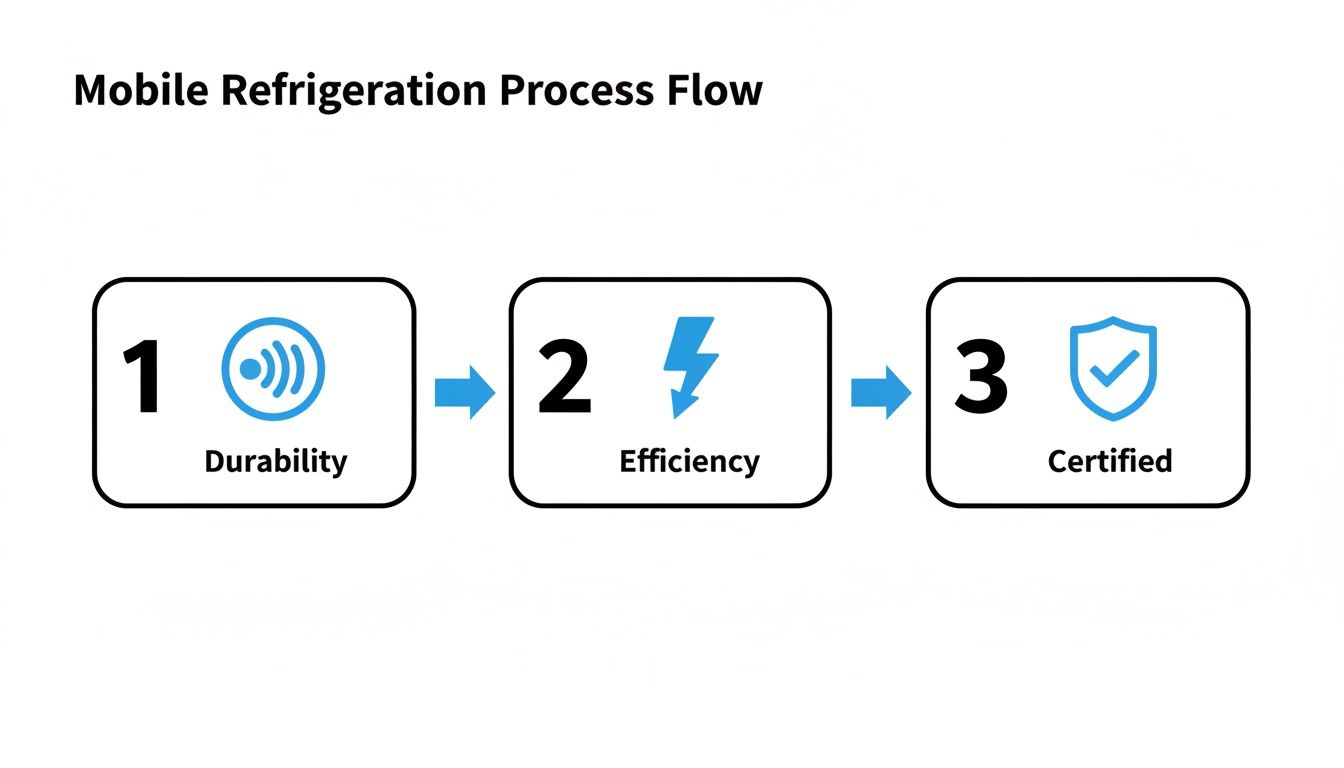
This image really drives home the point for mobile equipment—it has to be tough enough for the road, efficient enough for your generator, and certified for health codes. These same principles apply to every single support system on your truck.
Powering Your Operation with the Right Generator
Your generator is the heart of your food truck, pumping out the electricity that runs absolutely everything. Picking the right one isn't guesswork; it's simple math. First, you have to figure out your kitchen's total electrical load. Add up the wattage for every single piece of equipment you need to run at the same time—your commercial refrigerator, fryer, lights, fans, you name it.
Once you have that magic number, get a generator that can provide at least 20-25% more power than you actually need. That extra cushion is crucial. It stops you from overloading the system, which can cause power surges that fry your expensive appliances or just shut you down completely during the lunch rush.
Managing Your Onboard Water and Sanitation
Last but not least, your water system is everything when it comes to food safety and sanitation. The Los Angeles County Department of Public Health has very specific rules, and there's no wiggle room. Your truck must have:
- Fresh Water Tank: This holds all the clean, potable water for cooking, cleaning, and hand washing. The size you'll need depends on your menu and the equipment you're running.
- Grey Water Tank: All the used, dirty water from your sinks drains into this tank. It absolutely must be at least 15% larger than your freshwater tank to keep it from overflowing.
- Three-Compartment Sink: This is mandatory for properly washing, rinsing, and sanitizing your dishes, pots, and pans. Make sure each basin is big enough to fully submerge your largest piece of cookware.
- Separate Hand-Washing Sink: Health codes demand a totally separate sink just for washing hands. It needs hot and cold running water, soap, and paper towels right there.
These systems are the bedrock of a successful, legal food truck. By planning carefully and investing in quality support systems, you're not just buying gear—you're building a reliable foundation for your business to thrive on the streets of Los Angeles.
Organizing Your Kitchen for Maximum Workflow
Speed is everything for a successful Los Angeles food truck. Efficiency is your best friend. Both are born from smart organization. While the big-ticket items like griddles and commercial refrigerators get all the glory, it’s the smaller, strategic choices that create a smooth, fast workflow.
Properly organizing your space is like tuning a high-performance engine; it unlocks the full potential of every piece of equipment in your food truck kitchen.
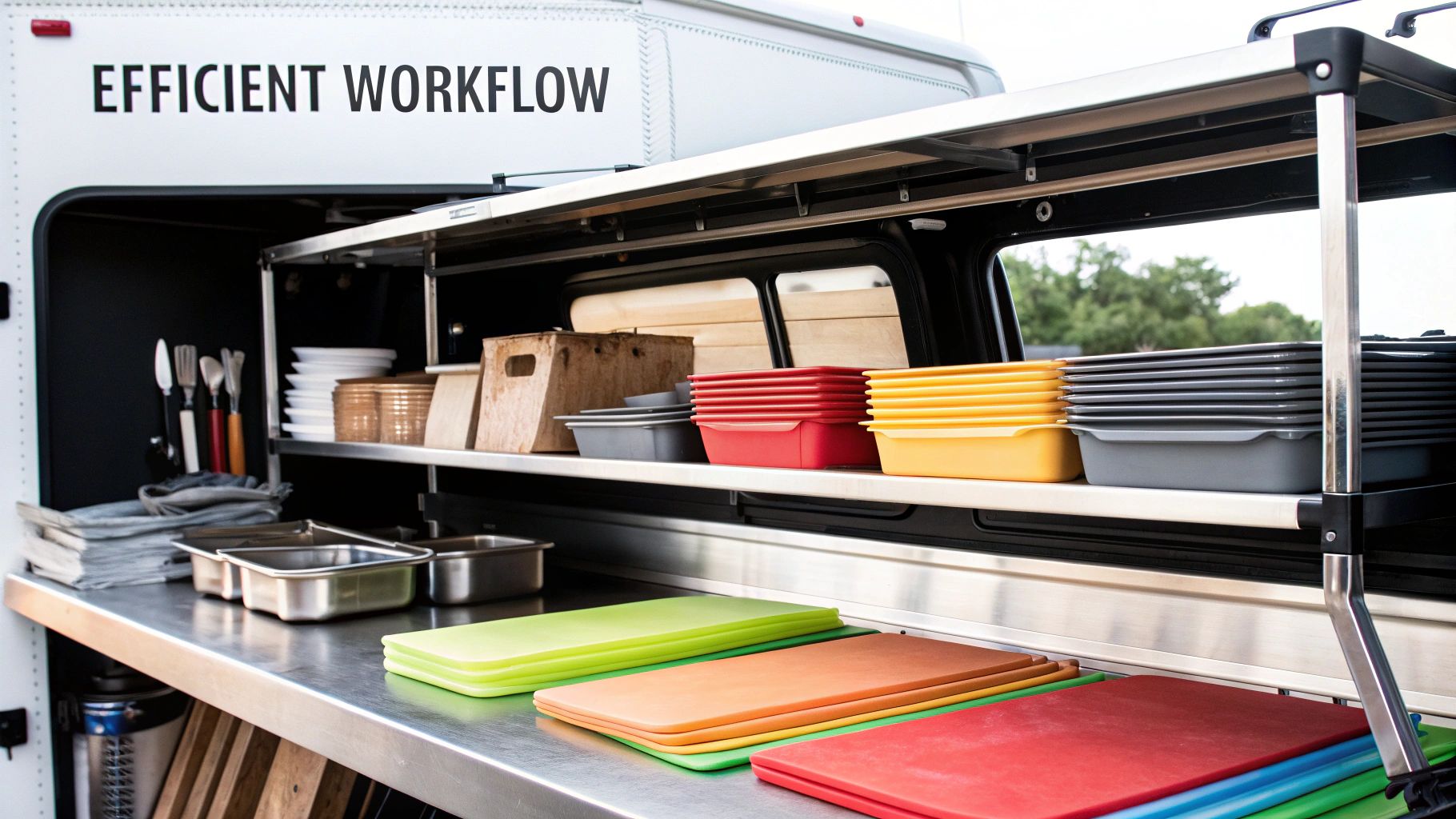
Think of your kitchen like a surgeon’s operating room. Every tool has its place, ready for instant access. This mindset transforms a potentially chaotic space into a high-performance machine, leading directly to faster service, less stress during peak hours, and more money in your pocket.
Smart Smallwares: The Unsung Heroes
The right smallwares are the foundation of an efficient kitchen. They aren't just accessories—they are critical tools that ensure your food is consistent, safe, and served up fast. Investing in professional-grade items here is a small cost with a massive return.
- NSF-Certified Food Pans: These stainless steel workhorses are non-negotiable. They hold everything from prepped veggies for a Thai green curry to marinated meats for Korean BBQ. Their standard sizes mean they stack perfectly and fit right into your prep tables and steam wells.
- Color-Coded Cutting Boards: This is one of the simplest and most brilliant tools for preventing cross-contamination. Using one color for raw meats (like for Mexican carne asada) and another for produce is a basic food safety practice that health inspectors always look for.
- High-Quality Utensils: Don’t cheap out here. Flimsy spatulas, dull knives, and weak tongs will slow you down and break at the worst possible moment. Get durable, ergonomic tools that can handle the daily grind of a busy service.
These details might seem minor, but they add up. They reduce errors and shave precious seconds off every single order.
Creative Storage for Tight Spaces
In a food truck, every square inch is prime real estate. You absolutely have to think vertically and get creative. A cluttered countertop is the enemy of speed. The goal is to keep your main prep surfaces clear, with everything you need just an arm’s length away.
Your workflow is a direct reflection of your layout. An organized station can shave 10-20 seconds off every order, which can add up to dozens of extra customers served during a busy Los Angeles lunch rush.
Here are a few proven storage hacks for mobile kitchens:
- Magnetic Knife Strips: Mount these on a wall to keep your knives secure, sharp, and easy to grab without eating up any counter or drawer space.
- Overhead Shelving: Make use of the vertical space above your prep counters. It's perfect for storing lightweight items like takeout containers, spices, or extra food pans.
- Wall-Mounted Racks: Use racks and hooks to hang pots, pans, and the utensils you use most often. This keeps them out of the way but always within reach.
By putting these organizational strategies into practice, you’re building a smarter, faster kitchen from the ground up. For more ideas on how to make the most of a compact area, check out our guide on designing a small restaurant kitchen layout—the principles apply perfectly to a food truck.
Smart Strategies for Acquiring Your Equipment
Outfitting your food truck with professional-grade kitchen equipment is a huge investment. But it doesn't have to empty your bank account before you even serve your first customer. Getting past the simple "new vs. used" debate opens up much smarter financial roads for new entrepreneurs trying to make it in the competitive Los Angeles food truck scene.
Thinking smart about how you get your gear is just as critical as picking the right griddle or commercial refrigerator. Smart financing and paying close attention to warranty details can set your mobile restaurant up for success without cutting corners on quality.
Lease-to-Own Financing: A Path to Ownership
For many new food truck operators, leasing equipment is a total game-changer. This route lets you get top-tier, reliable equipment—like a brand-new Atosa freezer or sandwich prep table—with very little cash upfront. Instead of one massive bill, you have predictable monthly payments that are much easier to handle.
This strategy brings some powerful advantages to a new business:
- Conserve Startup Capital: You get to keep more cash on hand for other must-haves like inventory, marketing, and permits. That financial breathing room is priceless in your first few months.
- Align Payments with Revenue: Your equipment costs are spread out, lining up your expenses with the actual money your truck is bringing in.
- Build Business Credit: Making your lease payments on time helps build a positive credit history for your business, which makes it easier to get financing for future growth.
A lease-to-own plan is like a bridge. It gets you the professional equipment you need to compete right now while giving you a clear path to owning those assets down the road. It turns a monthly expense into a long-term investment.
The Non-Negotiable Value of a Strong Warranty
Whether you buy new or lease, the warranty is your safety net. In the rough-and-tumble world of a food truck, equipment breaking down isn't just an annoyance—it can shut down your entire day. A solid warranty is a great sign that the manufacturer believes in their product's durability.
Look for warranties that cover both parts and labor. For example, a quality commercial refrigerator should come with a comprehensive warranty, like two years on parts and labor and five years on the compressor. That level of coverage means if a key part fails, you won't get slammed with a surprise bill for hundreds or even thousands of dollars in repairs. An authorized service network also means you get fast, professional help, keeping your downtime to a minimum.
At the end of the day, getting the right equipment for your food truck kitchen is about more than just the price tag. By using smart financial tools like leasing and making strong warranties a priority, you set up your Los Angeles food truck for reliability and profitability right from the start.
Common Questions About Food Truck Kitchen Equipment
Getting into the food truck business, especially in a competitive place like Los Angeles, always brings up a ton of questions. It's only natural. Making smart, cost-effective choices from the get-go is the key to getting off on the right foot. We'll tackle some of the most common questions here to help clear things up.
Think of this as the final once-over on your game plan. You've got the big pieces figured out, but these are the details that ensure everything clicks into place when you hit the road.
What Is the Single Most Important Piece of Equipment?
While every item has its purpose, it almost always comes back to your main cooking appliance. This is truly the heart and soul of your truck, and it's completely tied to what you're serving. For a Korean BBQ truck rolling through L.A., it's going to be a high-performance charbroiler. If you're slinging authentic Mexican food, a solid multi-zone flat-top griddle is your champion.
Your primary cooking unit sets the pace for everything—how fast you can serve, how much food you can put out, and how consistent your product is. Picking the right one is the foundation of your kitchen's entire flow and, ultimately, your profitability. Everything else, from your commercial refrigerators to your prep counters, is there to support it.
Do I Really Need a Commissary Kitchen in Los Angeles?
Yep, you absolutely do. The Los Angeles County Department of Public Health is very clear on this: food trucks must operate out of a licensed commercial kitchen, which we call a commissary. This is your home base for doing the heavy-duty food prep, storing your bulk ingredients, and legally getting rid of greywater and used cooking oil.
A commissary isn't just a box to check for the health department; it's your operational anchor. It’s the support system that makes it possible to run a clean, legal, and efficient food truck.
You simply can't do the large-scale prep and sanitation needed for a professional operation inside the truck itself. The commissary makes it all possible.
Can I Use Residential Appliances to Save Money?
We get why people ask this, but it’s a tempting shortcut you have to avoid. The answer is a hard no. Home appliances aren't built for the road; the constant vibrations from driving would shake them to pieces in no time. More importantly, they can't keep up with the demands of a busy commercial kitchen.
On top of that, residential units are not NSF-certified, which is a deal-breaker for passing a health inspection in Los Angeles. Using them means you'll fail your inspection before you even serve your first customer. Investing in tough, commercial-grade restaurant equipment isn't just a good idea—it's non-negotiable for safety, reliability, and staying in business.
Ready to build a high-performance kitchen for your Los Angeles food truck? Los Angeles Restaurant Equipment has the professional-grade cooking appliances, commercial refrigerators and freezers, and essential smallwares you need to succeed. Explore our full catalog and flexible financing options at https://losangelesrestaurantequipment.com.