

Kitchen Equipment for Food Truck: Your Guide to Outfitting a Los Angeles Mobile Kitchen
Getting your food truck kitted out with the right kitchen equipment is easily the most critical part of launching a successful mobile restaurant in Los Angeles. At a minimum, you’ll need a solid cooking line, commercial-grade refrigeration, and a proper setup for prep and sanitation. What you choose specifically will come down to your menu, whether you’re slinging tacos, Korean BBQ, or Thai street food.
Your Essential Los Angeles Food truck Kitchen Checklist
Bringing a food truck to life on the competitive streets of L.A. is a huge undertaking. Turning that dream into a real, profitable business all starts with a smart equipment plan. Space is tight in a mobile kitchen—you’re often working with just 120 to 200 square feet—so every single piece of gear has to earn its spot. This isn't like a brick-and-mortar restaurant; you simply don't have room for single-use gadgets or bulky units that will kill your generator.
Think of this checklist as your foundational roadmap. Nailing down these core equipment needs from the get-go will save you from making expensive mistakes down the line and ensure your kitchen is built to be efficient and compliant with L.A. County health codes.
Core Equipment Categories
Your menu is always the final say on what equipment you need. A truck focused on Korean BBQ has a totally different shopping list than one making Chinese dumplings or Thai curries. Still, every great mobile kitchen is built on four essential pillars:
- Cooking Line: This is the heart and soul of your truck. It might be a flat-top griddle for those perfect smash burgers, some high-BTU burners for wok cooking, or a couple of deep fryers for getting everything crispy.
- Cold Storage: In the California heat, reliable commercial refrigerators and freezers are non-negotiable. They’re what keep your ingredients fresh and, more importantly, safe.
- Prep and Sanitation: We're talking stainless steel countertops for durability, a three-compartment sink for washing, and a separate, dedicated handwashing station. These are must-haves for the health department.
- Power and Ventilation: A generator that’s sized correctly and a commercial-grade exhaust hood are the life support of your operation. Don't skimp here.
Planning for Success and Compliance
The food truck scene is absolutely booming. In fact, the U.S. food truck market is expected to grow from USD 1.09 billion in 2025 to USD 1.51 billion by 2030, which just shows how popular and profitable this business model can be.
To make sure your truck meets all the local rules, get familiar with the best practices for acing your food truck health inspection. Doing this prep work is crucial for passing those initial inspections and keeping your business running without any surprise shutdowns.
For a deeper dive into the numbers, you can check out the market trends in the full United States Food Truck Market report.
To give you a clearer picture, let's break down how these categories apply to some of the most popular food truck concepts you'll see rolling through Los Angeles.
Core Equipment for Popular LA Food Truck Concepts
| Equipment Category | Primary Function | Example for LA Cuisine (Mexican, Japanese, Korean) |
|---|---|---|
| Cooking Line | Preparing hot food | Mexican Food Truck: Flat-top griddle (al pastor), charbroiler. Japanese Food Truck: Gas range for ramen broth, tempura fryer. Korean Food Truck: Gas charbroiler, rice cooker. |
| Cold Storage | Keeping ingredients fresh and safe | All trucks will need undercounter refrigerators for quick access and a chest or upright freezer for bulk storage of meats and other perishables. |
| Prep & Sanitation | Food preparation and cleaning | Mexican Food Truck: Steam table (for holding meats), salsa bar. Japanese/Korean: Ample stainless steel prep tables, three-compartment & hand sinks. |
| Power & Ventilation | Running appliances and ensuring air quality | All trucks need a quiet, powerful generator (5,000-10,000 watts) and a Type 1 exhaust hood to handle grease and smoke safely. |
This table just scratches the surface, but it helps visualize how your menu directly translates into your equipment list. The right gear not only makes your life easier but is fundamental to serving great food safely and efficiently.
Designing Your Compact and Powerful Cooking Line
Think of your food truck's hot line as its engine. It’s where your menu truly comes to life, and inside the tight quarters of a mobile kitchen, every single piece of equipment has to be a top performer. Putting together a powerful cooking line isn't just about making a list of appliances; it's about strategically matching compact, multi-functional gear to your specific culinary vision.
The choices you make here directly shape your speed, your efficiency, and your ability to keep up with those hungry Los Angeles crowds. A flat-top griddle, for instance, is the ultimate workhorse for a huge range of LA food concepts. It’s perfect for searing carne asada for Mexican food trucks, cooking up breakfast burritos, or even stir-frying bulgogi for a Korean BBQ bowl. That large, even surface lets you juggle multiple orders at once—a massive advantage during the lunch rush.
Matching Equipment to Your Menu
On the flip side, a Japanese ramen truck would be completely lost without a powerful multi-burner range. That's what you need for simmering rich broths, boiling noodles, and sautéing toppings all at the same time. Similarly, a Thai food truck requires high-BTU wok ranges to achieve the authentic "wok hei" flavor. The real key is to break down your menu's core cooking methods and pick the equipment that supports them without wasting a single inch of precious space.
For many food truck owners, the decision boils down to a trade-off between specialized tools. A charbroiler gives you that authentic, smoky flavor that's essential for so many Mexican and Korean dishes, but it eats up a lot of room. A commercial deep fryer is non-negotiable for getting that perfect crispy texture, but you have to factor in its power draw and ventilation needs. This is where multi-functional units become your absolute best friends.
A food truck’s footprint is usually between 120 to 200 square feet, so every inch of counter space counts. Traditional restaurant equipment often won’t fit, and even if it does, it may drain too much power or generate more heat than the small space can handle.
Choosing the right equipment always starts with your food. This decision tree is a great way to visualize how different menus point you toward different core cooking setups.
As you can see, a menu built around burgers absolutely requires a griddle, while a taco concept is all about having enough prep space. For wok dishes like those in Chinese or Thai cuisine, it's the high-power burners that are non-negotiable.
BTUs and Power Management
Beyond the type of appliance, you have to think about its power, which is measured in British Thermal Units (BTUs) for gas equipment. Your cooking line needs enough muscle to keep up with demand but not so much that it overloads your generator. A low-BTU griddle might save you a little on propane, but it won’t recover its temperature quickly between orders, which means slow service and unhappy customers.
At the same time, installing gear with crazy-high BTUs can put too much strain on your generator, risking a power failure right in the middle of a rush. You're looking for that sweet spot—powerful enough for rapid cooking but efficient enough for your truck's power supply. As you outfit your cooking line, choosing microwave ovens for mobile kitchens can also offer a versatile, space-saving solution for reheating or quick-cooking certain items.
Maximizing Small Kitchen Space
Ultimately, designing your cooking line is an exercise in optimization. You're building a complete system where every component works together seamlessly in a very limited space. For anyone planning a mobile kitchen or any compact culinary setup, really understanding workflow in tight quarters is a must. You can dive deeper into these strategies in our guide to designing a small commercial kitchen for maximum efficiency. By prioritizing multi-functional, correctly sized, and appropriately powered equipment, you’ll build a hot line that’s not just compact, but incredibly powerful.
Choosing Your Commercial Refrigeration and Freezers
In the relentless Los Angeles heat, your food truck's refrigeration isn't just another piece of equipment. It's the lifeline that protects your ingredients, your investment, and ultimately, your reputation. A failing fridge on a hot summer day can shut you down in an instant, making this one of the most important decisions you'll make.
When you're working with the tight quarters of a food truck, the big debate is usually under-counter versus upright units.
Under-counter refrigerators are the champions of space efficiency. They tuck neatly under your prep counters, saving every precious inch of workspace while keeping key ingredients right where your crew needs them. This is the secret to a smooth workflow when the lunch rush hits.
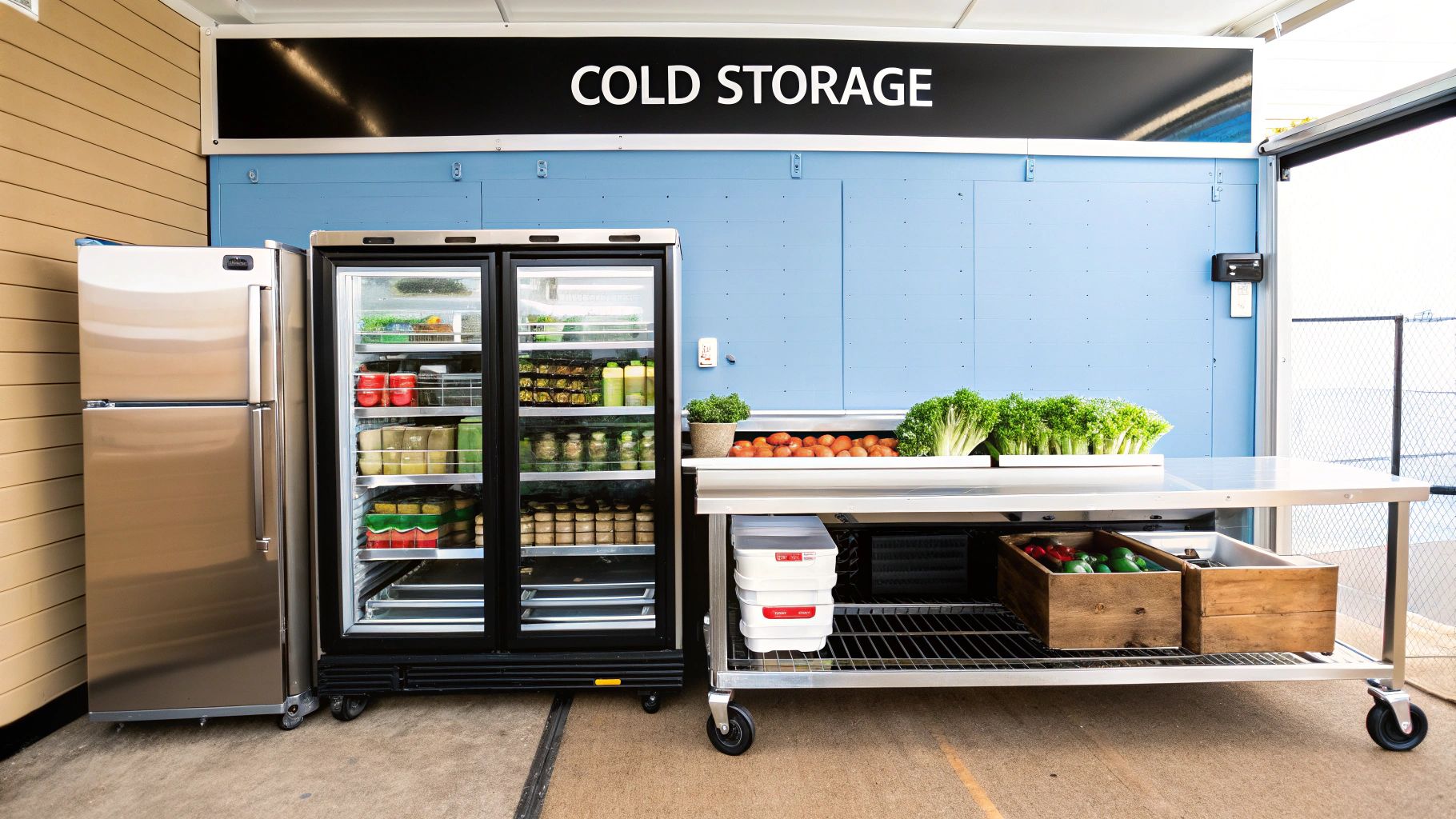
On the other hand, a slim upright reach-in unit gives you that bulk storage for proteins, produce, and backup items. It takes up a bit of vertical real estate but lets you stock up for a busy weekend, meaning fewer trips back to the commissary. Most trucks find a sweet spot by using both—an under-counter unit for what you're grabbing constantly and a reach-in for everything else.
Specialized Units for High-Speed Service
For some LA food trucks, specialized refrigeration can completely change the game. Think about a Mexican food truck at a festival or a Thai spot parked downtown. A refrigerated prep table is a must-have. These combine a prep surface with refrigerated wells, keeping toppings like salsa, chopped onions, and cilantro perfectly chilled and ready to go.
This is the kind of smart setup that shaves seconds off every order. Those seconds add up to real money over a busy service.
In a food truck, your refrigeration has to work harder than in a traditional kitchen. It battles higher ambient temperatures, constant vibrations from the road, and the strain of frequent door openings, making commercial-grade durability non-negotiable.
The demand for this kind of high-performance equipment is growing. In fact, the commercial kitchen equipment market is projected to expand by USD 41.81 billion between 2024 and 2029. It just goes to show how critical efficient refrigeration is for modern food businesses, especially fast-paced ones like food trucks. For more on this trend, you can check out the full commercial kitchen equipment market analysis.
Key Considerations for Your Investment
When you're picking out your units, look past the price tag. A few key factors will decide whether your investment pays off.
- NSF Certification: This is an absolute must. An NSF rating means the equipment meets public health standards, and you won't pass your Los Angeles County health inspection without it.
- Energy Efficiency: Your generator can only handle so much. ENERGY STAR® certified refrigerators and freezers use less power, which eases the strain on your generator and saves you money on fuel.
- Warranty and Service: A good warranty is your safety net. Look for solid coverage, especially for the compressor—it's the heart of the unit. Atosa products, for example, come with a robust five-year compressor warranty and a network of technicians ready to help.
Choosing the right refrigeration is all about building a dependable foundation for your business. To get a better feel for how different units can fit your space, take a look at our guide to common undercounter refrigerator sizes and find the perfect match for your truck.
Building an Efficient Prep and Sanitation Workflow
In a Los Angeles food truck, speed and safety are two sides of the same coin. A cluttered prep area or a clumsy sanitation station doesn't just slow you down; it creates bottlenecks that can bring your whole service to a grinding halt. Building a smart workflow is all about creating a smooth path from raw ingredients to finished dishes, all while keeping up with the strictest health standards.
This all starts with your prep surfaces. Durable, NSF-rated stainless steel work tables are the backbone of any mobile kitchen. They’re non-porous, a breeze to sanitize, and tough enough to handle the daily grind. For a Korean BBQ truck, this is your space for marinating meats and prepping banchan. For a Mexican food truck, it’s where you have enough room to press tortillas and build tacos without everything getting mixed up.
Crafting a Seamless Prep Flow
The real goal is to create a logical flow. Your under-counter fridges should live right below your main prep table, cutting down the steps your team takes to grab ingredients. Small stuff—knives, cutting boards, mixing bowls, squeeze bottles—should be up on wall-mounted magnetic strips or overhead shelves. This keeps your main work surfaces clear and ready for action.
A well-designed layout stops your crew from bumping into each other and cuts out wasted motion. This is a lifesaver during those peak hours when every single second counts.
A food truck's workflow is like a well-choreographed dance in a tiny space. The layout must be so intuitive that every tool and ingredient is exactly where you expect it to be, allowing muscle memory to take over during the lunch rush.
Think about how a Thai food truck might set things up. The prep table would have color-coded cutting boards—one for fresh veggies, another for raw chicken—to stop cross-contamination in its tracks. Pre-portioned sauces and spices would be right next to the wok station, making the move from prep to cooking seamless.
Mastering Los Angeles Sanitation Codes
Beyond prep, your sanitation setup is completely non-negotiable if you want to pass Los Angeles County health inspections. Every single food truck is legally required to have two different sink systems:
- Three-Compartment Sink: This is the workhorse for all your dishwashing. Each sink has a job: one for washing with soapy water, one for rinsing with clean water, and a third for sanitizing. It has to be big enough to completely submerge your largest pot or pan.
- Separate Handwashing Sink: This sink is just for washing hands, nothing else. It must have hot and cold running water, soap, and paper towels. It’s a critical piece of the puzzle for preventing the spread of germs.
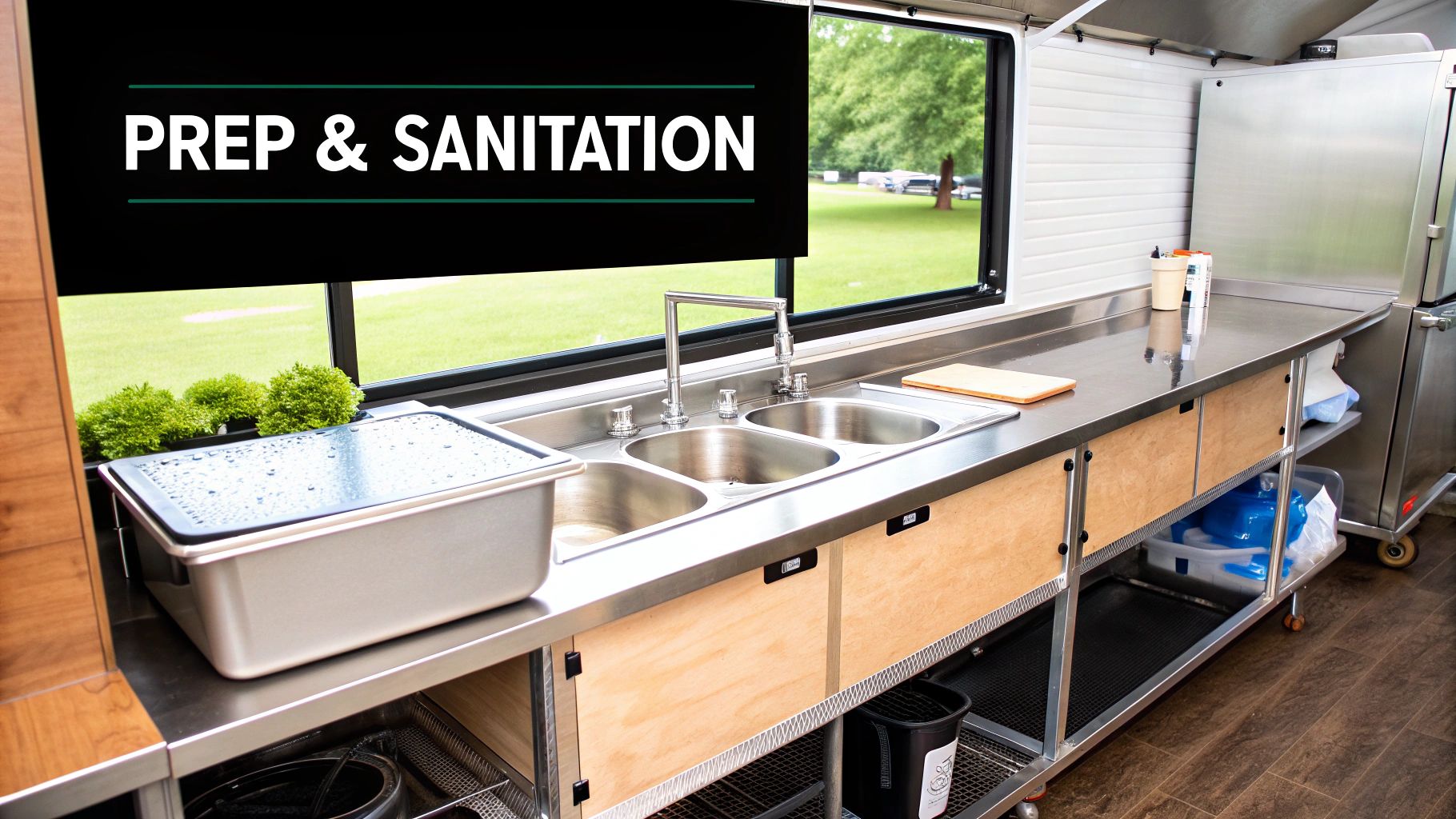
These sinks are just the visible part of a bigger system. They connect to two onboard water tanks: a fresh water tank for clean water and a grey water tank to collect all the wastewater. A key rule here in Los Angeles is that your grey water tank must be at least 15% larger than your fresh water tank to stop dangerous overflows. Getting this whole water cycle right is essential for running a safe and compliant mobile kitchen. A smart layout integrates these systems perfectly, letting your crew work faster, cleaner, and safer every single day.
Powering and Ventilating Your Mobile Kitchen Safely
Your cooking line and refrigerators are the heart of your Los Angeles food truck, but the generator and ventilation hood are its lungs. They’re the essential, behind-the-scenes systems that keep every other piece of your kitchen equipment running smoothly and safely. Getting these two technical decisions right isn’t just a good idea—it’s absolutely critical for passing city inspections and having a successful business.
Think of your generator as the power plant for your entire operation. One of the most common rookie mistakes is picking one that's too small. It's a recipe for frustration, with constantly tripped breakers and even damaged equipment. Don't guess—do a simple power audit first.
Sizing Your Generator Correctly
To figure out your power needs, just add up the wattage of every single appliance you’ll run at the same time. We're talking everything from the griddle and freezer to your lights and even your phone charger. Always tack on a 20-25% buffer to handle that initial power spike when equipment, especially refrigeration, kicks on.
A Korean BBQ truck, for example, running a charbroiler, rice cookers, and multiple commercial refrigerators needs a lot more juice than a simpler setup. For most fully-equipped LA food trucks, a generator in the 7,000 to 12,000-watt range is a solid, safe bet.
A generator isn’t just about raw power; it’s also about the vibe you create. A roaring-loud generator can be a real turn-off in a quiet neighborhood or at a curated food truck event, making a quieter model a very smart investment.
The Critical Role of Ventilation
While the generator brings the power, the ventilation hood brings the safety. A commercial-grade Type 1 hood is your most important line of defense against grease fires. In Los Angeles, it's a legal requirement for any truck with equipment that creates greasy vapors, like griddles, charbroilers, or deep fryers.
The system pulls hot air, smoke, and grease particles away from your cook line. This protects your staff from bad air quality and stops flammable grease from coating your walls and ceiling. You can bet the LA County Fire Department will be looking at your hood very closely during inspections.
This focus on safety and smart operations is more important than ever. The global food truck market, valued at USD 2.5 billion in 2023, is booming because it’s a more accessible way to start a food business than a brick-and-mortar restaurant. You can dig deeper into what’s driving this growth by checking out the full food truck market report.
Ultimately, putting good money into a powerful, reliable generator and a professional ventilation system is an investment in your truck’s future. It’s what lets you operate with confidence anywhere in Los Angeles, from a busy downtown street corner to a quiet neighborhood park, without sweating power failures or safety issues.
Budgeting and Sourcing Equipment in Los Angeles
So, you’ve got a killer concept for a food truck—maybe it’s incredible Mexican street food, innovative Japanese fusion, or authentic Thai curries. That’s the fun part. Now comes the part that makes it real: a solid financial plan. Nailing your budget is the single most important step in getting your truck on the road and turning that dream into a profitable Los Angeles business.
Forecasting your startup costs right from the get-go is everything. It helps you secure the right funding and ensures you don’t run out of gas (literally and figuratively) before you even serve your first customer.
The initial price tag for kitchen equipment for a food truck can swing wildly. If you're scrappy and go with used gear, you might get started for around $15,000. But if you’re aiming for a top-of-the-line mobile kitchen with all brand-new, premium appliances, that number can easily jump past $75,000. Knowing this range helps you make smart calls that line up with your vision and your wallet.
Estimating Your Initial Investment
The best way to get a grip on your costs is to map everything out, category by category. This way, there are no nasty surprises down the line. Every single piece, from the big-ticket items like your griddle to the smallest spatula, adds up. Think of your budget as the blueprint for a business that's built to last.
To give you a clearer picture, let's break down what you can expect to spend in the competitive L.A. market. These numbers will help you see what kind of financial commitment you're looking at for different levels of investment.
In the world of food trucks, your initial equipment budget directly impacts your long-term reliability. While saving money upfront is tempting, investing in dependable gear with strong warranties often prevents costly downtime and lost sales later on.
To help you plan, here’s a sample breakdown of what you might expect to invest in the core equipment categories.
Sample Food Truck Equipment Budget Ranges (USD)
| Equipment Category | Low-End Cost (Used/Basic) | High-End Cost (New/Premium) |
|---|---|---|
| Cooking Line (Griddle, Fryer, Range) | $3,000 - $7,000 | $10,000 - $20,000 |
| Refrigeration & Freezers | $2,500 - $5,000 | $8,000 - $15,000 |
| Prep & Sanitation (Sinks, Tables) | $1,500 - $3,000 | $4,000 - $7,000 |
| Ventilation & Fire Suppression | $2,000 - $4,000 | $5,000 - $8,000 |
| Generator & Power System | $3,000 - $5,000 | $7,000 - $12,000 |
These ranges give you a solid starting point for your own financial planning, whether you’re bootstrapping or seeking investors.
Smart Financing and Sourcing Strategies
Outfitting your entire truck doesn't mean you have to empty your bank account. Smart financing can be a lifesaver, helping you hold onto that crucial startup capital. For instance, lease-to-own programs are a fantastic way to get high-quality equipment with monthly payments you can actually manage. This frees up cash for things like ingredients, marketing, and paying your staff.
Then there’s the classic debate: new or used? New appliances give you peak performance, better energy efficiency, and—this is a big one—solid warranties. An Atosa commercial refrigerator, for example, often comes with a five-year compressor warranty, which is incredible peace of mind when you're on the road. You're not just buying a fridge; you're buying reliability.
On the other hand, used equipment can dramatically lower your startup costs. The trade-off is a higher risk of breakdowns and zero warranty protection. It's a gamble. Before you decide, it’s a good idea to dig into the pros and cons. Our guide on sourcing used restaurant equipment in Los Angeles can help you weigh your options carefully. Finding that perfect balance between your budget and the need for dependable gear is what will set you up for long-term success on the streets of L.A.
Frequently Asked Questions About Food Truck Equipment
As you get closer to launching, the big picture of your menu gives way to the nitty-gritty details of buying equipment. This is where a lot of practical questions pop up, and getting them right is key to avoiding costly mistakes that can sink your truck before it even hits the streets of Los Angeles.
This section tackles the most common questions we hear from new operators. We're cutting through the noise to give you direct answers on everything from sizing your fridges to understanding installation codes—the essential stuff you need to know before you start spending money.
What Is the Biggest Mistake People Make When Buying Food Truck Equipment?
Hands down, the single biggest mistake is underestimating your space and power. It happens all the time: new owners buy standard restaurant equipment that's either too big for the truck's layout or pulls way more electricity than the generator can handle. This one oversight leads to a cramped, frustrating kitchen and constant electrical headaches like tripped breakers during a busy service.
The fix is all in the planning. Before you buy a single piece of gear, draw up a detailed, to-scale floor plan of your truck. Then, do a power audit. Add up the wattage of every single appliance you'll need running at the same time to make sure your generator is up to the task. This prep work ensures you hunt for compact, energy-efficient commercial equipment that fits your space and your power supply.
How Do I Know What Size Refrigerator My Food Truck Needs?
Finding the right size for your commercial refrigerators and freezers comes down to three things: your menu, how much you expect to sell, and how often you can restock. A solid rule of thumb is to figure out how much cold storage you need to get through two busy days of service without a resupply run.
If your concept is heavy on fresh ingredients—think a Mexican food truck with ten different salsas or a Chinese food truck with piles of fresh veggies—a refrigerated prep table is an absolute game-changer. For most other trucks, a smart combo of an under-counter refrigerator for your most-used items and a slim upright freezer for your backup stock is the perfect mix of workflow and storage.
Do I really need a professional to install my gas and ventilation systems?
Yes, absolutely. For both safety and legal compliance in Los Angeles County, professional installation of gas and ventilation systems is non-negotiable and a critical investment in your business's longevity.
Why Do I Need a Professional to Install My Gas and Ventilation Systems?
This is one area where you simply can't cut corners. A shoddy gas line installation is a serious fire hazard, and an undersized or improperly installed ventilation hood is a surefire way to fail your fire department inspection.
Hiring licensed professionals is your best insurance policy. They make sure every connection is secure, everything is up to local code, and your ventilation hood is perfectly matched to your cooking equipment. It's an investment that protects your truck, your staff, and your business.
Ready to build a powerful, efficient, and compliant mobile kitchen? Los Angeles Restaurant Equipment has the durable, space-saving kitchen equipment food truck operators need to thrive. Explore our full catalog of Atosa commercial refrigerators, cooking lines, and prep stations today. Visit us at https://losangelesrestaurantequipment.com to get started.