

My Ice Machine Is Not Making Ice A Guide for LA Restaurants
It’s the middle of a dinner rush at your Thai Town restaurant, and suddenly, you’re out of ice. When your commercial ice machine grinds to a halt, it can feel like a full-blown crisis. But before you pick up the phone for a pricey service call, take a breath. More often than not, the culprit is something surprisingly simple.
The most common reasons are things you can check in seconds: the machine is turned off, the power cord is loose, a circuit breaker has tripped, or the water supply valve is closed. A quick walkthrough of these four basics can get you back up and running in minutes.
The First Steps When Your Ice Machine Stops
For any busy Los Angeles restaurant, from a bustling Koreatown BBQ joint to a food truck serving up tacos in Silver Lake, a dead ice machine is a major headache. The good news is that the fix is usually something you can handle yourself without needing a technician.
Before you start digging into complex diagnostics, always start with the fundamentals. It’s the fastest way to rule out the simple, common issues that pop up in a busy kitchen.
Check Power And Water Basics
First things first, check the power switch. Is it in the "ON" position? It’s easier than you think for someone to bump it during a deep clean. Next, follow the power cord to the wall and make sure it’s plugged in tight. A slightly dislodged plug can easily cut off the power.
If the plug is secure, head to your restaurant’s circuit breaker panel. A power surge from another heavy-duty appliance, like a freezer or deep fryer, could have tripped the breaker. Just flip it back and see if your ice machine comes back to life.
Finally, find the water supply line that feeds your machine. Trace it back to the valve and make sure it’s fully open. Sometimes a valve gets partially closed by accident, choking off the water supply and stopping ice production in its tracks.
This quick-glance table can help you identify and resolve the most common ice machine issues in just a few minutes.
Initial Diagnostic Checklist
| Symptom | Most Likely Cause | Immediate Action |
|---|---|---|
| Machine is completely silent, no lights | No power | Check the power switch, plug, and circuit breaker. |
| Machine hums but produces no ice | No water | Verify the water supply valve is fully open. |
| Machine cycles on and off quickly | Intermittent power | Ensure the power cord is firmly plugged into the outlet. |
| Low ice production | Partially closed water valve | Check the water valve to make sure it's not half-closed. |
Running through this checklist covers the vast majority of "sudden failure" scenarios we see in LA restaurant equipment.
This flowchart maps out the simple, step-by-step checks to follow when your ice machine isn’t working.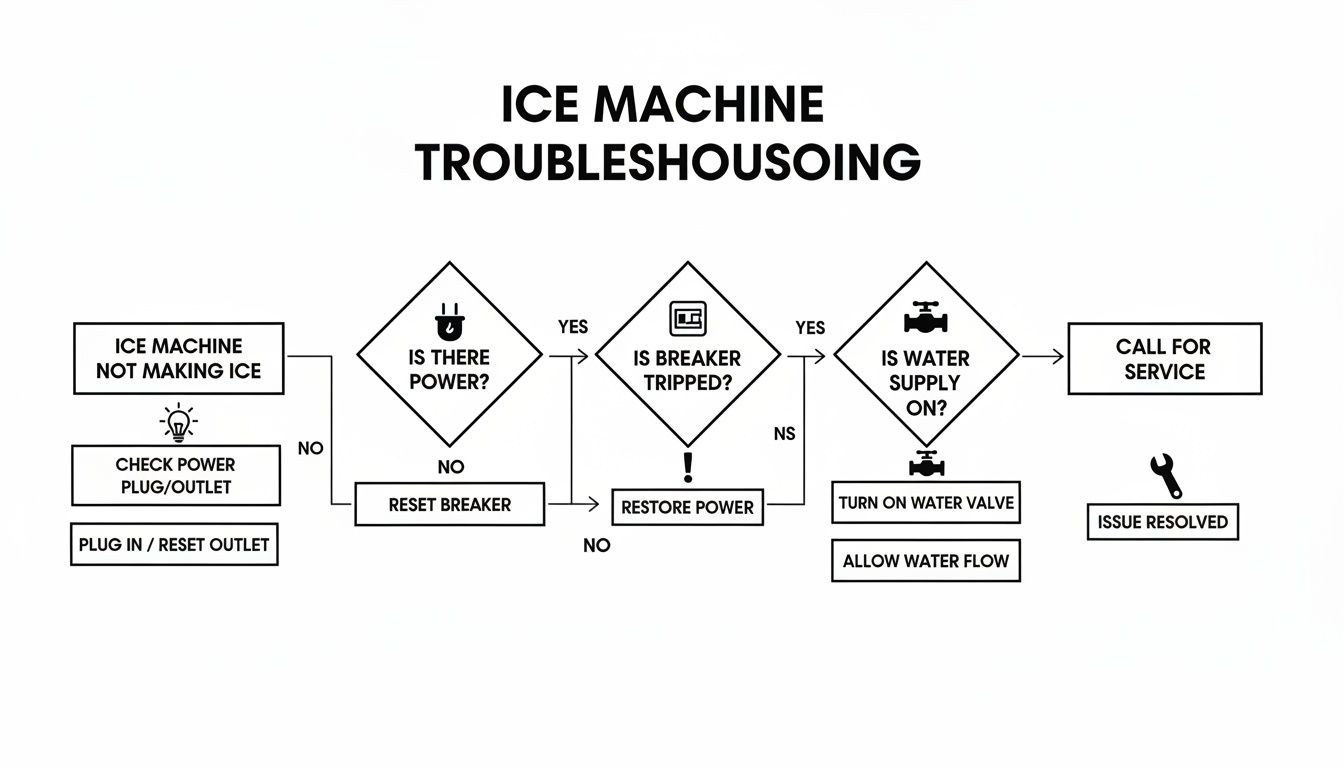
By working through this simple flow—Power, Breaker, Water—you can quickly figure out what’s wrong and, most of the time, fix it yourself.
Key Takeaway: An ice machine failure is rarely a catastrophic mechanical breakdown. It's usually a simple interruption of power or water that you can fix on the spot, saving you the cost and downtime of a service call.
For a wider look at appliance issues that might give you some insight, this guide on common machine problems and their fixes is a great resource. If these first steps don’t solve your problem, you can dive into more advanced solutions in our guide to commercial ice maker troubleshooting.
Troubleshooting Water Flow and Filtration Issues
If your ice machine is getting power but the ice tray is bone dry, the next place to look is the water supply. Here in Los Angeles, hard water and sediment are the silent killers of commercial ice machines, causing far more service calls than most restaurant owners realize.
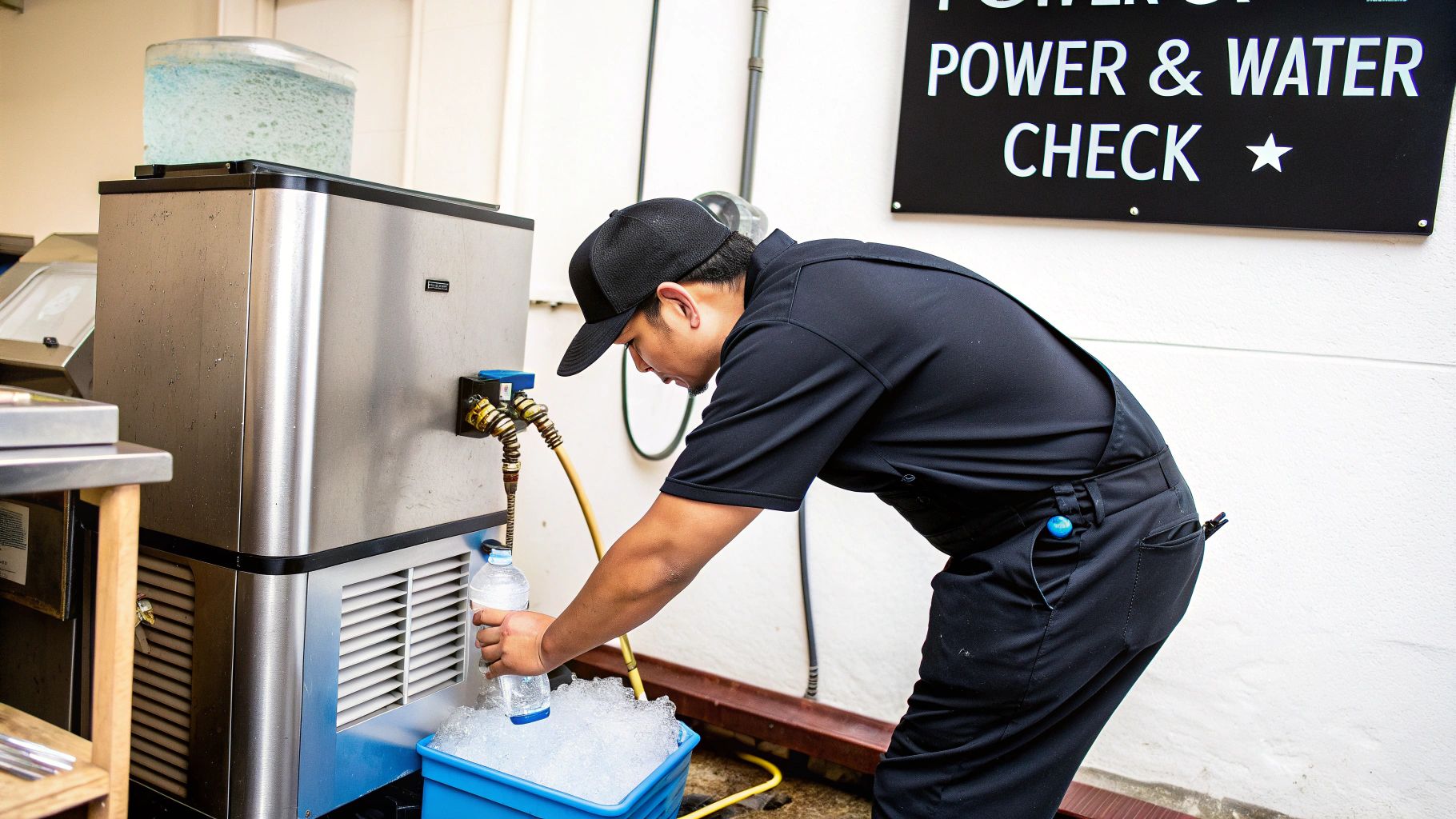
This is a familiar story for many in LA's food scene. Think of a popular Mexican restaurant in East LA that suddenly saw its ice production get cut in half. The culprit wasn't some complex mechanical failure; it was a water filter completely choked with mineral buildup, slowly starving the machine of the water it desperately needed.
Pinpointing Water-Related Failures
When water issues are stopping your ice production, it usually comes down to a few key culprits. Before you pick up the phone to call a technician, a quick look can often solve the mystery.
Start with the most common offenders first:
- The Water Filter: This is the #1 cause of reduced water flow. If it’s been over six months—or even three in a high-volume spot like a food truck—it’s probably clogged solid.
- The Water Inlet Valve: This little part is the gatekeeper, letting water into the machine. If it's blocked by sediment or just plain faulty, nothing gets through. You might even hear a faint buzzing noise with no water entering the tray.
- The Supply Line: Take a peek behind the unit and make sure the water line isn't kinked, pinched, or frozen. It’s an easy thing to overlook, especially after moving restaurant equipment around for a deep clean.
Water system failures are behind roughly 40% of all commercial ice maker breakdowns. The main cause? Mineral buildup from hard water, a constant battle in Los Angeles. A clogged filter can slash your ice production by up to 40%, forcing the machine to work overtime and driving up your energy bill.
The Importance of Descaling and Filtration
For restaurant equipment like Atosa ice makers, regular descaling is absolutely non-negotiable. Mineral scale is the enemy, leading to blockages and making your machine work way harder than it should. You can even find professional-grade scale prevention solutions to protect your investment long-term.
Ultimately, your best defense is a solid offense. Properly connecting your unit to a water line with an effective filter from day one is key. For a detailed walkthrough, check out our guide on connecting an icemaker to a water line. A little prevention here will save you a world of headaches and lost revenue down the road.
Tackling Temperature and Refrigeration Problems
So, your machine has water, but all you're getting is soft, slushy ice—or maybe no ice at all. When that happens, it's a good bet the problem lies with the refrigeration system. I’ve seen it a hundred times, especially in the sweltering heat of a packed Downtown LA Chinese restaurant kitchen. Those environments can really push a commercial ice machine to its limits, forcing its cooling components to work overtime.
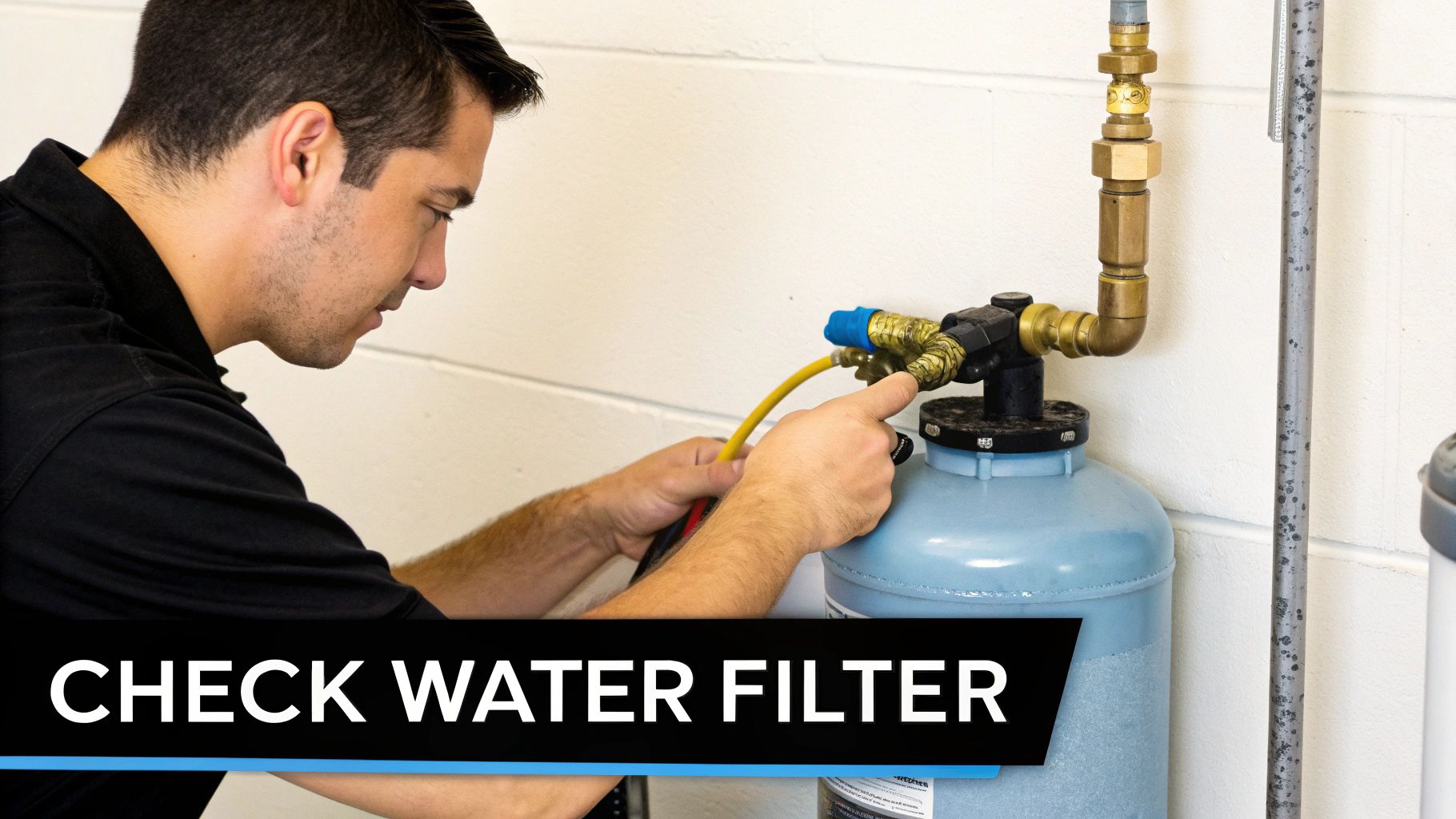
If your ice machine is failing because of temperature issues, the signs are pretty clear. The unit might be humming away, sounding like it's trying its best, but the evaporator plate never gets cold enough to actually form solid cubes. This is a classic symptom of a refrigeration cycle that’s on the ropes.
How to Diagnose Overheating and Compressor Issues
At the core of your ice machine, you've got the compressor and condenser. These two work together to pull heat out of the system. If they can't do their job, ice production stops dead in its tracks. And believe me, the temperature of your kitchen has a huge say in how well they work.
Here are a few things I always check first:
- Dirty Condenser Coils: You'll find these on the back or side of your machine, and their job is to get rid of heat. In a busy kitchen, they become magnets for grease and dust, which acts like a thick blanket, trapping all that heat inside.
- Bad Ventilation: Ice machines need to breathe. If you've got it crammed against a wall or sandwiched next to a hot commercial refrigerator or freezer, it's not getting the airflow it needs to cool itself down.
- High Ambient Heat: I can't stress this enough—don't put your ice machine next to a deep fryer or a charbroiler. It’s a recipe for disaster. The machine will constantly fight the surrounding heat, which leads to breakdowns and a much shorter lifespan.
Temperature control issues are a huge culprit, accounting for about 25% of all commercial ice machine failures. These problems often show up as poor-quality ice, like soft or cloudy pieces that just don't freeze right.
Today’s compressors are built tough, but they can't win a battle against a hostile environment. Something as simple as regularly cleaning the condenser coils is one of the best things you can do to prevent an expensive repair call.
If you’ve cleaned the coils and made sure the machine has plenty of room to breathe but it’s still not freezing, you might be looking at a more serious problem, like a refrigerant leak or a failing compressor. As some industry findings show, a well-maintained machine can often be fixed on the first visit, but a neglected one will always cost you more in the long run.
Identifying Common Mechanical Failures
So, you’ve checked the power, the water is flowing, and the temperature is right where it should be. If your ice machine is still on the fritz, chances are a mechanical part has finally worn out. This might sound like a major headache, but you can often pinpoint the problem just by paying close attention. You don’t need an engineering degree to spot the usual suspects.Picture a high-end Japanese restaurant in downtown L.A. that needs perfect, clear ice for its cocktails. If its harvest cycle sensor goes bad, the machine might not get the signal to release the finished ice, causing a jam. On the flip side, a faulty sensor could trigger the harvest too soon, leaving you with a batch of tiny, useless cubes. It’s amazing how one small part can disrupt the whole operation.
Key Components to Inspect Safely
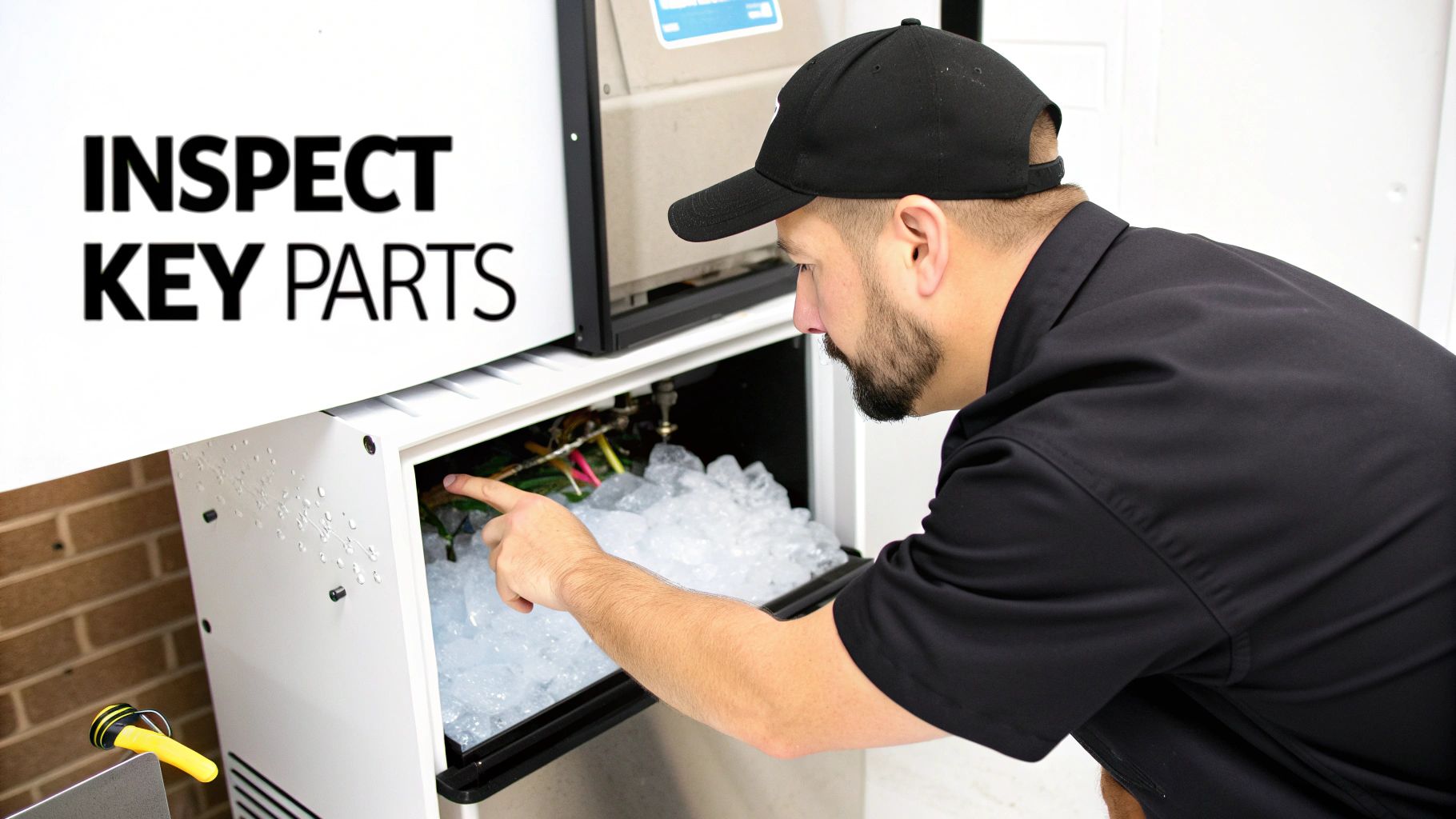
Before you pick up the phone to call a technician, a quick, safe visual check can tell you a lot. Knowing what to look for helps you describe the issue accurately, which almost always means a faster, cheaper repair.
Here’s a quick rundown of the main mechanical parts you’ll want to check out:
- Evaporator Plate: This is where the magic happens and ice is formed. Look for any uneven freezing patterns, stubborn scale buildup that a normal cleaning cycle didn't touch, or any obvious physical damage. A compromised plate just won't make good, uniform ice.
- Auger Motor: This one’s for nugget or flake ice machines. If you hear any strange grinding, squealing, or whining noises, that’s your auger motor crying for help. A struggling motor is a clear sign it's time to call in a pro.
- Harvest Cycle Components: Take a look at the harvest arms or grids while the machine runs a cycle. Are they moving smoothly? Or do they seem to be sticking, stuttering, or moving jerkily?
Pro Tip: Mechanical parts inevitably wear out, especially in a busy Los Angeles kitchen that’s running nonstop. Reliability studies show how much modern designs have improved an ice machine's lifespan. While older models had failure rates around 0.31% per year, new machines with better parts can achieve a 1% failure rate over 10 years. Even so, the average repair cost for U.S. restaurants is $708, so catching problems early is key. You can read more about these ice machine reliability findings for a deeper dive.
Keeping up with a solid maintenance schedule, especially regular cleaning, is your best defense against many of these mechanical failures. If you need a refresher, our guide on how to clean a Manitowoc ice maker has some great tips that apply to most brands.
Knowing When to Call a Professional Technician
As a smart Los Angeles restaurant owner, you know your limits. While you can definitely handle some minor ice machine issues on your own, there are clear red flags that signal it's time to put down the tools and call a professional. Trying to tackle serious electrical or refrigerant problems can be dangerous, void your warranty, and quickly turn a simple repair into a complete disaster.
If your ice machine isn't making ice and you spot any of these signs, don't hesitate. Pick up the phone immediately and protect both your safety and your valuable equipment.
Critical Signs That Demand a Pro
Some symptoms are non-negotiable warnings. For a busy food truck owner or the manager of a fine dining spot, recognizing these can save you thousands in the long run.
Keep an eye out for these serious issues:
- Refrigerant Leaks: Hear a hissing sound? Find a strange oily residue around the machine? You've likely got a refrigerant leak. This is hazardous material and absolutely requires certified handling.
- Loud Grinding or Squealing: Any unusual, loud mechanical noises often point to a failing compressor or auger motor. Continuing to run the machine could cause irreversible damage.
- Electrical Malfunctions: Flickering lights, a burning smell, or a breaker that keeps tripping are all urgent signs of an electrical problem. This isn't just a repair issue; it's a significant fire hazard.
A professional technician from an authorized service network is always your best bet. They have the right diagnostic tools, genuine parts for brands like Atosa, and the training to get the job done safely and correctly.
Ultimately, the goal is to get your kitchen back to 100% capacity quickly and safely. While DIY fixes are great for simple power or water line problems, complex mechanical and electrical issues are best left to the experts. It protects your investment and ensures the repair is done right the first time.
Frequently Asked Questions About Ice Machines
Running a restaurant or food truck in Los Angeles means battling intense kitchen heat and mineral-heavy water. When your ice machine stops producing, you need clear, fast answers. Below are the most common questions we hear from LA’s kitchen pros.
How Often Should I Deep Clean My Commercial Ice Machine In LA
Scale buildup is inevitable in our hard-water city. Schedule a professional deep clean and descaling every three to six months.
For high-volume operations—like a Koreatown bar or a popular weekend food truck—aim for a quarterly cleaning. If your kitchen sees lighter traffic, you can stretch out to six months, but always:
- Cross-check with your machine’s manual
- Watch for slower ice production
- Align cleanings with your peak or slow seasons
A steady maintenance routine keeps your ice clear, cuts down on breakdowns, and extends equipment life.
Why Does My Ice Taste And Smell Bad
Off-flavors and odors almost always trace back to one of two issues:
- A water filter that’s past its prime
- Bacteria or slime lurking in the food zone
Swap in a fresh filter first. If that doesn’t do the trick, schedule a full sanitization with a qualified technician. Health inspectors will flag this immediately, so quick action is a must.
Should I Repair My Old Ice Machine Or Buy A New One
Think about age and cost in tandem. If a repair quote hits more than 50% of what a new, similar unit costs, you’re usually better off replacing. The same holds true for machines older than 7–10 years that demand constant service calls.
New, energy-efficient models—like those from Atosa—often pay for themselves in lower power bills and include solid warranties.
Key Insight: Pouring money into a chronically failing ice machine drains your resources. Investing in a new, reliable unit often pays off faster through reduced downtime and utility savings.
Can I Use A Standard Water Filter On My Commercial Machine
Absolutely not. Residential filters can’t handle the volume or tackle LA’s mineral-rich water. Commercial-grade systems are engineered to trap the exact scale-causing minerals in our supply. Using a home filter leads to rapid scale buildup, lower ice output, and premature component failure.
Invest in the proper filtration system—your machine (and budget) will thank you.
When it’s time to upgrade or replace your kitchen’s essential equipment, Los Angeles Restaurant Equipment has the professional-grade solutions you need. Explore our selection of reliable Atosa ice makers, commercial refrigerators, and freezers to keep your LA restaurant running smoothly. Visit us at Los Angeles Restaurant Equipment.